
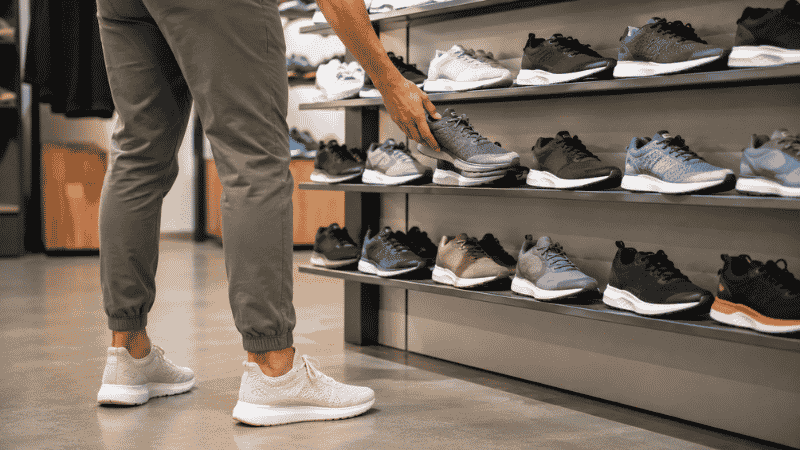
Most running shoe decisions get made the wrong way. Someone asks a friend what they wear, or picks the most cushioned option on the shelf, or buys whatever has good reviews on a retailer’s website. Then they run in the shoes for a few months, develop some knee soreness or shin pain, and assume the problem is their training — not the fact that their foot mechanics and their shoe’s support structure have been working against each other the entire time.
Choosing running shoes correctly isn’t complicated, but it does require knowing four things: your foot type, your primary running surface, your weekly mileage, and what you’re actually dealing with in terms of existing pain or injury history. Once you know those four things, the number of viable options narrows dramatically. You stop choosing between forty shoes and start choosing between five.
This guide covers the complete process — from figuring out your foot type at home to understanding heel drop, cushioning, and stability designations to knowing when a store fitting is worth your time. Every section links to a more detailed guide when the topic warrants it. Read the whole thing once, use it as a reference, and you’ll never waste money on the wrong running shoe again.
Key Takeaways
- Running shoe selection starts with foot type — flat, neutral, or high-arched. Everything else follows from this single variable.
- The wrong arch support type doesn’t just fail to help — it can actively increase injury risk compared to a neutral shoe with no support features.
- Heel drop (the height difference between heel and forefoot) affects your gait mechanics more than cushioning thickness. New runners and those with knee or Achilles issues should generally stay at 8–10mm.
- According to research in the British Journal of Sports Medicine, up to 79% of recreational runners sustain at least one injury per year — with footwear mismatch being among the most modifiable contributing factors.
- Running shoes last 300–500 miles in most cases. Tracking mileage per pair is the single most reliable way to know when to replace them.
- Gait analysis at a running specialty store takes five minutes and is free at most locations. It removes the guesswork from foot type assessment and is worth doing before any significant shoe purchase.
Step 1: Figure Out Your Foot Type
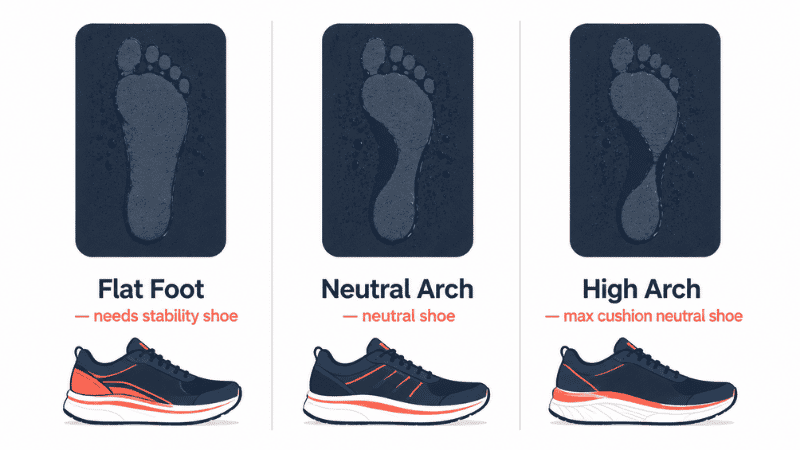
This is the non-negotiable starting point. Everything about running shoe selection — stability features, arch support, midsole structure — is calibrated to one of three foot types. Getting this wrong means the rest of your choices don’t matter.
The wet foot test. Wet the sole of your foot and step firmly onto a piece of dark cardboard or a dry tile floor. Step off and examine the imprint.
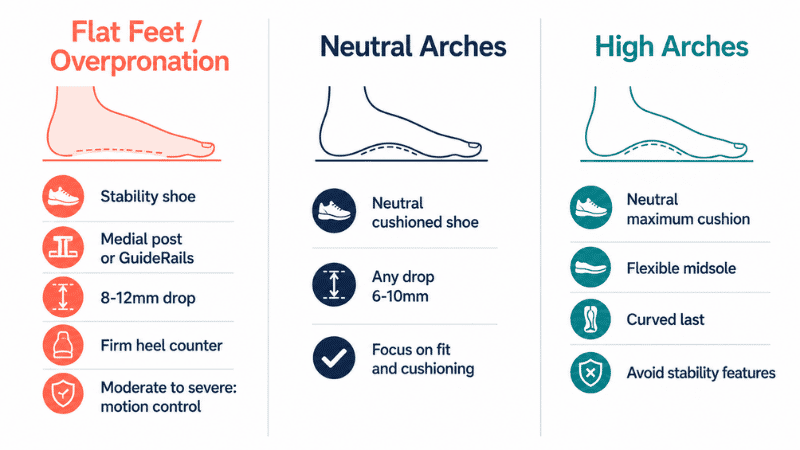
A complete footprint with almost no inward curve along the arch indicates flat feet — low or absent arch height that typically produces overpronation (excessive inward rolling of the ankle during the gait cycle).
A thin strip connecting the heel and forefoot with minimal midfoot contact indicates high arches — a rigid foot structure that doesn’t flatten to absorb shock and tends to supinate (roll slightly outward).
A moderate curve that shows clear midfoot contact but with a visible inward curve indicates neutral arches — the most common foot type, with the widest range of appropriate shoe options.
What your foot type needs:
Flat feet and overpronation need a stability shoe — one with a medial post (firmer foam on the inner midsole) or GuideRails system that resists the inward ankle collapse. Running in a neutral shoe with significant overpronation allows the kinetic chain — foot to ankle to tibia to knee — to misalign with every stride, which is how overpronation quietly becomes knee pain and shin splints over months of training.
High arches need a neutral maximum-cushion shoe — thick, soft foam that compensates for the shock absorption a rigid, high-arched foot can’t provide naturally. Importantly, high-arched feet should not be in stability shoes. Stability features push a supinating foot further in the wrong direction.
Neutral arches have the most options. Focus on cushioning level, heel drop, and fit rather than stability designation.
For a complete breakdown of how to assess your foot type and the specific shoe features each type needs, our flat feet vs high arches guide covers everything in detail — including what to do when your wear pattern and arch structure give different signals.
Step 2: Understand What the Shoe Labels Actually Mean
Running shoe marketing is full of terms that sound technical but are rarely explained. Here’s what actually matters.
Neutral vs Stability vs Motion Control
These three designations describe the shoe’s approach to foot motion correction.
Neutral shoes have no specific structure to resist ankle roll in either direction. They’re appropriate for neutral arches and high arches. They range from minimally cushioned to maximum stack height.
Stability shoes have a medial post or external rails (GuideRails in Brooks, for example) that limit excessive inward ankle roll. Appropriate for mild to moderate overpronation. Most popular category in running shoes.
Motion control shoes have maximum medial support — rigid posts, wider bases, reinforced heel counters. Appropriate for severe overpronation. Heavier and stiffer than stability shoes.
The mistake people make most often: buying stability shoes because they sound more “supportive” when they have neutral arches or high arches. Stability features aren’t universally beneficial — they’re corrective tools for a specific mechanical issue. Using them without that issue creates its own problems.
Heel Drop Explained
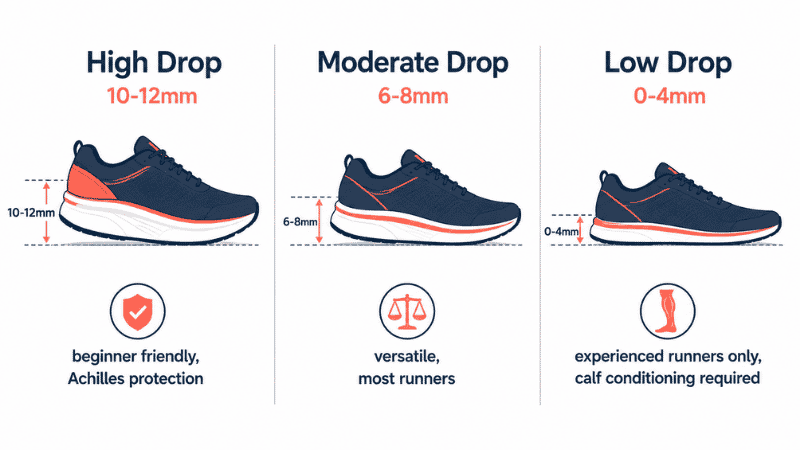
Heel drop is the height difference between the heel and forefoot inside the shoe, measured in millimeters. It’s one of the most consequential specifications in running shoe selection and one of the least understood.
High drop (10–12mm): The traditional range. Promotes heel striking, which most recreational runners naturally do. Reduces strain on the Achilles and calf. Appropriate for most beginners, runners recovering from Achilles issues, and anyone with plantar fasciitis who benefits from a slightly shortened fascial position during running.
Moderate drop (6–8mm): The middle ground. Allows more natural gait mechanics than high-drop shoes while providing some heel protection for heel strikers. A good starting point if you’re unsure.
Low drop (0–4mm): Encourages midfoot and forefoot striking. Increases demand on the calf and Achilles. Appropriate for experienced runners with conditioned posterior chains — not for beginners or anyone with Achilles or calf history.
Transitioning between dramatically different drop levels — particularly from high-drop to low-drop — should happen gradually over weeks to months, not overnight. The most common injury from rapid drop transitions is Achilles tendinitis.
Stack Height
Stack height is the total thickness of the midsole foam from the ground to the foot. High stack (35mm+) provides more cushioning and more impact absorption. Low stack (under 25mm) provides more ground feel and proprioception.
For most recreational runners, more stack is generally beneficial — it provides more cushioning for joints and soft tissue that aren’t elite-runner conditioned. The exception is runners specifically training proprioception or those who prefer ground feel for trail running.
High stack doesn’t automatically mean heavy. Modern foam technology (PEBA compounds, responsive EVA) allows very high stacks at relatively low weights.
Width Designations
Standard running shoes come in one width: standard. But feet don’t. Width designations (2E wide, 4E extra-wide for men; D wide, 2E extra-wide for women) indicate shoes built on genuinely different-width lasts — not just wider uppers on the same mold.
If your toes feel compressed laterally in standard shoes, a wide designation is worth trying. Brands most consistent in genuine wide engineering: New Balance (most committed, widest range from narrow to 4E), Brooks (reliable 2E and 4E in key models), ASICS (2E available in most stability models).
For a complete guide to measuring foot width and understanding the width label system, our wide toe box walking shoes guide covers the full picture — the same principles apply to running shoes.
Step 3: Match the Shoe to Your Running Context
Foot type is the most important variable, but it’s not the only one. Your running surface, weekly mileage, and running goals all affect which shoe is right.
Road Running
Road running shoes are optimized for pavement — firm midsoles that provide cushioning without sacrificing responsiveness, outsoles with moderate rubber coverage for durability. The majority of running shoes on the market are road shoes.
For daily road training: prioritize midsole resilience (foam that holds up over miles), appropriate arch support for your foot type, and heel drop appropriate for your history. Brooks Ghost, ASICS Gel-Nimbus, New Balance 1080, and Hoka Clifton are reliable across multiple foot types.
Treadmill Running
Treadmill running is easier on midsoles than road running — the belt absorbs some impact. Standard road shoes work fine. You can prioritize comfort and fit over durability more freely.
Trail Running
Trail running shoes have aggressive lug patterns for grip on soft, uneven surfaces. They’re typically lower-stack than road shoes (more ground feel for technical terrain), with rock plates in some models to protect against sharp rocks underfoot.
Using road shoes on technical trails creates traction problems and foot fatigue from impact on rocks and roots. Using trail shoes on roads wears the lugs quickly and feels uncomfortable on hard surfaces. The two categories serve different purposes.
Weekly Mileage
Low mileage (under 20 miles per week): Most quality shoes are appropriate. Focus on fit and foot type matching rather than midsole longevity.
Moderate mileage (20–40 miles per week): Midsole resilience matters more. Look for foam compounds (DNA FLASH, PWRRUN PB, Fresh Foam X, Gel technology) that maintain cushioning over higher compression cycles.
High mileage (40+ miles per week): Consider rotating two pairs of shoes — alternating between them gives each pair’s foam 24–48 hours to fully rebound between sessions. Research published in the Scandinavian Journal of Medicine & Science in Sports found that runners who rotated footwear had a 39% lower injury rate than single-pair runners.
Step 4: Get Gait Analysis If You Can
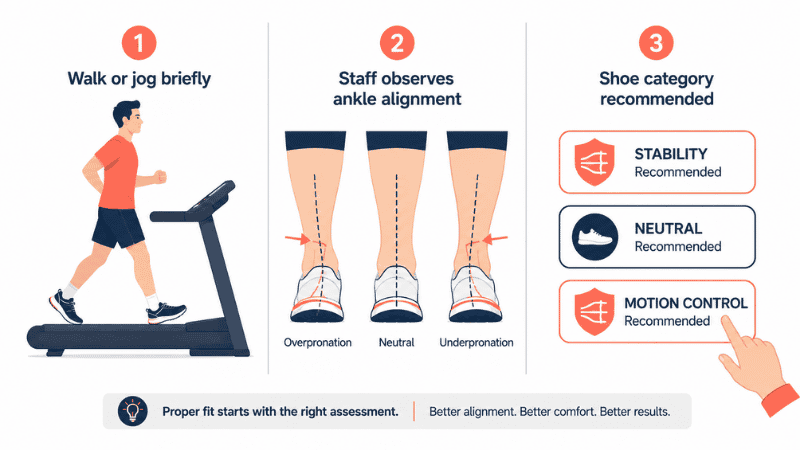
Gait analysis — where someone watches you walk or run briefly and assesses your pronation pattern — is the most reliable way to confirm your foot type assessment and get a shoe recommendation calibrated to your actual mechanics.
Most running specialty stores offer it free. It takes about five minutes. You walk or jog briefly (on a treadmill or across the store), a trained staff member observes your ankle and knee position during the gait cycle, and they narrow down your shoe category.
The value of in-store gait analysis: it removes the guesswork from the wet foot test, which tells you about arch structure but not necessarily about what your foot does under running load. Some people with flat arches have enough surrounding muscle strength to run with near-neutral mechanics. Some people with normal arches overpronate under running load because of hip or glute weakness. Gait analysis sees the actual motion.
If there’s a running specialty store near you, this is worth doing before any significant shoe purchase — particularly your first stability shoe. Buying a motion control shoe based on a self-assessment of severe overpronation, when you actually have moderate overpronation better served by a standard stability shoe, is a common and uncomfortable mistake.
What to tell the person doing your gait analysis:
- Your current weekly mileage
- Any history of running injuries (knee pain, shin splints, plantar fasciitis, IT band issues)
- How long you’ve been running
- Your primary surface (road, treadmill, trail)
- Any existing foot conditions
Step 5: The In-Store Tests That Tell You If a Shoe Actually Fits
Trying on shoes and walking around the store for two minutes is not a sufficient fitting process. Here’s what to do when you’re actually testing a shoe:
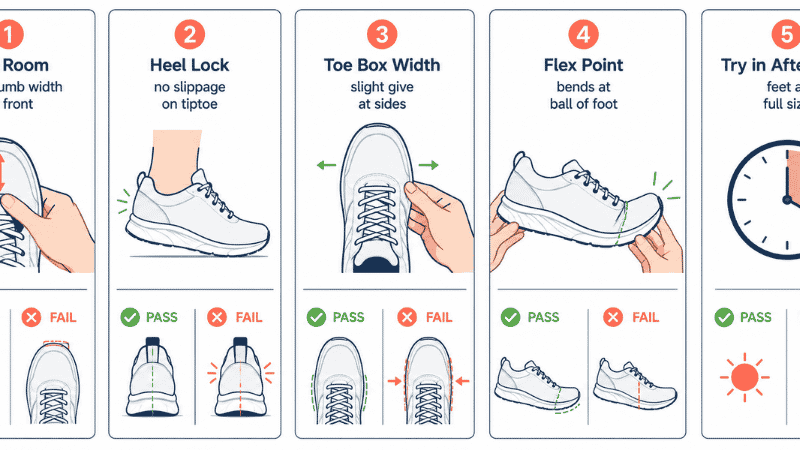
The toe room check. Press your thumb between your longest toe and the end of the shoe. There should be approximately one thumb’s width of space. Running creates forward foot movement in the shoe — without this space, toenails and forefoot take the hit on longer runs.
The heel lock check. Stand on one foot in the shoe and lift slightly onto your toes. Your heel should stay firmly seated in the heel cup — not slip upward. Heel slippage creates friction, blisters, and Achilles irritation.
The toe box width check. With the shoe laced at your normal tension, press the outer edge of the shoe at the widest toe area. There should be slight give — not immediate resistance against your little toe. If your toes feel compressed laterally, the toe box is too narrow.
The flex point check. Hold the shoe at heel and toe and press the toe down. It should fold at the ball of the foot — roughly the front third of the shoe. If it folds at the midfoot or barely bends at all, the shoe’s flex point doesn’t match normal walking and running mechanics.
The afternoon rule. If possible, try shoes in the afternoon rather than the morning. Feet swell throughout the day — sometimes by as much as half a size. A shoe that fits perfectly in the morning may feel slightly tight by mile 4 of an afternoon run.
The jog test. Ask to jog in the store or outside. Walk tests tell you almost nothing about running fit. A short jog reveals heel slippage, toe jamming, lateral instability, and whether the cushioning feels appropriate under actual running mechanics.
Matching Shoe to Common Running Problems
If You Have Knee Pain After Running
Knee pain in runners is often related to overpronation — the inward ankle collapse that internally rotates the tibia and displaces the kneecap. If you have flat feet or inner heel wear on your current shoes, a stability shoe is the first intervention to try before assuming the problem is purely training-related.
Also check your current shoes’ midsole condition. Worn-out midsoles that have lost cushioning are among the most common causes of new or returning knee pain in runners who haven’t changed their training load. Our knee pain after running guide covers the mechanism in detail.
If You Have Plantar Fasciitis
Plantar fasciitis changes shoe priorities significantly. You need heel cushioning at the attachment zone, a heel drop of 8–12mm that reduces fascial tension during running, and midfoot rigidity that prevents the fascia from being stretched excessively under load. A stability shoe with good heel cushioning is appropriate for flat-footed runners with PF; a neutral maximum-cushion shoe works better for high-arched runners with PF. Our plantar fasciitis shoes guide covers the full selection process.
If You’re a First-Time Runner
Beginners need more cushioning than they think, a heel drop of 8–10mm, and an arch support level matched to their foot type. What they don’t need: carbon plate racing shoes, minimalist shoes, or anything optimized for speed at the expense of protection.
The most important thing for beginner runners is staying uninjured long enough to build conditioning. Shoes that protect joints and soft tissue during the adaptation period matter more than any performance feature. Our running shoes for beginners guide covers age-specific recommendations and the C25K shoe guide in detail.
If You Overpronate
If your wet foot test shows a flat arch, or your current shoes show heavy inner heel wear, or a store gait analysis identified overpronation, you need a stability shoe. But the degree of overpronation matters — mild overpronation needs a different shoe than severe overpronation. Our overpronation shoes guide explains the three levels and what each requires, including when to consider custom orthotics.
If You’re Comparing Hoka and Brooks
These two brands represent the most common head-to-head comparison in running shoes, and they have fundamentally different design philosophies. Hoka prioritizes maximum cushioning and rocker geometry. Brooks prioritizes structured support and stability. Flat feet go Brooks. High arches go Hoka. Our Hoka vs Brooks walking guide and Hoka vs On Cloud guide cover both comparisons with specific model analysis.
How Long Do Running Shoes Last — and How to Know When to Replace Them
Running shoe midsoles last 300–500 miles for most runners. Body weight, running surface, and foam technology all affect where your specific shoes fall in that range. Heavier runners on concrete should expect closer to 300 miles; lighter runners on softer surfaces may get 500.
The outsole’s appearance is not a reliable indicator of midsole condition. A shoe can look almost new while the foam has compressed to a fraction of its original thickness. The reliable indicators: press your thumb into the heel midsole and check rebound speed (fast = functional, slow or none = compressed), twist the shoe at the midfoot (firm resistance = intact structure, easy twist = degraded), and monitor for new aches appearing without a training change.
For a complete guide to the six warning signs and how to assess midsole condition in five minutes, our when to replace running shoes guide walks through the full process. And for the specific question of how body weight, brand foam technology, and shoe rotation affect your replacement timeline, our running shoe lifespan guide has the complete picture.
Frequently Asked Questions
How do I choose running shoes for my foot type? Start with the wet foot test to identify flat, neutral, or high-arched feet. Flat feet need stability shoes with medial post support. High arches need neutral maximum-cushion shoes. Neutral arches have the most options — focus on cushioning level, heel drop, and fit. Confirm your assessment with a free gait analysis at a running specialty store if possible.
What running shoes should I get as a beginner? For flat feet: Brooks Adrenaline GTS or ASICS Gel-Kayano. For neutral feet: Brooks Ghost or ASICS Novablast. For high arches: Hoka Clifton or Bondi. All beginners should prioritize cushioning and a heel drop of 8–10mm over any performance features. Avoid minimalist or zero-drop shoes until you have 6+ months of consistent running.
How to get fitted for running shoes? Visit a running specialty store (not a general sporting goods store) and ask for a gait analysis. Staff will observe you walking or running briefly, assess your pronation pattern, and recommend shoe categories. Bring or wear the socks you plan to run in. Tell them your mileage, injury history, and primary surface. Try at least three models and jog in each before deciding.
What does heel drop mean in running shoes? Heel drop is the height difference between the heel and forefoot inside the shoe, measured in millimeters. Higher drop (10–12mm) promotes heel striking and reduces Achilles strain. Lower drop (0–4mm) encourages midfoot striking but requires more calf and Achilles conditioning. Most recreational runners do well at 8–10mm. Changing drop dramatically and quickly is one of the most reliable ways to develop Achilles tendinitis.
What’s the difference between neutral and stability running shoes? Neutral shoes have no specific feature to resist inward ankle roll. Stability shoes have a medial post or GuideRails on the inner midsole that limits overpronation. Neutral shoes are appropriate for neutral arches and high arches. Stability shoes are for flat feet and overpronation. Using stability shoes without overpronation doesn’t provide extra benefit and may create over-correction problems.
How do I know if my running shoes fit correctly? One thumb’s width between your longest toe and the end of the shoe. No heel slippage when you stand on one foot. No lateral toe compression when you press the outer edge of the shoe. The shoe flexes at the ball of the foot, not the midfoot. Tested in the afternoon (when feet are at their largest) and assessed by jogging, not just walking.
The Running Shoes Worth Knowing by Foot Type
For Flat Feet / Overpronation
Moderate overpronation: Brooks Adrenaline GTS 25 (the most widely used stability shoe, available in multiple widths), ASICS Gel-Kayano 32 (stronger medial support, gel heel unit), New Balance 860v14 (lighter stability option, genuine wide sizing).
Severe overpronation: Brooks Beast (men) or Brooks Ariel (women) — maximum width and motion control. ASICS Gel-Foundation for severe cases. Custom orthotics for cases that exceed what retail shoes can address.
For Neutral Arches
Standard cushioning: Brooks Ghost 17 (most forgiving daily trainer, available in four widths), Saucony Ride 18 (reliable neutral trainer, versatile).
Maximum cushioning: ASICS Gel-Nimbus 27, New Balance Fresh Foam 1080, Hoka Bondi 8.
For High Arches / Supination
Daily training: Hoka Clifton 10 (wide toe box, rocker geometry, generous cushioning), Hoka Bondi 8 (maximum cushioning), Brooks Ghost 17 (neutral, reliable).
Maximum cushioning: Hoka Bondi 8 or 9, ASICS Gel-Nimbus 27.
For Race Day
Carbon plate racing shoes: ASICS Metaspeed Sky Paris, Nike Alphafly 3, Saucony Endorphin Pro 4. Reserve for races and key sessions — not daily training. Full context in our carbon plate running shoes guide.
The Bottom Line
Choosing running shoes correctly comes down to four decisions, made in order: identify your foot type, match the stability designation to your mechanics, select appropriate cushioning and drop for your history and goals, and verify the fit before committing.
Skip step one and nothing else matters. Get step one right and the rest of the process becomes significantly clearer.
The most useful thing you can do right now: do the wet foot test, check the wear pattern on your current shoes, and compare the two results. If they agree — flat arch and inner heel wear, or neutral arch and even wear — you have your foot type. If they disagree, a store gait analysis will resolve it in five minutes.
From there, use the guides below to go deeper on whatever aspect of the decision is still unclear.
Your Running Shoe Resource Library
Every article below covers one aspect of running shoe selection in depth:
- Foot type identification and shoe matching: Flat Feet vs High Arches Guide
- Overpronation severity and correction levels: Overpronation Shoes Guide
- First pair for new runners: Running Shoes for Beginners
- Knee pain from shoe mismatch: Knee Pain After Running Guide
- When and how to replace shoes: When to Replace Running Shoes
- Mileage tracking and lifespan: How Long Do Running Shoes Last
- Hoka vs Brooks comparison: Hoka vs Brooks Walking Shoes
- Hoka vs On Cloud comparison: Hoka vs On Cloud
- Carbon plate racing shoes: Carbon Plate Running Shoes Guide
- Wide toe box and width sizing: Wide Toe Box Walking Shoes
References
- Lopes, A.D., et al. “What are the main running-related musculoskeletal injuries?” Sports Medicine, 2012.
- Malisoux, L., et al. “Can parallel use of different running shoes reduce the risk of injury?” Scandinavian Journal of Medicine & Science in Sports, 2015.
- Nielsen, R.O., et al. “Foot pronation is not associated with increased injury risk in novice runners wearing a neutral shoe.” British Journal of Sports Medicine, 2014.
- Nigg, B.M., et al. “The role of footwear on foot and lower limb biomechanics.” Footwear Science, 2015.
- American Podiatric Medical Association (APMA). Athletic Footwear Guidance. apma.org
- Barton, C.J., et al. “Running shoe prescription in recreational runners with patellofemoral pain.” Journal of Science and Medicine in Sport, 2011.