
The first running shoe purchase is where most new runners make their most expensive mistake. Not because they spend too much — often it’s the opposite. They pick up whatever’s on sale, or whatever looks good, or whatever a friend swears by, without understanding that running shoes are the one piece of gear where “close enough” isn’t close enough.
Running puts two to three times your body weight of force through your feet with every stride. Do that 1,500 times per mile — which is roughly how many steps a mile takes — and the mismatch between your foot mechanics and your shoe’s support structure becomes a very efficient injury machine. The knee pain, shin splints, and IT band issues that sideline new runners in their first month aren’t bad luck. They’re predictable outcomes of starting in the wrong shoe.
The good news is that getting it right isn’t complicated. You don’t need to know every technical detail of running shoe construction. You need to know four things: your foot type, your running surface, your weekly mileage goal, and — if you’re over 40 — how starting later changes what your shoe needs to do. This guide covers all four, plus the most common beginner shoe mistakes and how to avoid them.
Key Takeaways
- Running shoes for beginners should prioritize cushioning, appropriate arch support, and a forgiving heel-to-toe drop — not weight, speed features, or carbon plates.
- Your foot type (flat, neutral, or high-arched) is the single most important variable in shoe selection. The wrong arch support type actively increases injury risk compared to no support at all.
- Beginners over 40 need more cushioning and a higher heel drop than younger runners — joint recovery is slower, and the Achilles and calf complex needs more mechanical assistance than it did at 25.
- The 10% rule is non-negotiable for new runners: never increase your weekly mileage by more than 10% from one week to the next, regardless of how good you feel.
- Running shoes should feel comfortable from the first step in the store. There is no meaningful break-in period for modern running shoes. If they’re uncomfortable in the store, they’ll be uncomfortable at mile 3.
- According to research published in the British Journal of Sports Medicine, up to 79% of recreational runners sustain at least one injury per year — with footwear mismatch being among the most modifiable risk factors.
What Makes a Running Shoe Different from a Regular Sneaker
This matters more than most beginners realize, and it’s worth a brief explanation before getting into recommendations.
A regular sneaker — even a comfortable one — is designed for light daily activity: walking, standing, occasional movement. The cushioning is calibrated for low-impact, low-repetition use. The midsole structure is built for aesthetics and general comfort, not for the specific biomechanical demands of sustained forward propulsion at 3–6 mph with 2–3x body weight impact per stride.
Running shoes are engineered around a specific gait cycle: heel strike (or midfoot strike), midstance support, and toe-off propulsion. The midsole foam is calibrated to absorb impact at a specific force and frequency. The flex point is positioned to support the foot’s natural pivot at the ball. The heel counter is firm enough to stabilize the rearfoot through the landing phase.
None of this exists in standard casual footwear. Running in regular sneakers is like doing carpentry with a butter knife — technically possible for basic tasks, but you’ll notice the limitations quickly, and those limitations have consequences.
Step One: Know Your Foot Type
Everything else in shoe selection flows from this. If you get your foot type wrong, you can have the most expensive, most well-reviewed running shoe on the market and still end up injured.
The three foot types and what they mean for running shoes:
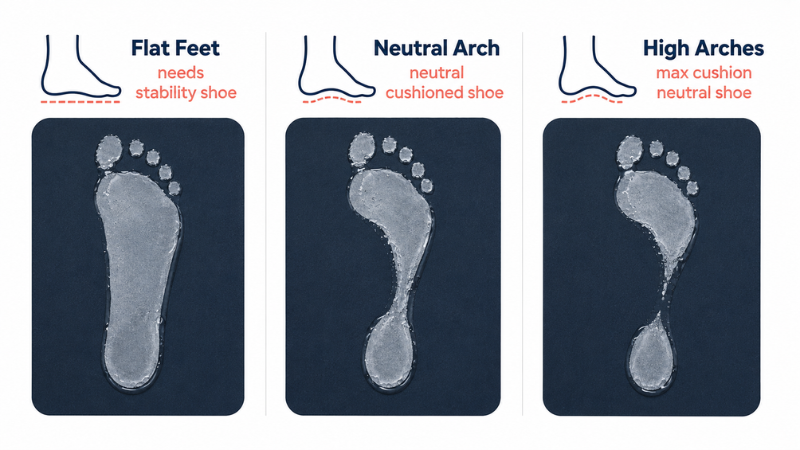
Flat feet / overpronation: Your arch collapses inward when you bear weight. During running, this means your ankle rolls inward with every landing, which internally rotates your tibia, which affects how your knee tracks. Left unaddressed, this is a reliable pathway to runner’s knee, shin splints, and plantar fasciitis.
What you need: a stability running shoe with medial post support or GuideRails — a firmer section of foam on the inner midsole that resists the inward roll. Brooks Adrenaline GTS, ASICS Gel-Kayano, and New Balance 860 are the most consistent performers for this foot type.
Neutral arch: Your foot follows a normal loading pattern — heel strike, moderate inward roll, toe-off — without excessive deviation in either direction.
What you need: a neutral cushioned running shoe. No correction needed — just good cushioning and a supportive heel counter. Brooks Ghost, ASICS Gel-Nimbus, Hoka Clifton, and Saucony Ride are reliable starting points.
High arches / supination: Your foot doesn’t flatten enough under load, rolling slightly outward instead. This concentrates impact on the outer foot and reduces the body’s natural shock absorption. Common results: stress fractures, IT band syndrome, outer ankle pain.
What you need: a neutral maximum-cushion shoe — thick, soft foam that compensates for the shock absorption your foot isn’t providing. Crucially, not a stability shoe — stability features push a supinating foot further in the wrong direction. Hoka Bondi, Brooks Ghost (neutral version), and ASICS Gel-Nimbus work well here.
The quick self-test: The wet foot test from our flat feet vs high arches guide takes under a minute and gives you a reliable starting point. Step on dark cardboard with a wet foot. Full footprint = flat feet. Thin connection between heel and forefoot = high arches. Moderate curve = neutral.
The Four Features That Matter Most for Beginner Running Shoes
1. Cushioning — More Than You Think You Need
Beginners consistently underestimate how much cushioning their first running shoes need. The logic seems reasonable — “I’m only going a mile or two, I don’t need maximum cushioning.” But cushioning isn’t just about long-distance comfort. It’s about protecting joints and muscles that aren’t yet conditioned for the repetitive impact of running.
When you start running, your muscles, tendons, and connective tissue need 8–12 weeks to adapt to the new load. During this adaptation period, your body doesn’t absorb impact as efficiently as it will once it’s conditioned. The shoe’s cushioning compensates for this gap — it absorbs impact that your undertrained muscles can’t yet handle.
For beginners, lean toward more cushioning rather than less. A shoe with 30–38mm of heel stack height is appropriate. This is not the time to experiment with minimalist or low-drop shoes — that’s a transition you make after 6–12 months of consistent running when your body is ready for it.
2. Heel-to-Toe Drop of 8–12mm
Most new runners — regardless of age — are heel strikers. This isn’t necessarily wrong, but it means the heel bears significant impact force with each stride. A heel drop of 8–12mm provides a cushioned heel platform that reduces the stress of heel striking while your form develops.
Lower drop shoes (0–6mm) require the foot and calf to absorb more impact, which is fine for conditioned runners but creates Achilles and calf strain for beginners whose posterior chain isn’t yet prepared for that demand. This is one of the most common causes of Achilles tendinitis in new runners who start in trendy minimalist shoes.
3. A Stable Heel Counter
The heel counter is the firm structure around your heel. Press the back of any shoe you’re considering — it should feel firm and resist your thumb. A firm heel counter keeps your heel stable through the landing phase, reducing the micro-movement that creates friction, blisters, and heel pain during long runs.
Soft heel counters — common in lifestyle sneakers — allow the heel to move inside the shoe. For casual walking, this is inconsequential. For running, that movement happens 1,500 times per mile and adds up quickly.
4. A Thumb’s Width of Toe Room
Your feet swell during running — sometimes by as much as half a size over the course of a longer run. The standard recommendation is a thumb’s width between your longest toe and the end of the shoe. This prevents the toe-jamming that causes black toenails, blisters under the nail, and forefoot discomfort on longer efforts.
When trying shoes, don’t assess toe room standing still — walk and jog in the store to feel whether your toes hit the front during the push-off phase.
Running Shoes for Beginners at Different Ages
Starting to run at different ages genuinely requires different shoes — not because the brands are different, but because what your body needs from the shoe changes.
Starting to Run in Your 20s and Early 30s
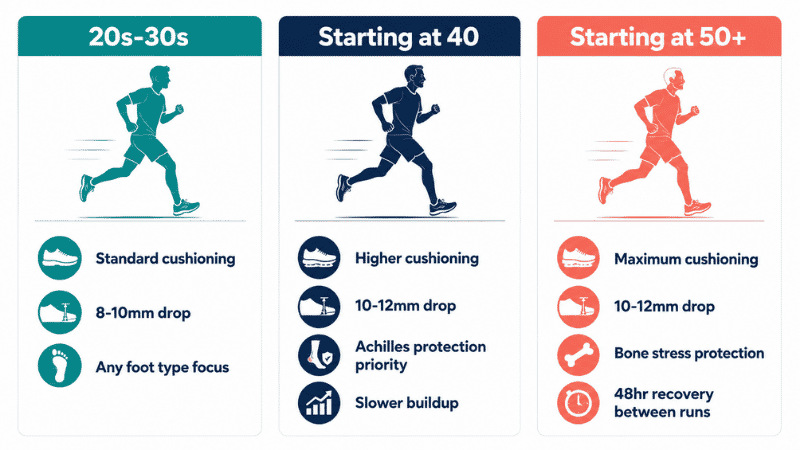
Your joints and connective tissue are at their most resilient. You can get away with slightly less cushioning and lower heel drop than older beginners, and your body adapts to running loads faster. The primary concerns are foot type matching and not doing too much too soon.
Good starting points: Brooks Ghost 17 (neutral), Brooks Adrenaline GTS 25 (flat feet), ASICS Gel-Nimbus 27 (high arches or neutral, maximum cushion), Saucony Ride 18 (neutral, versatile).
Starting to Run at 40
This is where the conversation changes meaningfully. After 40, joint cartilage is less resilient, recovery between sessions is slower, and connective tissue takes longer to adapt to new loading patterns. The Achilles tendon in particular becomes more vulnerable — it loses elasticity with age, which is why Achilles tendinitis is significantly more common in 40+ runners than younger ones.
What this means for shoes: lean toward higher heel drop (10–12mm) to reduce Achilles tension, maximum cushioning to compensate for reduced cartilage resilience, and stability features if you have any history of overpronation or knee issues.
The Hoka Bondi and Brooks Glycerin GTS (the maximum-cushion stability version) are particularly well-suited for 40+ beginners. The rocker geometry in Hoka specifically reduces peak knee joint loading — research shows it can reduce knee loading by up to 19% compared to standard shoes, which matters more as cartilage naturally thins with age.
Building up mileage also needs to happen more slowly at 40. The 10% weekly mileage increase rule is stricter, not a suggestion. Plan for 10–12 weeks of gradual buildup before your first 5K attempt.
Starting to Run at 50 or Later
The same principles as 40+ apply, amplified. Cushioning priority increases further. Recovery time between runs needs to be built into your schedule — 48 hours between running sessions is appropriate for most 50+ beginners, not the 24-hour recovery that younger runners use.
There’s also a consideration that almost no beginner shoe guide addresses: bone density and stress fracture risk increase with age, particularly for women post-menopause. This makes the cushioning priority even more critical — the shoe needs to absorb impact that aging bone can’t absorb as effectively as it once did.
Shoe choices for 50+ beginners: Hoka Bondi 8 or 9 (maximum cushioning, rocker geometry, joint-friendly), Brooks Beast or Ariel (maximum stability and cushioning, wide options), ASICS Gel-Kayano 32 (stability, gel heel unit specifically engineered for longevity and heel protection).
The transition to running at 50+ is slower and requires more patience than starting younger, but it’s entirely achievable. The key is accepting that the adaptation timeline is 3–4 months rather than 6–8 weeks.
Running Shoes for Couch to 5K (C25K)
The Couch to 5K program is one of the most effective beginner running frameworks ever developed — and it has specific footwear implications that most guides overlook.
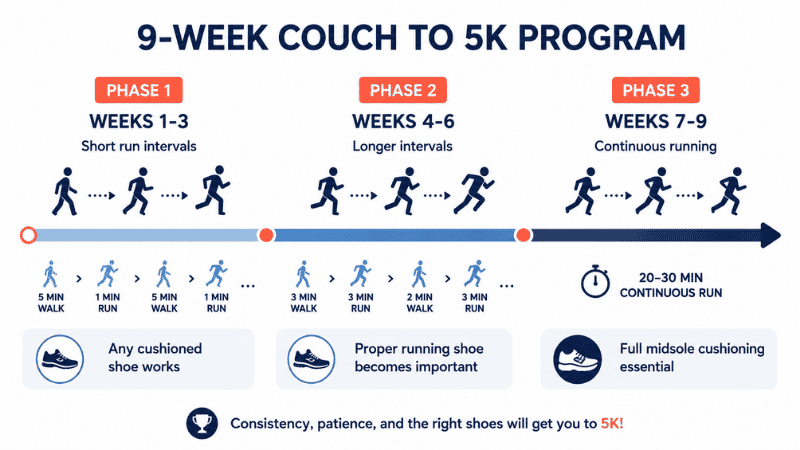
C25K is a 9-week program that gradually builds from run/walk intervals to continuous 30-minute running. The early weeks involve very short running intervals (60 seconds) with long walking recovery, which means:
Week 1–3: Impact demands are low. Almost any well-cushioned shoe works. Focus on fit and foot type matching rather than performance features.
Week 4–6: Running intervals extend to 3–5 minutes. This is when cumulative impact starts to matter. Midsole cushioning quality becomes more important. If you started in a casual shoe, this is when discomfort often appears — and when switching to a proper running shoe makes the most immediate difference.
Week 7–9: Continuous running for 20–30 minutes. You need a proper running shoe at this point. The impact load over 20–30 minutes of continuous running is substantial enough that inadequate cushioning will make itself known clearly.
The C25K shoe recommendation: Start the program in a proper running shoe — don’t wait until you’re running continuously to invest in the right footwear. The transition from weeks 3–5 is where most people drop out, and discomfort from inadequate footwear is a significant contributing factor.
Reliable C25K shoes: Brooks Ghost 17 (the most forgiving neutral daily trainer available), ASICS Novablast 5 (fun, bouncy, encourages you to keep going), Hoka Clifton 10 (maximum cushion for impact absorption during early adaptation weeks).
The Most Common Beginner Running Shoe Mistakes
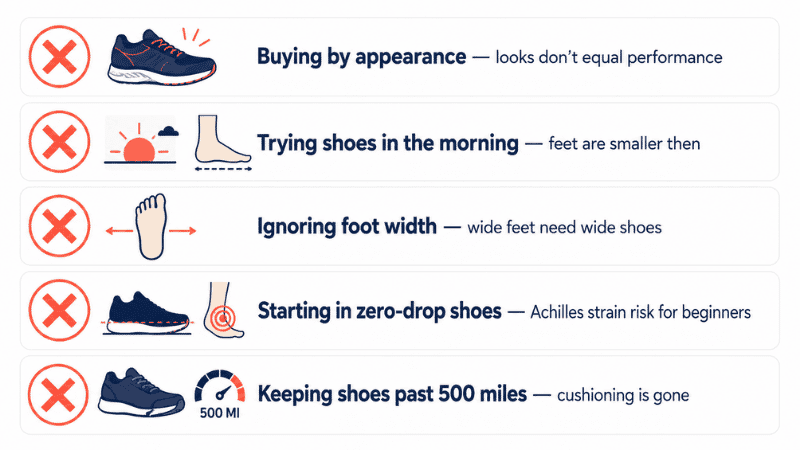
Buying based on appearance. Running shoes that look fast are not faster. Running shoes that look minimal are not better for you as a beginner. Running shoes that look like what serious runners wear are not what serious runners started in. Buy for fit and support, not aesthetics.
Buying at the wrong time of day. Feet swell throughout the day. Trying shoes in the morning gives you a smaller foot measurement than you’ll have during an afternoon or evening run. Try running shoes in the afternoon or after you’ve been on your feet for a few hours.
Ignoring foot width. Standard running shoes come in standard width. If you have wide feet, a standard-width running shoe will compress your forefoot regardless of how good the cushioning is. Check whether the shoe is available in wide (2E for men, D for women) before committing. New Balance and Brooks have the most consistent genuine wide sizing in beginner-appropriate models.
Starting in zero-drop or minimalist shoes. This advice comes up in running communities and it’s wrong for beginners. Minimalist shoes require significant calf and Achilles conditioning that takes months to develop. Starting in them as a beginner is among the fastest ways to get Achilles tendinitis or stress fractures. Run in standard cushioned shoes for at least 6 months before experimenting with lower-drop options.
Keeping them too long. Running shoe midsoles last 300–500 miles. For a beginner running 15 miles per week, that’s 5–8 months. After that, the cushioning is functionally exhausted even if the shoe looks fine. If your knees start hurting after months of pain-free running, check when you bought your shoes before assuming anything else is wrong. Our guide on running shoe lifespan covers how to tell when your shoes are done.
Skipping the gait assessment. Most running specialty stores offer free gait analysis — they watch you walk or run briefly and assess your pronation pattern. This takes five minutes and removes the guesswork from foot type identification. If there’s a running specialty store near you, this is worth doing before your first shoe purchase.
Specific Recommendations by Foot Type and Age
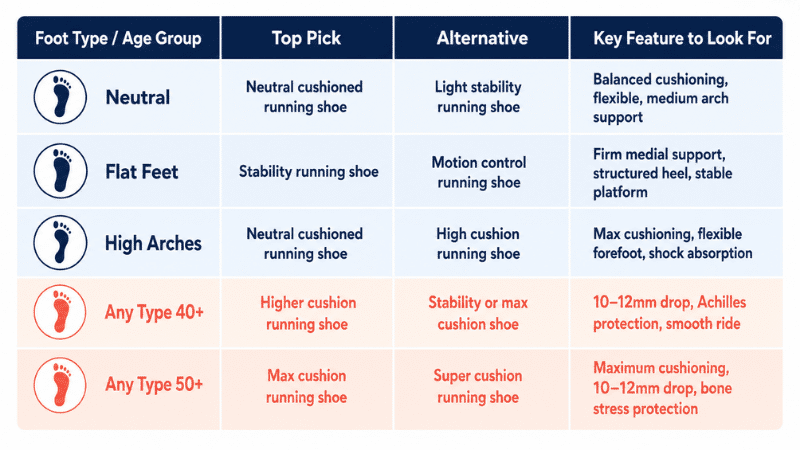
Neutral Feet, Under 40
Top pick: Brooks Ghost 17 — the most consistently recommended beginner neutral shoe for a reason. Reliable cushioning, available in four widths, forgiving heel drop, immediate step-in comfort. Alternative: ASICS Novablast 5 — slightly more cushioned and bouncy, encourages a faster cadence, excellent for C25K programs.
Flat Feet / Overpronation, Under 40
Top pick: Brooks Adrenaline GTS 25 — GuideRails stability system is the most refined motion control available without crossing into maximum control territory. Available in 2E width. Alternative: ASICS Gel-Kayano 32 — stronger medial support for more significant overpronation, gel heel unit for longevity.
High Arches, Under 40
Top pick: Hoka Clifton 10 — rocker geometry and generous cushioning suit supinating feet well. Wider toe box accommodates foot spread under load. Alternative: ASICS Gel-Nimbus 27 — maximum neutral cushioning, slightly more structured than Clifton.
Any Foot Type, 40+
Top pick: Hoka Bondi 8 or 9 — maximum cushioning, rocker geometry for joint protection, available in wide. The most joint-friendly beginner running shoe available at any price point. Stability version for flat feet 40+: Brooks Glycerin GTS — maximum cushioning with GuideRails, the rarest combination in beginner shoes.
Any Foot Type, 50+
Top pick: Hoka Bondi 8 or 9 — same reasoning as 40+, amplified. The stack height provides impact absorption that aging joints need. For very wide feet: Brooks Beast (men) or Brooks Ariel (women) — maximum stability, maximum width options (up to 4E), maximum durability.
When to See a Professional Before Starting
Most healthy adults can start a beginner running program with appropriate shoes without medical clearance. However, see your doctor or a sports medicine physician before starting if:
- You have existing knee, hip, or lower back conditions
- You’ve had a previous running injury that required medical treatment
- You have diabetes — foot issues in diabetes require specialist management
- You’re significantly overweight — the impact forces on joints are substantially higher, and a supervised start reduces injury risk
A podiatrist can assess your foot mechanics more precisely than any store gait analysis and can prescribe orthotics if your overpronation or structural issues exceed what off-the-shelf stability shoes can address.
Frequently Asked Questions
What are the best running shoes for beginners? For neutral feet: Brooks Ghost 17 or ASICS Novablast 5. For flat feet: Brooks Adrenaline GTS 25 or ASICS Gel-Kayano 32. For high arches: Hoka Clifton 10 or ASICS Gel-Nimbus 27. For beginners over 40: Hoka Bondi 8 or 9 regardless of foot type. The “best” shoe is the one that matches your foot type and running surface — not the most popular or most expensive option.
What running shoes should a beginner buy for Couch to 5K? The Brooks Ghost 17 is the most beginner-friendly C25K shoe for neutral feet — forgiving, cushioned, available in multiple widths, and comfortable from week one through completion. For flat feet, Brooks Adrenaline GTS provides the stability that becomes important as running intervals extend. Start the program in a proper running shoe from day one — don’t wait until week five when you’re running longer.
Do I need to get gait analysis before buying running shoes? It’s helpful but not essential. The wet foot test identifies your arch type reliably enough to narrow down your shoe category. If you have access to a running specialty store that offers free gait analysis, take advantage of it — it removes the guesswork. If not, start with your arch type from the wet foot test, buy from a retailer with a good return policy, and assess after a few runs.
How much should a beginner spend on running shoes? $100–$150 is the practical range for quality beginner running shoes from established brands. Under $80, you’re accepting significant compromises in foam quality and support structure that will show up as discomfort or injury over time. Over $150 for a beginner’s first shoe often means paying for performance features (carbon plates, racing foams) that aren’t relevant to beginner training loads.
Should beginners run in minimalist or zero-drop shoes? No — not as a starting point. Minimalist shoes require Achilles tendon, calf, and intrinsic foot muscle conditioning that takes 3–6 months of gradual adaptation to develop safely. Starting in zero-drop shoes as a complete beginner dramatically increases the risk of Achilles tendinitis, calf strains, and stress fractures. Run in standard cushioned shoes for at least 6 months before considering any transition toward minimal footwear.
The Bottom Line
The best running shoes for beginners are the ones that match your foot type, provide enough cushioning for your body weight and running surface, and fit correctly in both length and width. Everything else — brand prestige, colorway, carbon plates, marketing claims — is noise.
Get your foot type right first. Start with more cushioning than you think you need. Buy for how your foot feels in the afternoon, not the morning. Keep a mileage log and replace shoes at 300–500 miles.
If you’re starting to run at 40 or older, accept that your timeline is longer and your cushioning needs are higher than younger runners. That’s not a limitation — it’s just information that helps you choose correctly and stay injury-free long enough to actually become a runner.
For a deeper look at how to identify your foot type and what each type needs from a shoe, our flat feet vs high arches guide walks through the full assessment. And once you’ve been running for a few months and start thinking about replacing your first pair, our guide on how long running shoes last will tell you exactly when it’s time.
References
- Lopes, A.D., et al. “What are the main running-related musculoskeletal injuries?” Sports Medicine, 2012.
- Malisoux, L., et al. “Shoe cushioning influences the running injury risk according to body mass.” American Journal of Sports Medicine, 2017.
- Barton, C.J., et al. “Running shoe prescription in recreational runners with patellofemoral pain.” Journal of Science and Medicine in Sport, 2011.
- American Academy of Orthopaedic Surgeons (AAOS). Running Injuries. orthoinfo.aaos.org
- Sobhani, S., et al. “Biomechanics of slow running and walking with a rocker shoe.” Gait & Posture, 2013.
- Nielsen, R.O., et al. “Foot pronation is not associated with increased injury risk in novice runners wearing a neutral shoe.” British Journal of Sports Medicine, 2014.