
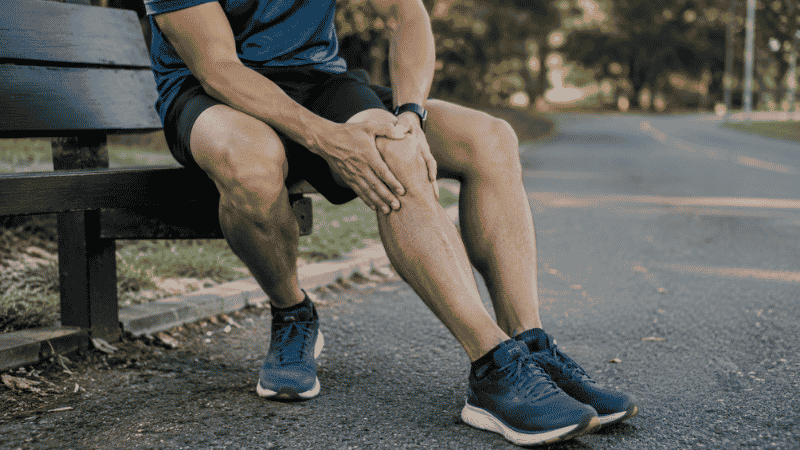
You made a plan. You were going to start running — maybe three times a week, maybe training for a 5K, maybe just getting more active. The first two weeks felt fine. Then somewhere around week three, the pain showed up. Not during the run — usually after. A dull ache around the kneecap. Stiffness when you sit down for too long. That grinding sensation when you go down stairs that makes you wince and grab the railing.
You googled it. You found terms like “patellofemoral pain syndrome” and “runner’s knee” — which technically answered what it is, but didn’t quite explain why it happened to you specifically, or what you’re supposed to do about it beyond “rest and ice.”
Here’s what most medical articles don’t tell you: in many cases, the shoes you’re running in are a significant part of the problem. Not the only factor — but often a contributing one that’s entirely fixable. The way your foot lands, how your ankle rolls, and how the shoe supports (or doesn’t support) the arch all cascade upward through the tibia, into the knee joint, and determine how much stress the patella absorbs with every stride.
This guide explains the mechanism, helps you figure out whether shoes are contributing to your knee pain, and gives you a concrete framework for choosing running shoes that reduce rather than amplify that stress.
Key Takeaways
- Knee pain after running is the most common running injury, affecting an estimated 25% of recreational runners at some point, according to research published in the British Journal of Sports Medicine.
- The most common type — patellofemoral pain syndrome (PFPS), or runner’s knee — occurs when the kneecap doesn’t track properly through its groove in the femur, creating friction and inflammation under the patella.
- Overpronation (excessive inward rolling of the ankle) is one of the most documented shoe-related contributors to knee pain in runners. Running in neutral shoes with significant overpronation rotates the tibia inward, which directly affects patella tracking.
- Worn-out running shoes are a frequently overlooked cause of new or returning knee pain. Midsole foam that has compressed past its effective life stops absorbing impact and changes your gait mechanics.
- According to the American Academy of Orthopaedic Surgeons (AAOS), shoe inserts and footwear correction are among the recommended non-surgical interventions for PFPS — specifically when foot alignment is a contributing factor.
- Most cases of runner’s knee respond to conservative treatment within 4–8 weeks when the underlying cause is addressed.
How Running Shoes Cause Knee Pain: The Mechanism
Understanding why shoes matter requires a brief detour into how the knee actually works — but stay with it, because this is the part that changes how you think about shoe selection.
Your kneecap (patella) sits in a groove at the end of your femur and slides up and down that groove as you bend and straighten your knee. For this to work without pain, the patella needs to track through the center of that groove. If it tracks to the outside, the cartilage on the lateral side gets compressed. If it tracks to the inside, the medial side takes the load. Either way, repetitive friction on cartilage that isn’t designed to be a friction surface produces inflammation — and inflammation produces the aching, grinding pain that defines runner’s knee.
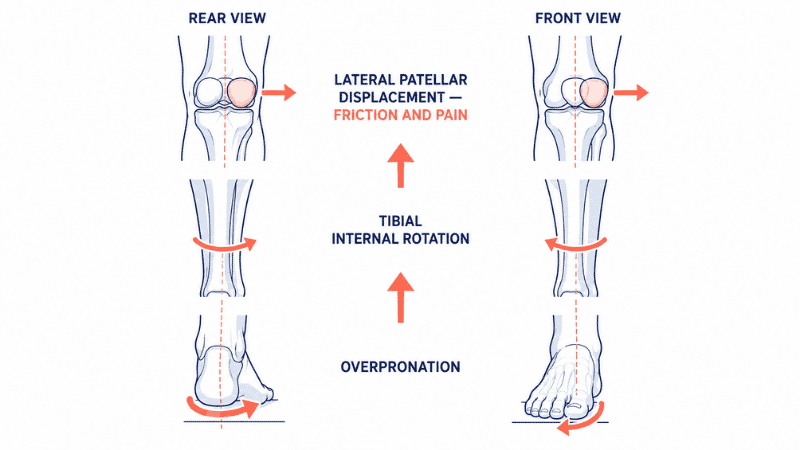
What determines patella tracking? Largely the alignment of everything below it. Your foot’s position on the ground influences your ankle angle, which influences your tibia’s rotation, which influences your knee alignment, which determines where the patella sits in its groove.
This is the kinetic chain — and it explains why foot mechanics are so directly connected to knee pain.
Overpronation’s specific contribution: When the foot rolls excessively inward (overpronation), it internally rotates the tibia. Internal tibial rotation pulls the knee inward. This displaces the patella toward the outer side of its groove and increases lateral compression. Run enough miles in shoes that allow significant overpronation and the cartilage under the lateral patella accumulates friction damage that eventually becomes symptomatic.
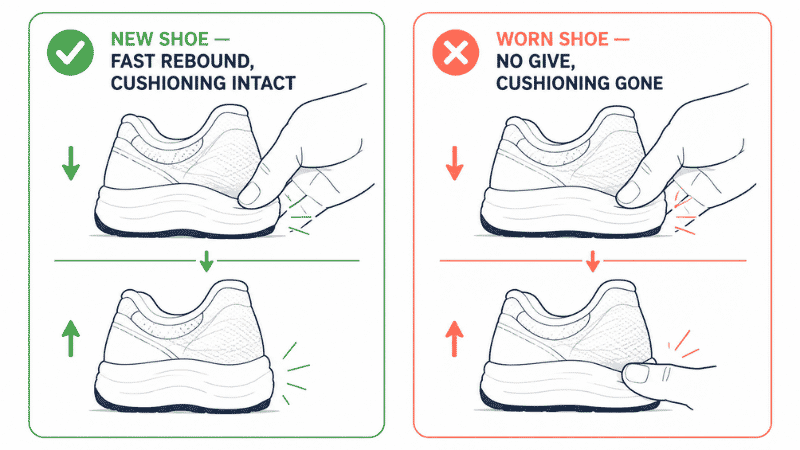
Worn midsoles’ contribution: Running shoe midsoles are designed to absorb a specific amount of impact. When the foam compresses past its effective lifespan, it stops absorbing that impact — meaning the force that was being absorbed by the shoe now travels straight through the foot, ankle, and into the knee. If your knee pain appeared gradually after owning a pair of shoes for a long time, or returned after you started running more miles, worn midsoles are worth investigating before anything else.
Heel drop’s contribution: Shoes with a very low heel drop (0–4mm) place more demand on the calf-Achilles complex and change the landing mechanics relative to the knee. Transitioning too quickly from standard drop shoes (10–12mm) to minimal drop shoes can temporarily increase knee stress while the body adapts. This is why “barefoot-style” running shoes have a learning curve that produces knee complaints in runners who switch too abruptly.
Can Shoes Cause Knee Pain? A Practical Self-Assessment
Before assuming the worst, run through this. Four questions that help identify whether shoes are a likely contributor to your knee pain:
1. When did the pain start relative to your shoes? New shoes: The shoe’s flex point, heel drop, or support level may not match your mechanics. Old shoes: Midsole compression is the most likely culprit — check how long you’ve had them and how many miles they’ve covered.
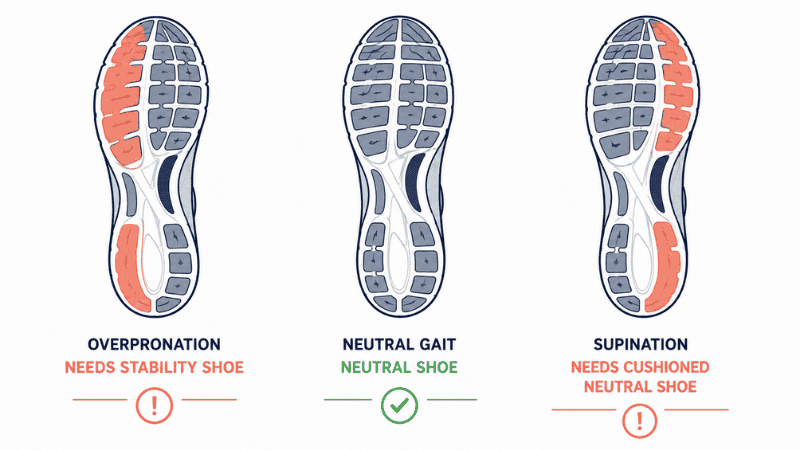
2. Look at the wear pattern on your current shoe’s outsole. Significant wear on the inner heel and forefoot indicates overpronation. Wear concentrated on the outer edge indicates supination. Either pattern, combined with knee pain, suggests a biomechanical mismatch between your gait and your shoe’s support structure.
3. Does the pain change when you run on different surfaces? If knee pain is worse on concrete than on trails or a track, midsole cushioning is likely inadequate for the surface. If pain is similar on all surfaces, the cause is more likely mechanical than surface-related.
4. Press your thumb firmly into the heel of the shoe’s midsole. If it feels completely firm with no give, the foam has compressed and the cushioning is effectively gone. New shoes have meaningful give in the midsole foam. If yours don’t, they need replacing regardless of how the upper looks.
If you answered yes to any of these, shoes are worth addressing before escalating to medical treatment.
Running Shoes for Knee Pain: What to Look For
Stability Features for Overpronators
If your outsole wear pattern shows medial (inner) wear and you have flat feet or low arches, a stability running shoe is likely the most impactful change you can make for knee pain. The medial post or GuideRails in a stability shoe reduces inward ankle roll during the landing phase, which reduces internal tibial rotation, which reduces the lateral patellar displacement that creates PFPS.
This isn’t theoretical — a systematic review published in the Journal of Orthopaedic & Sports Physical Therapy found that motion control and stability footwear reduced overpronation and associated lower extremity injury rates in runners with flat feet compared to neutral footwear.
Reliable stability options: Brooks Adrenaline GTS (the most widely used stability shoe for this purpose, available in multiple widths), ASICS Gel-Kayano (higher heel drop, strong medial support, effective for moderate to severe overpronation), New Balance 860 (lighter than Adrenaline, genuine stability features, true wide sizing).
Cushioning for Impact Reduction
For runners with neutral to high-arched feet whose knee pain is related to impact rather than alignment, maximum cushioning in the heel and midsole reduces the load reaching the knee with each landing.
The key here is choosing cushioning with structure — not just softness. A highly cushioned but floppy midsole that allows arch collapse won’t help knee pain regardless of its stack height. You want foam that’s both thick and resilient.
Reliable high-cushion options: Hoka Bondi (maximum stack height, rocker geometry that reduces peak loading), Brooks Glycerin (plush but structured, available in stability version for overpronators who also need maximum cushion), ASICS Gel-Nimbus (generous heel gel cushioning, neutral designation, reliable for long-distance runners).
Heel Drop Matched to Your Mechanics
If you’re currently running in zero-drop or low-drop shoes and experiencing knee pain, a gradual increase in heel drop may reduce posterior chain tension and change landing mechanics in ways that unload the patella. The reverse is also true for some runners — a very high-drop shoe that promotes heavy heel striking can increase knee loading at the point of ground contact.
Most recreational runners with knee pain do well in the 8–10mm drop range, which is moderate enough to provide some heel protection while not dramatically altering natural gait mechanics.
Replace Your Shoes at the Right Time
This sounds obvious but is consistently underestimated. Running shoe midsoles are rated for approximately 300–500 miles. For a runner logging 15 miles per week, that’s 5–8 months. For a runner logging 30 miles per week, that’s 2.5–4 months.
Track your mileage. If you can’t, a reasonable rule is: if the shoes are more than 8 months old and you run regularly, replace them and see if the knee pain changes before pursuing other interventions.
Running Shoes for Bad Knees: By Foot Type
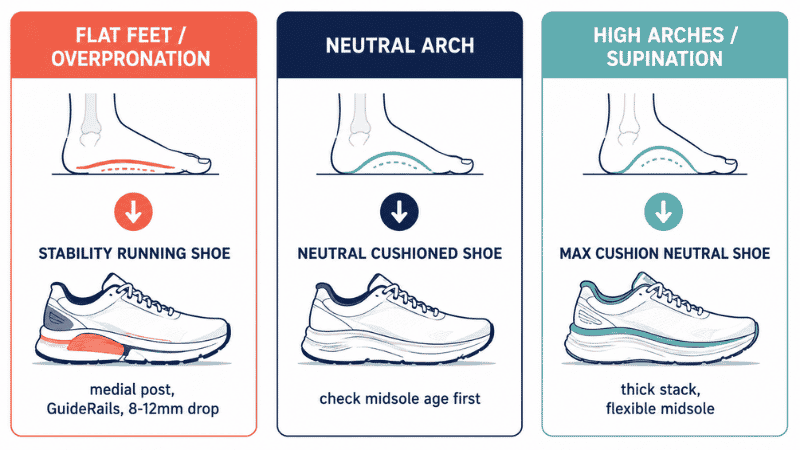
Flat Feet with Knee Pain
The combination of flat feet and knee pain is among the most common presentations in recreational runners, and it has a clear solution path. Flat feet overpronate — the arch collapses inward under load, which internally rotates the tibia, which displaces the patella. The shoe fix is a stability shoe that controls that inward collapse.
What to look for: Medial post or GuideRails designation, heel drop of 8–12mm, firm heel counter, available in wide if needed.
Recommended: Brooks Adrenaline GTS 25, ASICS Gel-Kayano 32, New Balance 860v14. For severe overpronation: Brooks Beast 20 or ASICS GT-2000.
If stability shoes and correct sizing don’t resolve the knee pain within 4–6 weeks, custom orthotics from a podiatrist are the next logical step — they provide more precise correction than any off-the-shelf shoe can.
High Arches with Knee Pain
High-arched feet supinate — they tend to roll outward rather than inward. This concentrates impact on the outer edge of the foot and lateral leg, which can contribute to IT band syndrome (pain on the outer knee) rather than the classic runner’s knee pattern. The shoe fix is maximum cushioning in a neutral shoe that doesn’t try to correct the arch position.
What to look for: High stack height, neutral designation (no stability features), flexible midsole, curved or semi-curved last.
Recommended: Hoka Bondi 8 or Clifton 10, Brooks Ghost 16, New Balance Fresh Foam 1080.
Neutral Arches with Knee Pain
Neutral-arched runners with knee pain are more likely to have a training load or midsole wear issue than a structural mismatch. Check the shoe’s age and mileage first. If the shoes are recent and in good condition, look at training volume — increasing mileage too quickly (more than 10% per week) is the most common cause of PFPS in runners without foot type issues.
What to look for: Well-cushioned neutral shoe with good heel support, appropriate for your weekly mileage.
Recommended: Brooks Ghost, ASICS Gel-Nimbus, Hoka Clifton, Saucony Ride.
The 10-Minute Knee Pain Assessment Before Your Next Run
You don’t have to stop running completely unless the pain is severe (more on that below). But before your next session, do this:
Check the midsoles. Press both thumbs firmly into the heel foam. If there’s no give at all, the shoes are done.
Check your outsole wear. Significant wear on the inner heel = you’re overpronating in neutral shoes. Get a stability shoe before your next long run.
Do a knee pain log for one week. Rate your pain 0–10 before the run, immediately after, and the following morning. If the morning-after score is consistently higher than the during-run score, that’s an inflammatory pattern that suggests you need more recovery between sessions, not just different shoes.
Shorten your stride temporarily. Overstriding — landing with your foot significantly ahead of your center of mass — increases the braking force at the knee with every step. Shortening your stride by 5–10% and increasing cadence slightly often reduces knee stress meaningfully while you sort out footwear.
When to Stop Running and See a Doctor
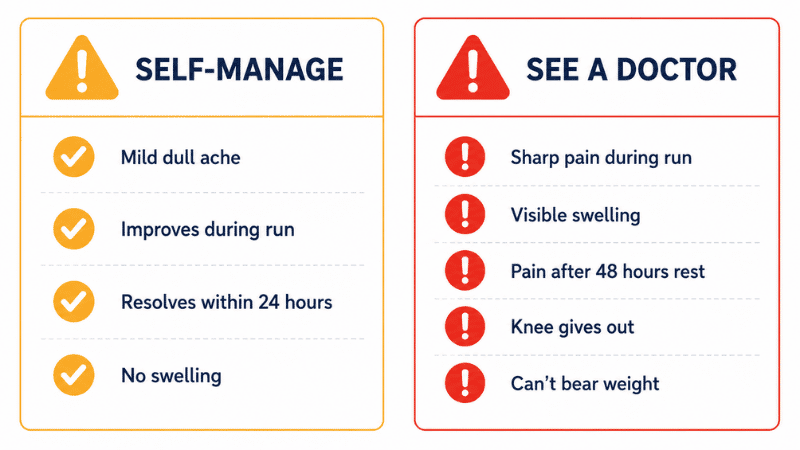
Running through mild knee discomfort that resolves quickly is generally acceptable. Running through the following is not:
Stop running and see a sports medicine physician or orthopedist if:
- Pain is sharp rather than dull during the run
- The knee swells visibly after running
- You hear or feel a distinct pop or click accompanied by pain
- Pain doesn’t improve after 2–3 days of rest
- You’ve modified your shoes and training load and pain persists beyond 6–8 weeks
- Pain occurs going down stairs, squatting, or after prolonged sitting — these suggest PFPS has progressed beyond mild inflammation
Go to urgent care or an emergency room if:
- The knee suddenly buckles or gives out completely
- You can’t bear weight after a fall or collision
- Swelling develops rapidly (within hours) after an injury
Most PFPS responds to conservative treatment — rest, appropriate footwear, targeted strengthening of the quadriceps and hip abductors, and gradual return to activity. Surgery is rarely indicated and only for cases that genuinely fail all conservative measures over an extended period.
If You’ve Changed Your Shoes and Knee Pain Persists
Shoes are one variable. If you’ve addressed the shoe situation — replaced worn midsoles, matched the support level to your foot type, checked heel drop — and knee pain continues beyond 4–6 weeks of consistent running, the cause is likely multifactorial.
The most effective conservative treatment for PFPS, according to research from the British Journal of Sports Medicine, is a combination of footwear correction and targeted exercise — specifically strengthening the hip abductors and external rotators, which directly influence how the knee tracks during running. Weak hip muscles allow the knee to collapse inward during landing, which increases lateral patellar stress regardless of what the shoe is doing.
Physical therapy focused on hip and quad strengthening has a strong evidence base for PFPS. If you haven’t tried this alongside shoe changes, it’s the logical next step before any imaging or injection treatment.
Frequently Asked Questions
Can shoes cause knee pain when running? Yes, specifically through two mechanisms: biomechanical mismatch (shoes that allow excessive overpronation, changing how the tibia rotates and how the patella tracks) and insufficient cushioning (worn midsoles that no longer absorb impact, increasing the load reaching the knee). Both are fixable with the right shoe choice.
What running shoes are best for knee pain? It depends on your foot type. For flat feet with overpronation: stability shoes (Brooks Adrenaline GTS, ASICS Gel-Kayano). For high arches or neutral feet with impact-related knee pain: maximum cushion neutral shoes (Hoka Bondi, Brooks Ghost, ASICS Gel-Nimbus). For all types: replace shoes at 300–500 miles regardless of appearance.
Should I stop running if my knee hurts? For mild, diffuse aching that improves during the run and resolves within 24 hours: you can continue with reduced mileage, shorter stride, and shoe assessment. For sharp pain, swelling, or pain that persists more than 48 hours after running: rest until symptoms resolve, then return gradually. Pain that doesn’t improve with 2–3 days of rest warrants professional evaluation.
How long does runner’s knee take to heal? Most cases of PFPS improve meaningfully within 4–8 weeks of appropriate conservative treatment — which includes rest from aggravating activities, corrective footwear, and targeted strengthening. Some cases take 3–6 months. Returning to running before symptoms fully resolve typically extends recovery time significantly.
Why do my knees hurt after running but not during? This is a common pattern with PFPS. During the run, increased blood flow and body temperature reduce inflammation temporarily — the knee warms up and feels better. After the run, as the tissues cool and inflammation returns, the pain becomes more pronounced. Pain that’s worse after running than during is typically inflammatory in nature, not structural — which is actually a more optimistic sign than pain that’s consistent throughout.
The Bottom Line
Knee pain after running has a shoe component more often than most runners realize — and that component is usually fixable without stopping running entirely or needing medical intervention.
Check your midsoles first. If they’re compressed and past their mileage, replace before anything else. Then assess your gait pattern: if you overpronate significantly and you’re running in neutral shoes, that’s your most likely culprit. Match the shoe’s support level to your foot type and give the new setup 4–6 weeks of consistent running before evaluating.
If you’re not sure what foot type you have or what kind of support your running shoe needs to provide, our flat feet vs high arches guide walks through the self-assessment and shoe matching process in detail. And if you’re trying to figure out how long your current shoes have actually been in service, our walking shoes complete guide covers midsole lifespan and the signs that cushioning has genuinely expired.
References
- Taunton, J.E., et al. “A retrospective case-control analysis of 2002 running injuries.” British Journal of Sports Medicine, 2002.
- Nigg, B.M., et al. “The role of footwear on foot and lower limb biomechanics.” Footwear Science, 2015.
- Barton, C.J., et al. “The ‘best practice guide to conservative management of patellofemoral pain’: incorporating level 1 evidence with expert clinical reasoning.” British Journal of Sports Medicine, 2015.
- American Academy of Orthopaedic Surgeons (AAOS). Patellofemoral Pain Syndrome. orthoinfo.aaos.org
- Collins, N.J., et al. “Foot orthoses and physiotherapy in the treatment of patellofemoral pain syndrome.” British Medical Journal, 2008.
- Ferber, R., et al. “Changes in knee biomechanics after a hip-abductor strengthening protocol for runners with patellofemoral pain syndrome.” Journal of Athletic Training, 2011.
- National Institutes of Health (NIH) — StatPearls. Patellofemoral Syndrome. ncbi.nlm.nih.gov/books/NBK557657/