
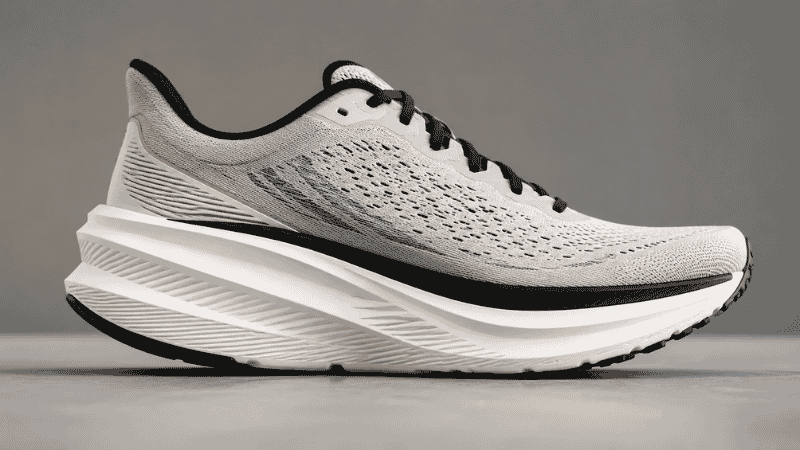
You’ve seen them. The thick-soled, aggressively shaped shoes that look almost comically futuristic — and cost as much as a car payment. Elite runners wear them. Your faster running friends swear by them. You’ve read that they can improve performance by 4% or more, which sounds significant but also sounds like exactly what a shoe brand would put in a press release.
So the question sitting in the back of your mind, the one that brought you here, is: are carbon plate running shoes actually worth it for someone like you? Not an Olympian. Not a Boston Qualifier. Just a person who runs a few times a week, cares about improving, and is wondering whether $250 shoes represent genuine performance gains or just very expensive placebo.
The honest answer is: it depends on one number — your pace — and one decision — whether you’ll use them correctly. Most guides skip both of those things in a rush to show you a product list. This one doesn’t.
Key Takeaways
- Carbon plate running shoes — often called “super shoes” — use a stiff carbon fiber plate embedded in a highly responsive foam midsole to improve running economy by reducing energy loss at the ankle joint.
- Research published in the British Journal of Sports Medicine confirmed an average 4% improvement in running economy for trained runners wearing advanced footwear technology — roughly 2–3 minutes in a half marathon for a runner averaging 1:45.
- The pace threshold matters. Multiple studies suggest the running economy benefit is most significant for runners completing a kilometer in under 4:30 (approximately 7:15 per mile). At slower paces, the stiffness of the plate may work against your natural mechanics.
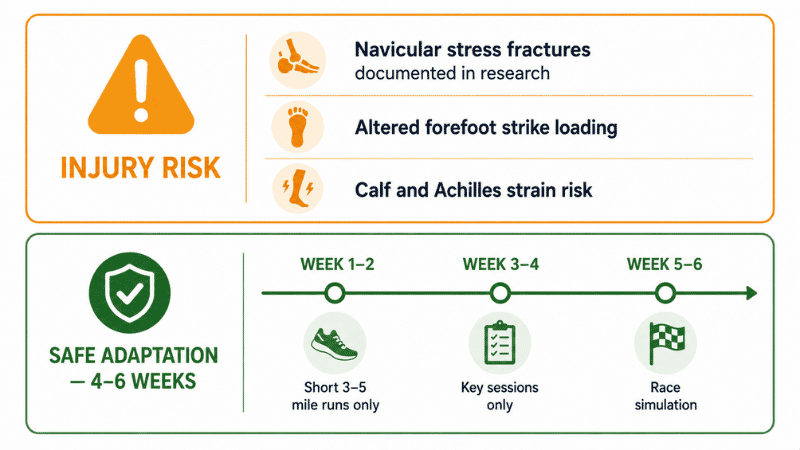
- Carbon plate shoes typically last 150–300 miles before losing their performance properties — significantly shorter than training shoes and a major factor in their true cost-per-use.
- Using carbon plate shoes for training is a common and expensive mistake. Most experienced runners reserve them for race day and key workouts only.
- A growing body of research, including a case series published in Sports Medicine, has identified an association between carbon plate shoes and specific bone stress injuries — particularly navicular stress fractures — in runners who transitioned too quickly.
What Carbon Plate Running Shoes Actually Do
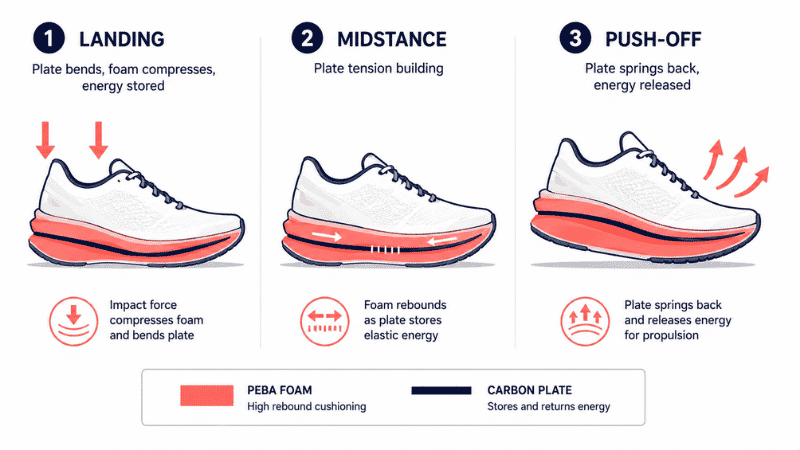
The name implies the carbon plate is the main event. It’s not — not entirely. The real innovation in modern super shoes is the combination of two technologies working together: a highly responsive foam and a stiff plate that changes how energy moves through your foot.
Here’s what’s happening mechanically. When your foot lands during running, the ankle joint dorsiflexes — the foot flexes upward relative to the shin — and then plantarflexes during push-off. Each of these movements involves tendons, muscles, and connective tissue stretching and contracting. Some energy is stored in this system and returned. Some is lost as heat and mechanical inefficiency.
The carbon plate (or nylon plate in some models) sits in the midsole and resists this bending. Instead of allowing the foot to fully flex at the ankle joint during the gait cycle, the plate routes that energy through a springboard mechanism — storing it during landing and releasing it more efficiently during push-off. Combined with highly responsive PEBA foam (used in Nike ZoomX, Adidas Lightstrike Pro, ASICS FF Turbo+) that returns a much higher percentage of impact energy than standard EVA, the result is a shoe that makes each stride measurably more efficient.
The 4% running economy figure from research is real. For a runner completing a half marathon in 1:45, a 4% improvement translates to roughly 4 minutes. That’s significant. For a runner completing the same distance in 2:30, a 4% improvement translates to 6 minutes — but the actual benefit may be less because the plate’s mechanics are most efficient at faster running velocities.
Do Carbon Plate Running Shoes Make You Faster? The Honest Answer
For most recreational runners: yes, but conditionally.
Research on non-elite runners found that carbon fiber plate midsoles did improve running performance compared to standard shoes, with runners also transitioning to a forefoot strike pattern while wearing them — a pattern associated with faster running. This isn’t just an elite-level benefit.
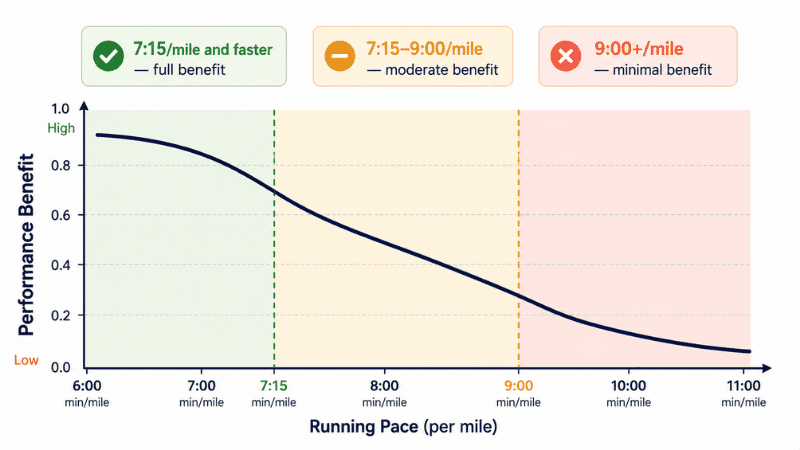
However, the magnitude of the benefit scales with your pace. The plate’s mechanical advantage works most efficiently when foot turnover is fast enough for the spring-and-release cycle to operate optimally. At slower paces, the plate may feel stiff and unresponsive rather than propulsive — and if your natural gait is altered in ways your body isn’t conditioned for, the risk of injury increases without proportional performance gains.
A practical pace guideline: Runners who complete a kilometer in under 4:30 (roughly 7:15 per mile or faster) are most likely to experience the full documented benefit. Runners between 4:30–5:30/km (7:15–8:50 per mile) will likely notice some benefit, particularly in reduced leg fatigue at the end of longer efforts. Runners slower than 5:30/km may find the plate feels more like a liability than an asset — stiffening the foot’s natural mechanics without providing the spring that makes the technology work.
This doesn’t mean slower runners can’t wear carbon plate shoes or won’t enjoy them. It means the cost-benefit analysis changes significantly as pace decreases.
The Usage Mistake That Turns a $250 Investment into $250 Wasted
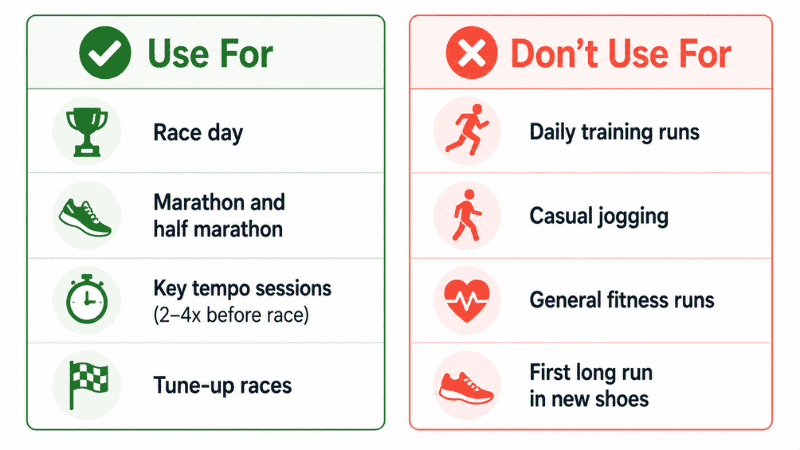
The most common carbon plate running shoe mistake — and the one most responsible for the “they wore out so fast” complaints across running communities — is using them for regular training.
Carbon plate shoes are not built for daily training mileage. The PEBA foam compounds that provide exceptional energy return are less resilient than the EVA foam in training shoes. They compress faster, degrade faster, and lose their performance properties at a rate that makes daily training use economically irrational.
Most serious runners and coaches recommend reserving carbon plate shoes for:
Race day. The primary use case. Running a half marathon, marathon, or competitive 5K in your super shoes means those 150–300 miles of effective life are concentrated entirely in your most important efforts.
Race-specific key workouts. Long tempo runs, race-pace intervals, and goal-pace long runs are appropriate occasions to practice in your race shoes, so you’re adapted to the mechanics on race day. Limit this to 2–4 sessions before a major race.
Tune-up races. If you race frequently, smaller tune-up events are good opportunities to accumulate miles in the shoe and assess how your body responds.
What this means practically: if you buy a $250 carbon plate shoe and run 25 miles per week in it, you’ll blow through it in 6–12 weeks and have spent roughly $4 per mile on footwear. If you use it only for one marathon and related race-specific sessions, you might run 80–100 miles in it before the race, preserve it for the event, and get considerably better value.
Editor’s note: The “save them for race day” advice used to feel excessive to me until I wore my carbon racers for three months of regular training, felt them go dead right before my target race, and had to decide between racing in depleted shoes or scrambling for a new pair. Don’t do what I did.
Carbon Plate Running Shoes and Injury Risk: What the Research Actually Says
This is the part that most brand-sponsored content quietly ignores.
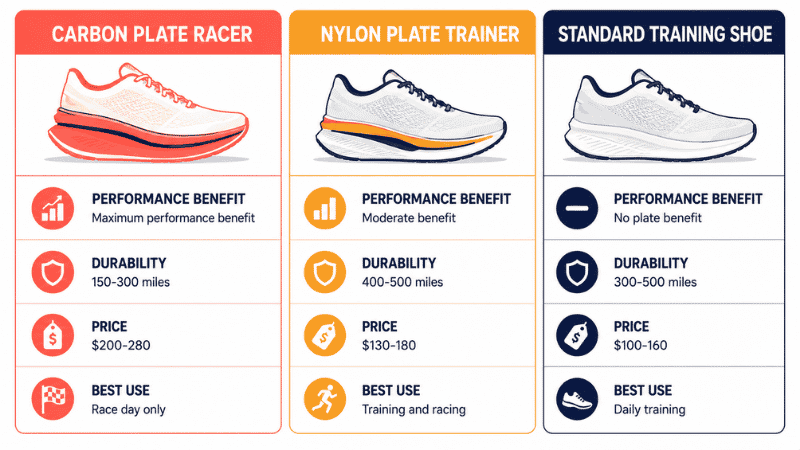
Research published in Sports Medicine documented bone stress injuries — specifically navicular stress fractures — in highly competitive running athletes associated with carbon fiber plate footwear use. The researchers noted that the altered biomechanics produced by the plate, including changes to foot and ankle mechanics, may transfer load to areas of the foot not conditioned for that loading pattern.
The navicular is a small bone on the inner side of the foot. Stress fractures there are notoriously slow to heal. In the documented cases, runners had transitioned to carbon plate shoes without adequate adaptation time.
The injury risk is real, and it’s driven by two factors:
Changed mechanics. Carbon plate shoes encourage a forefoot strike pattern. Runners accustomed to heel striking who put on carbon plate shoes and immediately change their gait without conditioning their calves, Achilles, and forefoot structures for that loading pattern are setting themselves up for overuse injury.
Stiffness in the wrong places. The plate prevents the foot from moving naturally through some of its range. For runners with existing foot conditions — stress fractures, plantar fasciitis, metatarsal issues — a rigid plate may concentrate load rather than distribute it.
Adaptation protocol: If you’re new to carbon plate shoes, don’t use them for your first long run in the lead-up to a race. Start with short efforts (3–5 miles) to assess how your calves and feet respond. Give yourself 4–6 weeks of occasional use before relying on them for a major effort.
See a sports medicine physician before using carbon plate shoes if: You have a history of bone stress injuries, navicular or metatarsal stress fractures, plantar fasciitis, or any current foot pain. The altered mechanics of a plated shoe can aggravate existing conditions.
Who Should Buy Carbon Plate Running Shoes
Strong yes:
- Runners who compete in timed races and care about their finish time
- Anyone running a half marathon, marathon, or competitive shorter race
- Runners at 7:15/mile or faster who will notice the full mechanical benefit
- Experienced runners who understand how to adapt to new shoes gradually
Conditional yes:
- Runners at 8:00–9:00/mile who run occasional races and want to experience reduced leg fatigue in the final miles
- Beginners who’ve been running consistently for 6+ months and want race-day gear for their first official event
- Runners with a specific goal race and a budget for race-specific footwear
Probably not:
- Runners who primarily run for fitness and don’t race
- Beginners in their first few months of running — the altered mechanics require an existing baseline of foot and calf conditioning
- Runners dealing with any active foot injury
- Anyone who would use them for all daily training miles (the cost-per-mile doesn’t work out)
Carbon Plate vs Non-Plated Racing Shoes: Is There a Middle Ground?
Yes — and it’s worth knowing about, because it’s where the better value often lives for recreational runners.
Several brands make “plated trainer” or “super trainer” models that use a nylon plate (softer and more flexible than carbon) with highly responsive foam. These provide a meaningful portion of the performance benefit with more durability and more forgiving mechanics:
Hoka Mach X2 — nylon plate, responsive foam, significantly more durable than true carbon racers. Appropriate for training use. Around $180.
Saucony Endorphin Speed 4 — nylon plate, PWRRUN PB foam, excellent versatility between training and racing. Around $160.
Adidas Adizero SL2 — lighter plate with Lightstrike Pro foam, more affordable entry into the plated shoe category. Around $130.
These shoes won’t give you the full 4% running economy improvement of a top-tier carbon racer, but they’ll give you a meaningful improvement at lower cost and better durability. For most recreational runners racing once or twice a year, a quality plated trainer used for races and key sessions may offer better overall value than a $250 carbon racer reserved for race day only.
The Specific Models Worth Knowing About
For serious racers:
- Nike Alphafly 3 — the gold standard for marathon racing, ZoomX foam plus carbon plate, $285. Exceptionally fast but also exceptionally expensive and low durability.
- ASICS Metaspeed Sky Paris — fastest ASICS racer, FF Turbo+ foam, excellent for any race distance, $250.
- Adidas Adizero Adios Pro 3 — excellent marathon racer, slightly lower stack than Nike/ASICS top models, $230.
- Saucony Endorphin Pro 4 — best value among true carbon racers, PWRRUN HG foam, $225.
For recreational runners who want to try the technology:
- Brooks Hyperion Max — nylon plate, DNA FLASH foam, much more durable than carbon racers, $150. Better as a daily trainer that also works for races.
- New Balance FuelCell SuperComp Trainer v2 — designed for training mileage in a plated shoe, $175. The most durable option in the plated shoe category.
If You’ve Tried Carbon Plate Shoes and They Didn’t Feel Right
This is more common than the marketing suggests. Some runners find carbon plate shoes feel awkward, stiff, or actually slower than their regular training shoes. Usually this means one of three things:
Your pace and mechanics aren’t yet at the threshold where the plate works efficiently. The spring-and-release mechanism requires a certain pace and foot turnover rate to work as designed. At slower paces, the stiffness is more noticeable than the propulsion.
You need adaptation time. The changed mechanics — particularly the forefoot strike encouragement — take time for calves and Achilles to adjust to. If they felt wrong after one run, give it 3–4 short sessions before concluding they’re not for you.
The specific model doesn’t suit your foot. Carbon plate shoes vary significantly in their geometry, stack height, toe box shape, and the aggressiveness of their rocker. Nike Alphafly feels very different from Saucony Endorphin Pro, which feels different from ASICS Metaspeed. Finding the right model may require trying multiple options.
Frequently Asked Questions
Are carbon plate running shoes worth it for recreational runners? For recreational runners who race regularly and run at or near 7–9 minute mile pace, yes — with the caveat that they should be reserved for racing and key sessions rather than daily training. For runners who don’t race or run primarily for fitness, the cost-per-mile calculation usually doesn’t justify the investment.
Do carbon plate shoes make you run faster? Research confirms they improve running economy (efficiency), which translates to faster times for a given effort level. The effect is most significant for faster runners and diminishes at slower paces. For recreational runners completing a half marathon or marathon, reduced leg fatigue in the final miles is often a more noticeable benefit than outright speed.
How long do carbon plate running shoes last? 150–300 miles before losing meaningful performance properties — significantly shorter than training shoes. At $200–280, this means a cost of $0.70–1.90 per mile. Daily training use makes this economically untenable; race-only use spreads the cost much more reasonably.
Can carbon plate shoes cause injury? There is documented evidence of bone stress injuries — particularly navicular stress fractures — associated with rapid transition to carbon plate footwear. The altered mechanics encourage forefoot striking, which loads the calf, Achilles, and forefoot structures differently than heel striking. Gradual adaptation over 4–6 weeks before using them for major efforts reduces this risk.
What’s the difference between carbon plate and nylon plate running shoes? Carbon plates are stiffer and provide a more pronounced spring-and-release effect, delivering more of the performance benefit but with more rigid mechanics. Nylon plates are more flexible, producing a more subtle effect that’s easier to adapt to, with better durability. Nylon-plated shoes (Hoka Mach X, Saucony Endorphin Speed) are better for daily training and serve as a middle ground between standard shoes and carbon racers.
The Bottom Line
Carbon plate running shoes are real technology that delivers real performance benefits — but they’re not magic shoes that make every runner faster automatically. The benefits scale with pace, require correct usage (not daily training miles), and come with injury risks that deserve honest consideration.
If you race seriously and run at 7:30/mile or faster, a carbon plate shoe on race day is a legitimate investment that the evidence supports. If you’re a recreational runner who races occasionally at a 10+ minute mile pace, a quality nylon-plated trainer may deliver similar experiential benefits at lower cost and better durability.
Whatever you choose, don’t make the mistake of treating them as training shoes. Reserve them for when they matter, adapt to their mechanics gradually, and replace them when the snap is gone — not when the outsole is worn.
For more context on how running shoe foam degrades and when to replace any pair — carbon or otherwise — our running shoe lifespan guide covers the mechanics of foam compression and mileage tracking in detail. And if you’re in the market for a beginner’s first pair and wondering whether carbon shoes make sense at that stage, our running shoes for beginners guide gives you a straightforward answer.
References
- Barnes, K.R., & Kilding, A.E. “A randomized crossover study investigating the running economy of highly-trained male and female distance runners in marathon racing shoes versus track spikes.” Sports Medicine, 2019.
- Hoogkamer, W., et al. “A comparison of the energetic cost of running in marathon racing shoes.” Sports Medicine, 2018.
- Tenforde, A., et al. “Bone stress injuries in runners using carbon fiber plate footwear.” Sports Medicine, 2023.
- Reynolds, S., et al. “The effect of carbon fiber plated midsoles on the biomechanics of non-elite runners.” International Journal of Exercise Science, 2022.
- Madsen, L.L., et al. “Persistent improvements in running economy with advanced footwear technology during prolonged running in trained male runners.” Scandinavian Journal of Medicine & Science in Sports, 2025.
- American College of Sports Medicine (ACSM). Position Stand on Advanced Footwear Technology. acsm.org