
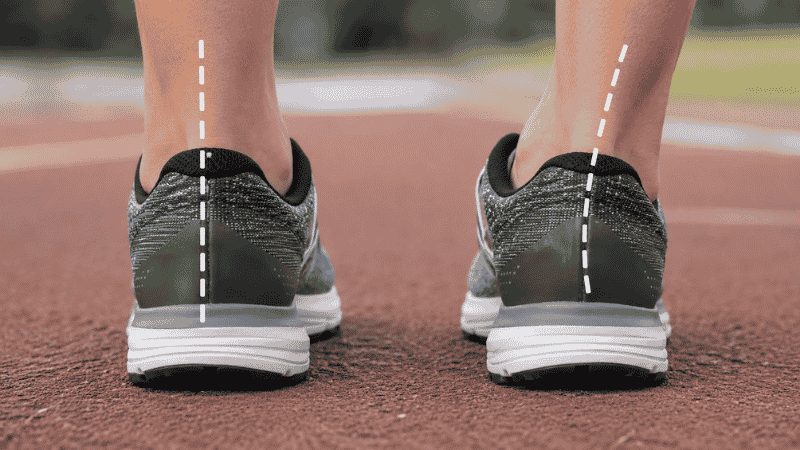
Someone at the running store watched you walk across the floor for thirty seconds and told you that you overpronate. Or you googled your knee pain and “overpronation” kept coming up. Or you’ve just always been told you have flat feet, and now you’re wondering if that’s the same thing as overpronation and whether your shoes are the problem.
Here’s the frustrating reality: most of the information about overpronation shoes is written for people who already understand the biomechanics. The articles assume you know what a medial post is, what GuideRails do, and why motion control shoes exist as a separate category from stability shoes. They skip the part where they explain whether you actually need any of this — or what level of correction your specific situation calls for.
This guide starts from scratch. What overpronation actually is, how to tell if you have it and how severe it is, what different types of overpronation shoes actually do differently, and — critically — when a stability shoe genuinely helps versus when it’s just extra shoe you don’t need. Because putting a motion control shoe on someone with mild overpronation is its own kind of mistake, and it happens constantly.
Key Takeaways
- Overpronation means your foot rolls excessively inward during the walking or running gait cycle — beyond the normal 15% inward roll that healthy gait includes.
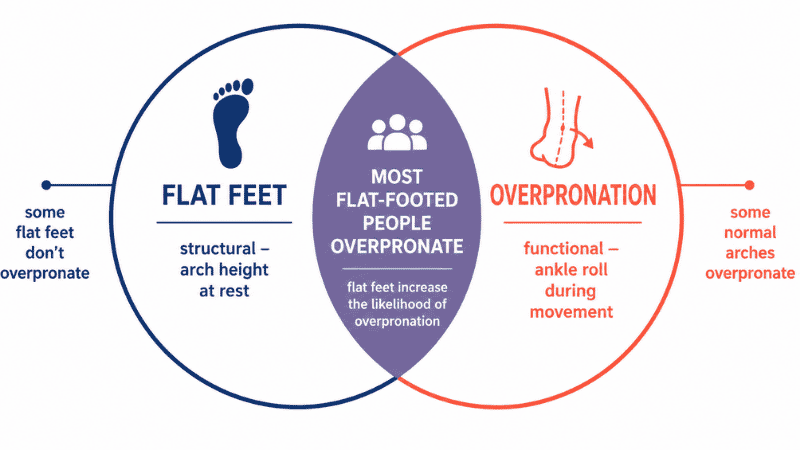
- Flat feet and overpronation are related but not identical. You can have flat feet without significant overpronation, and some people with normal arches still overpronate under running load.
- The degree of overpronation matters more than its presence. Mild overpronation often responds to a light stability shoe or a supportive insole. Severe overpronation may require motion control shoes or custom orthotics.
- According to research in the British Journal of Sports Medicine, overpronation is associated with significantly higher rates of knee pain, shin splints, and plantar fasciitis in runners — but it’s also important to note that not all overpronators get injured, and not all running injuries are caused by overpronation.
- Stability shoes work by limiting medial collapse — not by forcing your foot into an unnatural position. When matched correctly to your degree of pronation, they reduce the muscular fatigue and joint stress that uncontrolled inward roll creates.
What Is Overpronation? The Explanation Nobody Gives You
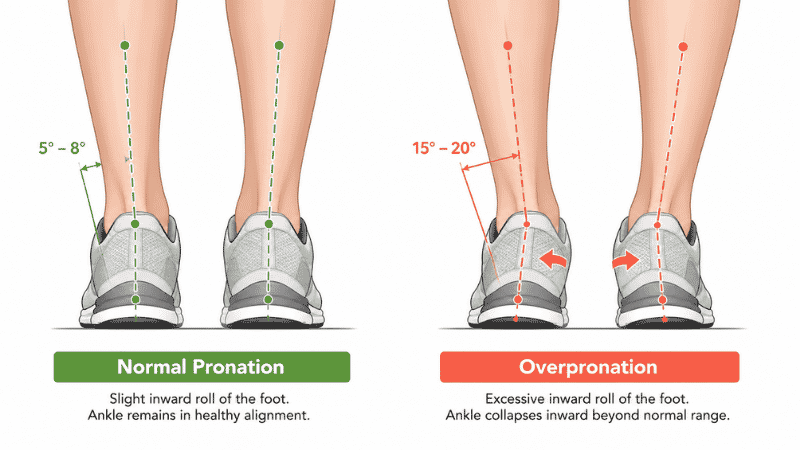
Pronation is not a problem. Pronation is a normal part of how your foot works.
When your heel contacts the ground during walking or running, your foot naturally rolls slightly inward as it flattens to absorb impact. This inward roll — called pronation — is your foot’s shock absorption mechanism. It’s supposed to happen. A foot that doesn’t pronate at all (called supination or underpronation) is actually a less efficient shock absorber and creates its own set of problems.
The issue is excess pronation — when the inward roll goes further than the foot can control efficiently. When that happens, several things occur simultaneously: the ankle rolls inward past its stable range, the tibia internally rotates, the knee tracks inward rather than straight, and the hip compensates. Every step with uncontrolled overpronation sends a small misalignment signal up the entire kinetic chain.
Over a few miles, this is inconsequential. Over hundreds of miles, it accumulates as knee pain, shin splints, plantar fasciitis, and IT band issues — the most common running injuries, and the ones most consistently associated with gait mechanics.
The key word is “uncontrolled.” Overpronation that the body can compensate for without generating pain is different from overpronation that’s loading joints and tendons beyond their tolerance. This distinction matters for how aggressively you need to address it.
Signs of Overpronation: How to Tell If You Have It
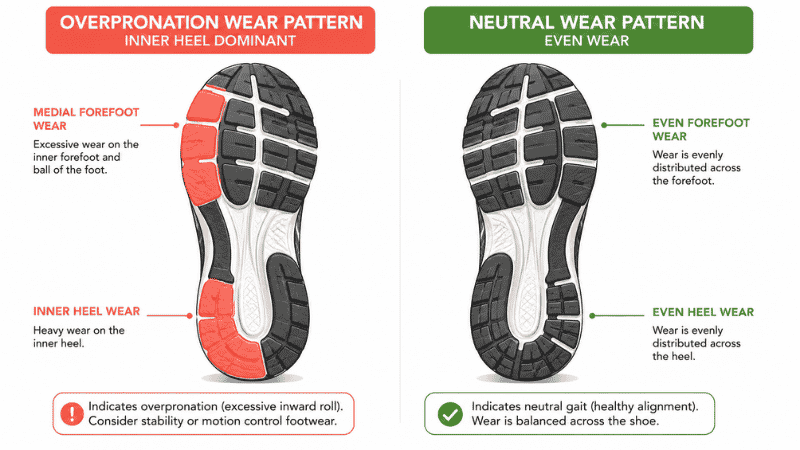
You don’t need a gait lab to get a reasonable assessment of your pronation pattern. Several indicators are available to anyone willing to spend five minutes looking.
The outsole wear test. Look at the bottom of your current shoes — specifically the heel area. Significant wear on the inner heel edge (medial side) indicates that your heel is striking and collapsing inward. If the wear pattern is heavily concentrated toward the inner edge rather than distributed across the heel, you’re likely overpronating. Compare left and right shoes — asymmetric wear often indicates asymmetric pronation.
The wet foot test. Wet your foot and step on dark cardboard. A full footprint with almost no arch curve indicates flat feet — which correlates strongly (though not perfectly) with overpronation. The wet foot test identifies arch structure; your wear pattern tells you what that arch actually does under load.
The standing ankle check. Stand in front of a mirror and look at your ankles from the front. If your ankles lean noticeably inward — the inner ankle bone appears lower and the outer ankle bone appears higher — your foot is collapsing. This is often most obvious when you stand on one foot.
The running video test. If you have a smartphone, have someone film you running from behind for 30 seconds. Watch the ankle position as each foot lands. Normal pronation shows a slight inward roll that recovers quickly. Overpronation shows a more pronounced inward collapse that persists through the midstance phase.
The store gait analysis — where someone watches you walk or run on a treadmill — is the most reliable assessment, and most running specialty stores offer it free. If accuracy matters to you (and it should, given that you’re about to buy shoes based on the result), this is worth doing before committing to a stability shoe.
Is Overpronation the Same as Flat Feet?
This is the question that confuses most people, and the answer matters for how you address it.
Flat feet refers to the structure of your arch at rest — specifically, an arch that is low or absent when you’re standing or bearing weight. It’s a structural characteristic visible in both static and dynamic positions.
Overpronation refers to the dynamic behavior of your foot during movement — specifically, how much your ankle rolls inward during the gait cycle. It’s a motion pattern, not a structural characteristic.
The relationship: flat feet and overpronation strongly correlate, but they’re not the same thing. Most people with flat feet overpronate — because a collapsed arch reduces the foot’s mechanical ability to control inward roll. But some people with flat feet have enough surrounding muscle strength to maintain reasonable gait mechanics without excessive pronation. And some people with normal or high arches still overpronate under running load, because the issue is muscle strength and control rather than structural arch height.
This is why buying a stability shoe simply because you have flat feet — without assessing your actual pronation pattern — sometimes results in shoes that don’t help. And it’s why some people with flat feet do fine in neutral shoes if they’re not actually overpronating significantly under load.
The practical takeaway: use both the wear pattern and the wet foot test together. Flat arch + significant inner heel wear = you almost certainly overpronate and need stability support. Flat arch + even heel wear = your flat feet may not be producing significant overpronation, and a lighter intervention may be sufficient.
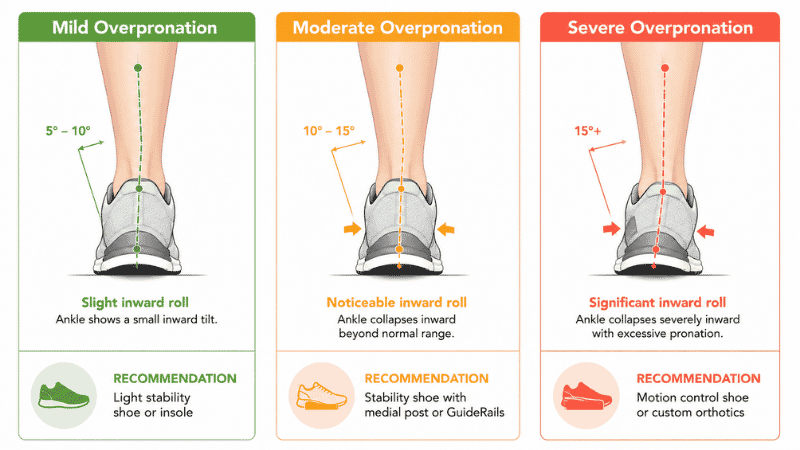
Levels of Overpronation: Mild, Moderate, and Severe
This is the distinction that virtually no guide makes, and it’s the most important thing to understand before buying a shoe.
Overpronation exists on a spectrum. Putting someone with mild overpronation in a motion control shoe — the maximum-correction category — is like wearing a cast for a bruise. The over-correction creates its own mechanical stress and often produces new discomfort. Getting the correction level right matters as much as getting the shoe category right.
Mild Overpronation
What it looks like: Slight inner heel wear. Ankle rolls inward noticeably but not dramatically during gait analysis. Foot returns to neutral relatively quickly after landing. May or may not produce symptoms.
What it needs: A light stability shoe or a supportive neutral shoe with a good aftermarket insole. The goal is mild medial support — enough to reduce the inward roll without overcorrecting.
Good options: Brooks Ghost with a Superfeet Green insole, ASICS Gel-Nimbus (neutral but structured), New Balance Fresh Foam 860 (light stability), Saucony Guide.
Moderate Overpronation
What it looks like: Clear inner heel wear, often extending to inner forefoot. Visible ankle collapse in walking gait. Likely produces some symptoms — knee discomfort, shin soreness, or arch fatigue after longer runs or walks.
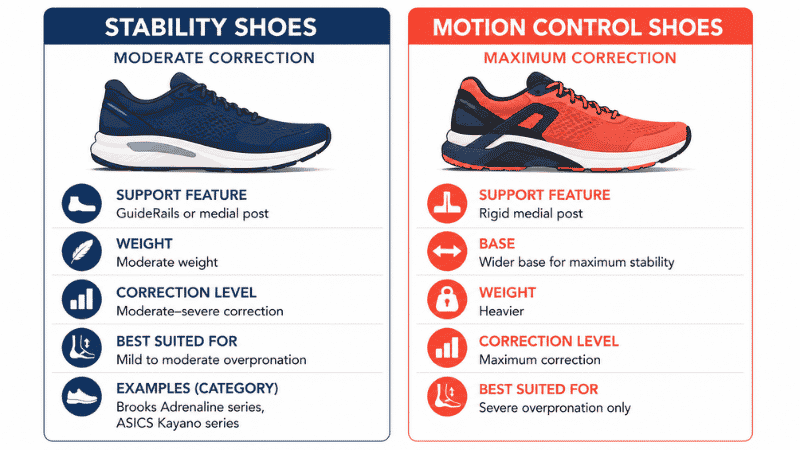
What it needs: A proper stability shoe with a medial post or GuideRails — a firmer section of midsole foam on the inner side that physically resists the inward roll. This is the most common level of overpronation and the category most stability shoes are designed for.
Good options: Brooks Adrenaline GTS (the most widely used stability shoe for moderate overpronation), ASICS GT-2000 or Gel-Kayano (slightly more aggressive medial support), New Balance 860v14, Saucony Guide 18.
Severe Overpronation
What it looks like: Heavy inner wear that extends well beyond the heel. Significant visible ankle collapse — the inner ankle bone may appear nearly touching the floor. Usually produces clear symptoms: persistent knee pain, significant arch pain, shin splints.
What it needs: Motion control shoes — the highest correction category, with a rigid medial post, wider base, and reinforced heel counter. These are substantially heavier and stiffer than standard stability shoes, which is why they’re inappropriate for mild overpronation.
Good options: Brooks Beast (men) or Brooks Ariel (women), ASICS Gel-Foundation, New Balance 928. For severe overpronation, custom orthotics prescribed by a podiatrist are often the most effective intervention — they provide precisely calibrated correction that over-the-counter shoes can only approximate.
Overpronation Shoes for Running vs Walking
The shoe requirements differ meaningfully between these two activities, and using the same shoe for both isn’t always optimal.
For running: The impact forces are higher (2–3x body weight vs 1–1.5x for walking), which means the medial post needs to work harder and the midsole structure needs to maintain its integrity at higher loads. Running-specific stability shoes are built for this — they’re designed to provide correction through the entire running gait cycle including the push-off phase. Brooks Adrenaline GTS, ASICS Gel-Kayano, and New Balance 860 are the most consistently recommended across different levels of overpronation for running.
For walking and all-day wear: The forces are lower and the gait cycle is different. A walking shoe with medial support doesn’t need the same structural aggressiveness as a running shoe. Many people with overpronation find that a supportive walking shoe with a quality insole is sufficient for all-day wear, even if they need a more structured shoe for running. Our walking shoes for flat feet section covers the walking-specific options in more detail.
Overpronation Insoles: When the Shoe Isn’t Enough
For people whose overpronation is at the mild-to-moderate boundary, or who have an otherwise good shoe that lacks adequate medial support, aftermarket insoles can be a highly effective and cost-efficient intervention.
Superfeet Green is the most widely used over-the-counter insole for overpronation. The semi-rigid base provides meaningful arch support without the aggressiveness of a full medial post. Works well in neutral shoes to add mild stability correction.
Powerstep Pinnacle provides arch support with slightly more cushioning than Superfeet — useful if your overpronation is paired with general foot fatigue or plantar fasciitis symptoms.
Tread Labs Stride offers a more aggressive arch post for moderate overpronation — closer to what a stability shoe’s medial post provides, but in insole form. Useful for people who need moderate correction in shoes that don’t come in stability versions (dress shoes, certain work shoes).
Important caveat: insoles work best when placed in a shoe that’s structurally appropriate. Adding a stability insole to an already motion-control shoe creates over-correction. Adding one to a neutral shoe that otherwise fits well is the correct use case.
For severe overpronation, custom orthotics from a podiatrist are substantially more effective than any over-the-counter insole — they’re molded to your specific foot mechanics rather than designed for a general population range.
The Brands That Do Stability Best (And Why)
Brooks for Overpronation
Brooks’ GuideRails system is the most refined stability technology currently available in a mainstream running shoe. Unlike traditional medial posts — which are simply a firmer wedge of foam — GuideRails are external rails that guide the heel through the gait cycle, limiting excess motion without forcing the foot into a corrected position.
The practical difference: GuideRails feel less intrusive than medial posts. Many runners who found traditional stability shoes uncomfortable — “they felt like the shoe was fighting my foot” — adapt well to GuideRails. The Adrenaline GTS 25 is the standard recommendation for moderate overpronation; the Glycerin GTS is for people who want maximum cushioning alongside the stability features.
ASICS for Overpronation
ASICS offers a clear progression from light stability to aggressive correction: GT-2000 (moderate), Gel-Kayano (moderate-aggressive), Gel-Foundation (severe). The Gel-Kayano is the most popular in the range — it provides strong medial support, a gel heel unit for longevity, and a 10mm heel drop that benefits overpronators who also have Achilles or plantar fasciitis issues.
New Balance Overpronation
New Balance’s stability line runs from the 860 (moderate) through the 928 (severe/motion control). Their genuine width engineering (2E, 4E options in most stability models) makes them the most reliable choice for overpronators who also have wide feet — a common combination, since flat feet tend to spread laterally under load.
Hoka for Overpronation
Hoka’s stability offering is centered on the Arahi — which uses J-Frame technology, a firmer foam on the inner midsole. It’s less aggressive than Brooks’ GuideRails or ASICS’ traditional medial post, making it appropriate for mild-to-moderate overpronation. The Gaviota provides more stability for moderate cases while maintaining Hoka’s characteristic cushioning stack.
Editor’s note: Hoka’s stability shoes are often better tolerated by people who found traditional stability shoes too rigid — the softer overall construction makes the correction feel less mechanical.
If You’ve Been Running in Neutral Shoes for Years Without Injury
This comes up constantly in running communities: “I just found out I overpronate, but I’ve been running in neutral shoes for five years without any problems — do I need to change?”
The honest answer: probably not, if you’re genuinely symptom-free.
Overpronation is a risk factor for injury, not a guarantee of it. Some people with significant overpronation run successfully in neutral shoes for years because their muscles and connective tissue have adapted to compensate. If your gait is producing no pain, no chronic soreness, and no recurring injuries, your body may be managing the mechanics adequately.
Where this changes: if you’re increasing your mileage, starting a more demanding training program, returning after time off, or getting older (joint and tendon resilience decreases with age), existing compensation strategies may start to fail. Many runners discover their overpronation when they push volume beyond what their compensatory mechanisms can handle.
The practical recommendation: if you’re injury-free, don’t change shoes just because someone tells you that you overpronate. If you start developing recurrent knee pain, shin issues, or arch problems, that’s when reassessing your footwear makes sense.
When Overpronation Shoes Alone Aren’t Enough
Shoes correct the mechanical expression of overpronation — the inward roll — but they don’t address the underlying causes. For many people, overpronation is partly or largely driven by weakness in the hip abductors, glutes, and intrinsic foot muscles. These muscles are supposed to control lower limb alignment during the gait cycle; when they’re weak, the foot compensates by rolling inward.
A stability shoe reduces the roll. Strengthening the underlying muscles reduces why the roll happens in the first place. The combination — appropriate footwear plus targeted strength work — produces better long-term outcomes than either alone, according to research from the Journal of Orthopaedic & Sports Physical Therapy.
See a podiatrist or sports medicine physician if:
- Symptoms persist despite switching to appropriate stability footwear for 6–8 weeks
- Your overpronation appears to be severe enough that over-the-counter options aren’t providing adequate correction
- You have pain that extends beyond the foot — significant knee, hip, or lower back pain associated with running or walking
- Your overpronation is asymmetric — one foot substantially more than the other — as this can indicate a structural issue worth professional assessment
Frequently Asked Questions
What is overpronation and how do I know if I have it? Overpronation is excessive inward rolling of the foot and ankle during the gait cycle, beyond the normal 15% inward roll that healthy mechanics include. Signs include inner heel wear on your current shoes, a flat arch imprint on the wet foot test, and visible ankle collapse when standing or running. A free gait analysis at a running specialty store is the most reliable assessment.
Do I need stability shoes if I overpronate? It depends on severity and symptoms. Mild overpronation without symptoms may not require any correction. Moderate overpronation producing knee pain, shin splints, or arch fatigue typically benefits from a stability shoe with medial support. Severe overpronation usually requires motion control shoes or custom orthotics.
Are flat feet the same as overpronation? Related but not identical. Flat feet describe arch structure; overpronation describes gait mechanics. Most people with flat feet overpronate, but not all — and some people with normal arches overpronate due to muscle weakness rather than structural arch issues. Assess both your arch structure and your wear pattern together for the most accurate picture.
What’s the difference between stability shoes and motion control shoes for overpronation? Stability shoes (Brooks Adrenaline GTS, ASICS Gel-Kayano) provide moderate medial support suitable for mild-to-moderate overpronation. Motion control shoes (Brooks Beast, ASICS Gel-Foundation) provide maximum correction with rigid medial posts and wider bases, appropriate for severe overpronation. Using motion control shoes for mild overpronation creates over-correction and its own discomfort.
Can overpronation be fixed permanently? Not structurally — if you have flat arches, the structure doesn’t change. But the functional consequences can be significantly improved through a combination of appropriate footwear, quality insoles, and targeted strengthening of hip abductors, glutes, and intrinsic foot muscles. Many runners with significant overpronation manage it successfully long-term and run without pain.
The Bottom Line
Overpronation shoes work — when matched to the right degree of overpronation. The mismatch problem goes both ways: under-correcting leaves the mechanical issue unaddressed, while over-correcting creates new stress patterns that cause their own discomfort.
Start with an honest assessment of your severity. Check your wear pattern. Do the wet foot test. If possible, get a free store gait analysis. Then match the shoe’s correction level to what you actually need — not the most aggressive option available, not a neutral shoe with an insole if your overpronation is genuinely significant.
If you’re still figuring out whether flat feet are driving your overpronation, our flat feet and high arches guide covers the relationship in full detail. And if you’re experiencing knee pain that might be related to overpronation, our guide on knee pain after running explains exactly how the kinetic chain from foot mechanics to knee joint works.
References
- Taunton, J.E., et al. “A retrospective case-control analysis of 2002 running injuries.” British Journal of Sports Medicine, 2002.
- Nigg, B.M., et al. “The role of footwear on foot and lower limb biomechanics.” Footwear Science, 2015.
- Barton, C.J., et al. “Biomechanical gait retraining for patellofemoral pain syndrome.” Journal of Orthopaedic & Sports Physical Therapy, 2011.
- American Podiatric Medical Association (APMA). Overpronation and Supination. apma.org
- Nielsen, R.O., et al. “Foot pronation is not associated with increased injury risk in novice runners wearing a neutral shoe.” British Journal of Sports Medicine, 2014.
- Rome, K., et al. “Efficacy of insoles for the treatment of plantar heel pain.” Journal of the American Podiatric Medical Association, 2004.