
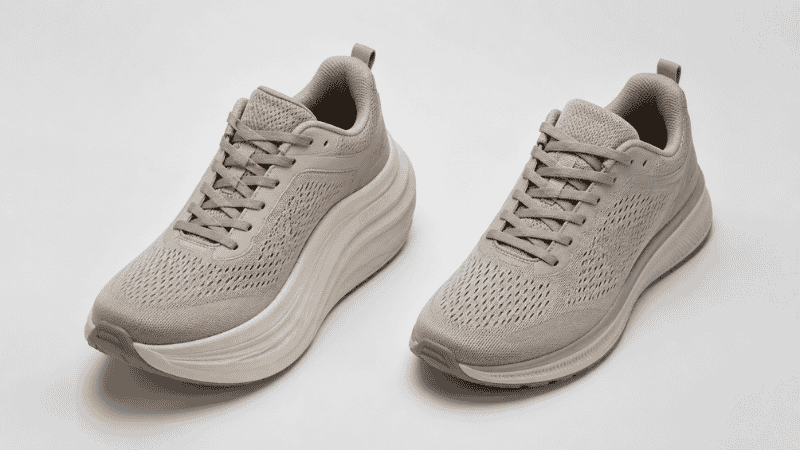
Here’s a scene a lot of people recognize: you’re standing in a shoe store, one Hoka on your left foot, one Brooks on your right. Both feel fine. Both get good reviews. Both cost around the same. And you genuinely cannot decide which one to buy, because every article you’ve read ends with some version of “it depends on personal preference.”
That answer is technically true and completely useless.
The reality is that Hoka and Brooks are built around fundamentally different design philosophies, and those differences matter enormously depending on your foot type, your daily demands, and what you’ve been dealing with shoe-wise. They’re not interchangeable options with minor variations — they solve different problems. For the right person, each one is genuinely excellent. For the wrong person, either can be actively disappointing.
This is an honest comparison of Hoka vs Brooks for walking and all-day wear. Not for competitive runners. Not for ultramarathoners. For people who spend their days on their feet — commuting, working long shifts, walking the city, standing in a classroom — and need to know which shoe is going to hold up and actually feel good by the end of the day.
Key Takeaways
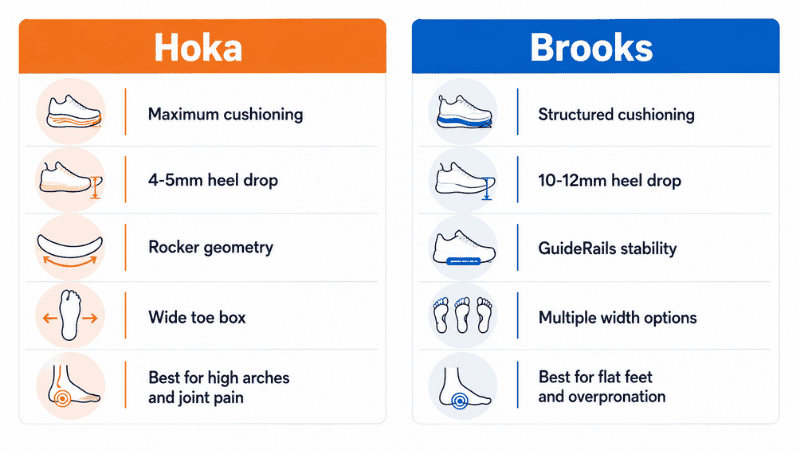
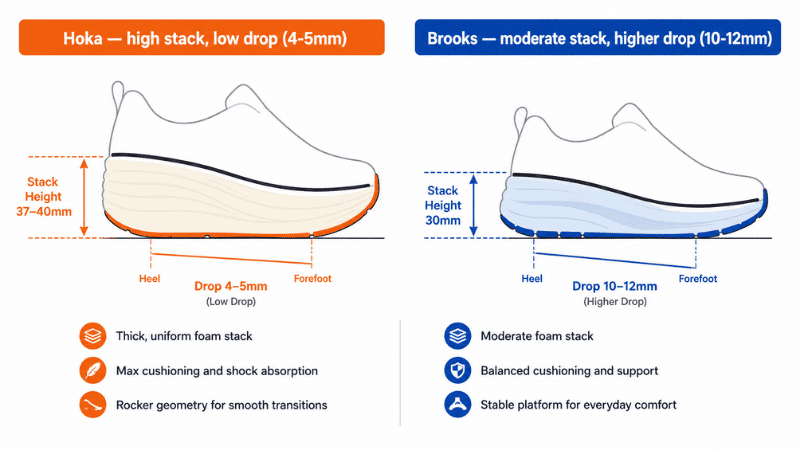
- Hoka’s defining feature is maximum cushioning via a thick, high-stack midsole with a rocker geometry that propels the foot forward. Heel drop is typically 4–5mm — significantly lower than most walking shoes.
- Brooks’ defining feature is structured, responsive cushioning combined with stability options that Hoka largely doesn’t offer. Heel drop typically 10–12mm — more traditional, more familiar underfoot.
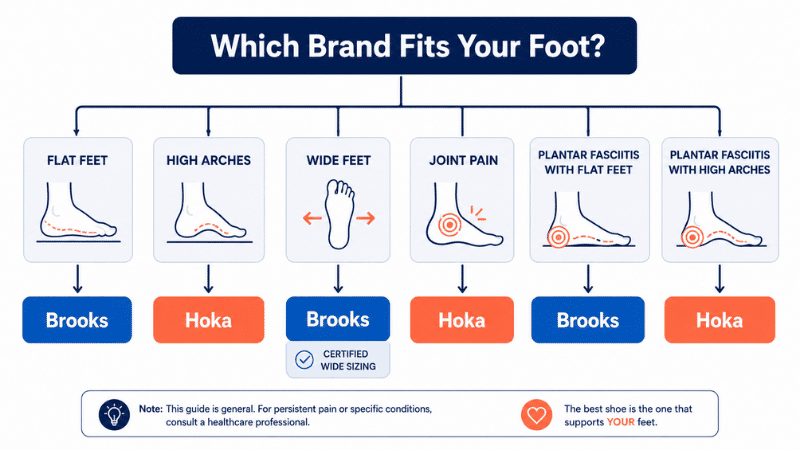
- For flat feet and overpronation: Brooks wins clearly. Its GuideRails and medial post options are purpose-built for this. Hoka’s stability line (Arahi) exists but is narrower in scope.
- For high arches and maximum cushioning needs: Hoka wins. The Bondi’s stack height and neutral geometry suit rigid, high-arched feet better than most Brooks options.
- For wide feet: Hoka generally fits wider by default. Brooks offers more genuine width designations (up to 4E in key models).
- Neither brand universally wins. Anyone telling you otherwise is not accounting for the enormous variation in foot types and use cases.
The Fundamental Difference Nobody Explains Clearly
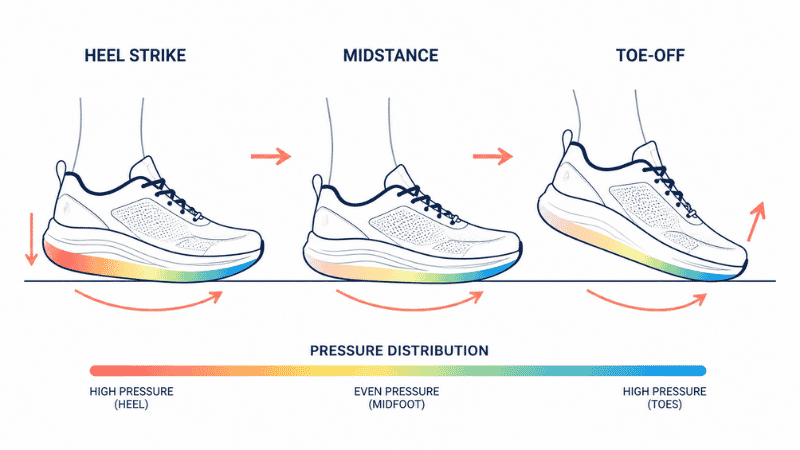
Most comparison articles describe Hoka and Brooks as “both great options with different feels.” That’s accurate but doesn’t help you make a decision. Here’s the actual difference that determines which one belongs on your foot:
Hoka is a cushioning-first brand. Their entire design philosophy starts with maximum foam stack height and builds outward from there. The rocker geometry — the curved sole that rocks from heel to toe — is engineered to reduce peak pressure at any single point during the gait cycle. This is genuinely brilliant for reducing joint stress, and it’s why Hoka became beloved by ultrarunners, healthcare workers, and people with joint pain.
The trade-off: that rocker geometry and thick stack height create a shoe that feels unstable to some people, particularly those who overpronate or have weak ankles. You’re standing on a curved platform, and if your foot mechanics don’t complement that curve, the shoe can feel like it’s fighting you rather than helping you.
Brooks is a support-first brand. Their flagship innovation — GuideRails — is specifically designed to limit excess motion during the gait cycle, particularly the inward collapse (overpronation) that causes knee, hip, and lower back problems downstream. Brooks starts with controlling your foot’s movement through the stride and adds cushioning on top of that structure.
The trade-off: more structured doesn’t automatically mean more comfortable for everyone. People with neutral mechanics or high arches who don’t need motion control may find Brooks feels more restrictive than Hoka — like wearing a shoe with opinions about how your foot should move.
The one-sentence summary: Hoka absorbs impact and propels you forward. Brooks controls your motion and keeps you aligned. You need to know which problem you actually have before you can pick the right solution.
Hoka vs Brooks for Walking: Who Should Choose Each
Choose Hoka if:
You have neutral to high arches. Hoka’s neutral cushioned models (Clifton, Bondi) are ideal for feet that don’t need structural correction. The high stack absorbs the impact a rigid, high-arched foot can’t absorb naturally.
Joint pain is your primary concern. The rocker geometry reduces peak loading at the knee and hip during walking — meaningfully, not just theoretically. Research published in Gait & Posture found that rocker-sole shoes can reduce knee joint loading by up to 19%. If you have knee osteoarthritis, hip problems, or general joint soreness from prolonged walking, Hoka’s geometry is purpose-built for you.
You want maximum cushioning for long shifts. The Bondi is the Hoka model most consistently recommended by healthcare workers, retail staff, and anyone spending 10+ hours on their feet. The foam is thick enough to maintain meaningful cushioning throughout a full shift in a way that most competitors’ shoes don’t.
You prefer a wider, more spacious fit. Hoka’s standard models tend to have a wider toe box than Brooks’ equivalent models. If you’ve found athletic shoes generally feel narrow, Hoka’s geometry often accommodates wider feet without requiring a wide-designated model.
You want something that doesn’t look overtly medical. Hoka’s aesthetic has crossed into mainstream fashion in a way Brooks hasn’t quite managed. If you want a walking shoe that reads as a style choice rather than a therapeutic shoe, Hoka has more options.
Choose Brooks if:
You have flat feet or overpronate. This is the clearest and most important recommendation in this entire article. Brooks’ stability lineup — Adrenaline GTS, Beast, Glycerin GTS — is one of the most developed and refined stability systems in any brand. The GuideRails specifically limit excess inward movement without forcing the foot into an overcorrected position. For flat-footed walkers, this reduces the fatigue cascade that goes from collapsed arch → inward ankle roll → knee stress → lower back ache.
You need wide sizing options. Brooks offers genuine width engineering up to 4E in key models. Their 2E and 4E shoes are built on different lasts — not just wider uppers on the same mold. For men or women who genuinely need extra-wide sizing, Brooks is more reliable than Hoka in this category.
You want a more traditional, grounded feel. Hoka’s rocker and stack height create a sensation that some people love and others find alienating — like walking on a curved platform rather than the ground. Brooks’ higher heel drop and more traditional geometry feels familiar in a way that makes the transition from everyday shoes less dramatic.
You have plantar fasciitis. The higher heel drop in Brooks (10–12mm vs Hoka’s 4–5mm) keeps the plantar fascia in a slightly shortened position during walking, which reduces tension at the attachment point. Combined with Brooks’ heel cushioning and arch support options, this makes Brooks marginally preferable for active plantar fasciitis — though both brands work, and individual response varies.
You need a shoe for professional environments. Brooks offers more models that cross into semi-professional aesthetics — particularly the Addiction Walker in leather finish and various Ghost colorways that read as casual-smart rather than athletic.
Hoka Clifton vs Brooks Ghost: The Direct Comparison
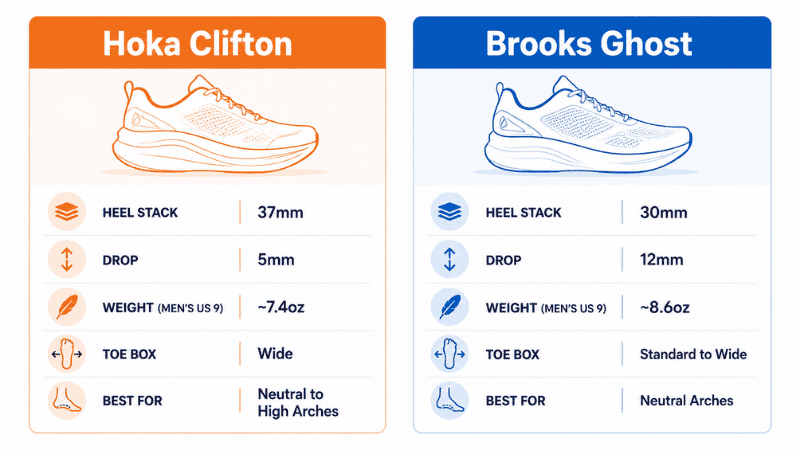
These are each brand’s most popular everyday walking and running shoe — the model people most commonly end up comparing. Both are neutral cushioned shoes without aggressive stability features.
Hoka Clifton 10
- Stack height: 37mm heel / 29mm forefoot
- Heel drop: 5mm
- Weight (women’s 8): ~7.4 oz
- Fit: Slightly wide and roomy in the toe box, true to size in length
- Feel: Soft, bouncy, noticeably propulsive due to rocker geometry
- Best for: Neutral to high arches, joint pain, long walking shifts, people who want plush cushioning
Brooks Ghost 16
- Stack height: 30mm heel / 18mm forefoot
- Heel drop: 12mm
- Weight (women’s 8): ~8.6 oz
- Fit: True to size, standard to slightly narrow toe box, available in narrow/standard/wide/extra-wide
- Feel: Responsive and cushioned but more grounded than Hoka — the heel drop creates a familiar traditional shoe sensation
- Best for: Neutral arches, people transitioning from standard shoes, those who want cushion without the Hoka rocker sensation, wider sizing needs
The verdict between these two: If you currently wear standard athletic shoes and find the Clifton too “floaty” in store, the Ghost will likely feel more immediately comfortable. If you’ve found most shoes feel too firm or create joint pain after long walks, the Clifton’s rocker and stack will likely serve you better. The Ghost also has a clear advantage for wide-footed buyers due to its extra-wide (2E) availability.
Hoka Bondi vs Brooks Glycerin: Maximum Cushion Comparison
Both brands’ flagship maximum-cushion models. This is the comparison for people who want the most shoe possible.
Hoka Bondi 8
- Stack height: 40mm heel / 34mm forefoot (among the highest in any non-racing shoe)
- Heel drop: 4mm
- Weight (women’s 8): ~9.2 oz
- Fit: Wider and higher volume than Clifton — very accommodating
- Feel: The plushest walking shoe from either brand. Substantial, almost marshmallow-soft, with the rocker geometry present but less pronounced than Clifton
- Best for: Maximum joint protection, healthcare workers on concrete, people with severe heel pain or general foot fatigue, high arches
Brooks Glycerin 22 GTS
- Stack height: 35mm heel / 23mm forefoot
- Heel drop: 10mm
- Weight (women’s 8): ~9.1 oz
- Fit: Slightly narrower than Bondi, available in standard and wide
- Feel: Soft but more structured than Bondi — the GTS designation means it has GuideRails, making it the only maximum-cushion stability shoe in this comparison
- Best for: People who want maximum cushioning AND stability — the rare combination of plush and controlled. Particularly effective for flat feet that also need significant cushioning.
The verdict between these two: The Bondi 8 wins on pure cushioning volume, particularly in the forefoot. The Glycerin GTS wins if you have flat feet and want maximum cushioning — it’s the only shoe in this comparison that delivers both. If you have high arches or neutral mechanics and want maximum protection for long shifts, the Bondi is the stronger choice.
Hoka Arahi vs Brooks Adrenaline GTS: Stability Comparison
For people who need motion control — primarily flat-footed walkers and overpronators.
Hoka Arahi 8
- Stability type: J-Frame technology (firmer foam on the inner midsole)
- Heel drop: 5mm
- Fit: Wide toe box, true to size
- Feel: Softer and more cushioned than the Adrenaline, with stability that’s present but less aggressive
- Best for: Mild to moderate overpronation, people who want stability with Hoka’s plush feel
Brooks Adrenaline GTS 25
- Stability type: GuideRails (external rails that limit excess motion without forcing correction)
- Heel drop: 12mm
- Fit: Available up to 2E width, true to size in standard
- Feel: More structured and grounded than Arahi, with more responsive cushioning
- Best for: Moderate to severe overpronation, flat feet, people with knee or hip pain related to gait mechanics
The verdict between these two: For most flat-footed walkers, the Adrenaline GTS is the stronger recommendation. GuideRails is a more sophisticated stability system than Hoka’s J-Frame, the higher heel drop is appropriate for flat feet, and the width options are better. The Arahi is a good choice for people who’ve tried Adrenaline-style shoes and found them too structured — it’s a softer stability experience.
Hoka vs Brooks for Specific Situations
For Nurses and Healthcare Workers
Both brands are popular in healthcare, but for slightly different reasons. Hoka’s Bondi SR (slip-resistant version) is purpose-built for hospital floors with a slip-resistance rating and the full Bondi cushioning stack — making it the most purpose-specific option from either brand for clinical environments.
Brooks’ Addiction Walker is the traditional healthcare shoe choice — more structured, available in very wide sizes (up to 4E), and with a leather option that’s easier to wipe clean. It’s less cushioned than the Bondi SR but more stable for flat-footed healthcare workers.
If you have neutral arches and stand 10+ hours: Hoka Bondi SR. If you have flat feet and need maximum stability for long shifts: Brooks Addiction Walker or Adrenaline GTS.
Our guide on shoes for standing all day covers the full breakdown for healthcare and other standing-intensive professions.
For Plantar Fasciitis
Both brands work for plantar fasciitis, but in different ways. Brooks’ higher heel drop (10–12mm) reduces fascial tension during walking, which is mechanically beneficial for the attachment zone. Hoka’s rocker geometry reduces peak heel impact, which also helps.
The deciding factor is usually foot type: flat feet with PF do better in Brooks stability models. High arches with PF tend to do better in Hoka’s high-cushion neutral models.
Our plantar fasciitis shoes guide covers this in detail, including why some cushioned shoes actually make PF worse.
For Wide Feet
Hoka tends to fit wider by default — the Bondi and Clifton both have notably generous toe boxes in standard width. But for people who need certified wide sizing (2E, 4E), Brooks is more reliable because their width designations reflect genuine last engineering.
If you’re between these situations — your foot is wide but not extreme — try Hoka in standard width first. If you need documented wide sizing, Brooks in 2E or 4E is the safer choice.
Our wide toe box walking shoes guide covers width measurement and brand reliability in detail.
What to Do If You’ve Tried One and It Didn’t Work
This comes up constantly in real user communities, and it’s worth addressing directly.
If Hoka didn’t work for you: The most common complaints are the rocker feeling unstable, the toe box feeling too loose, and the low heel drop causing calf or Achilles soreness for people accustomed to higher-drop shoes. If any of these apply, Brooks’ more traditional geometry is a logical next step — particularly the Ghost (neutral) or Adrenaline GTS (stability).
If Brooks didn’t work for you: The most common complaints are feeling too structured or rigid, the fit being too narrow, and the shoe feeling less “cloud-like” than expected. If cushioning and plushness are your priority and you don’t have overpronation issues, Hoka Clifton or Bondi addresses all three complaints.
If neither worked: The problem may not be the brand — it may be foot type mismatch (wearing neutral shoes with significant overpronation, or vice versa), width issues, or a structural foot condition that requires custom orthotics. Our flat feet vs high arches guide can help identify whether foot type is the underlying issue.
Frequently Asked Questions
Which is better for walking, Hoka or Brooks? It depends on your foot type. For flat feet and overpronation, Brooks’ stability options (particularly the Adrenaline GTS) are better engineered for walking comfort. For neutral to high arches, Hoka’s cushioning and rocker geometry deliver better all-day comfort and joint protection. Neither brand is universally superior for walking — the answer lives in your foot mechanics.
Hoka Clifton vs Brooks Ghost: which should I buy? If you want maximum cushioning with a propulsive, floating feel: Clifton. If you want responsive cushioning with a more grounded, traditional feel and better width options: Ghost. The Ghost also has a 12mm heel drop versus Clifton’s 5mm — if you’re coming from standard shoes, the Ghost will feel more familiar immediately.
Is Hoka or Brooks better for flat feet? Brooks, clearly. Their GuideRails stability system is specifically designed to control the inward motion that flat feet produce. The Adrenaline GTS is one of the most effective over-the-counter solutions for overpronation available. Hoka’s stability options (Arahi) exist but are less developed and less aggressive in their correction.
Why do some people find Hoka makes their feet hurt more? Two common reasons: First, the low heel drop (4–5mm) can strain the Achilles and calf in people accustomed to higher-drop shoes — transitioning too quickly is a common mistake. Second, the rocker geometry creates an unstable sensation for people with weak ankles or significant overpronation, causing the foot to roll in ways that increase rather than decrease strain. Neither is a universal problem — both are foot-type dependent.
Do Hoka and Brooks run true to size? Both brands generally run true to size in length. The main fit difference is width: Hoka’s standard models tend to run slightly wider in the toe box, while Brooks runs standard to slightly narrow in the toe box (though they offer more genuine width options). If you’re between sizes in Brooks, size up half. If you find Hoka’s standard width too roomy, check if your foot actually measures in the wide range before assuming the shoe is wrong.
The Bottom Line
Hoka vs Brooks is not a question with a universal answer — but it’s also not the coin flip most comparison articles make it seem. The decision framework is actually pretty clear once you know what to look for.
Flat feet, overpronation, need for structured support: Brooks. The Adrenaline GTS specifically.
Neutral to high arches, joint pain, maximum cushioning priority, long standing shifts: Hoka. The Bondi for maximum cushion, the Clifton for a lighter version of the same philosophy.
Wide feet, need for extra-wide sizing, plantar fasciitis with flat feet: Brooks for structure and width options.
Toe box room, first-time Hoka buyer, high arches: Hoka Bondi or Clifton in standard width.
If you’re still unsure after reading this, the most useful thing you can do is measure your foot width and identify your arch type before walking into a store. Our foot measurement guide and flat feet vs high arches guide will give you the information you need to walk out with the right brand the first time.
References
- Sobhani, S., et al. “Rocker shoe, minimalist shoe, and standard running shoe: A comparison of running economy.” Journal of Science and Medicine in Sport, 2014.
- Nigg, B.M., et al. “The role of footwear on foot and lower limb biomechanics.” Footwear Science, 2015.
- Hutchins, S., et al. “Biomechanics and motor control of normal and pathological gait.” Journal of Neuroscience Methods, 2009.
- American Podiatric Medical Association (APMA). Athletic Shoe Recommendations. apma.org
- Menant, J.C., et al. “Optimizing footwear for older people at risk of falls.” Journal of Rehabilitation Research & Development, 2008.
- Van Gent, R.N., et al. “Incidence and determinants of lower extremity running injuries in long distance runners.” British Journal of Sports Medicine, 2007.