
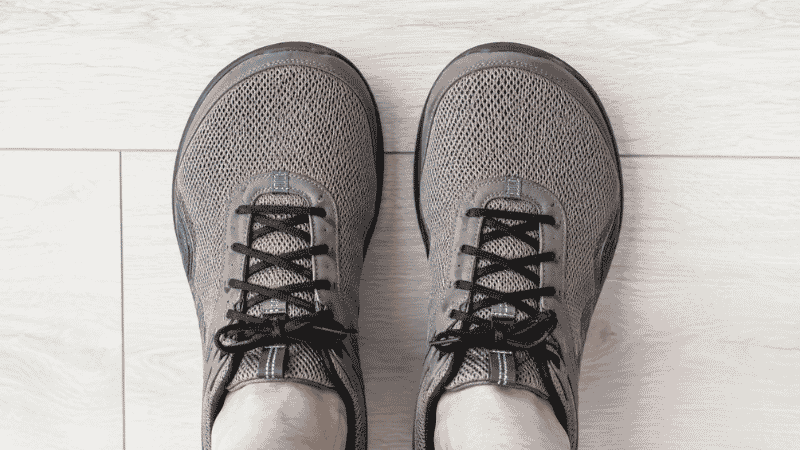
You’ve tried the wide fit. You asked for it specifically, the salesperson brought you a shoe with “W” on the box, you put it on and thought — this still feels exactly the same. Not much roomier. Still pressing on your little toe. Still squeezing the ball of your foot after two hours.
Here’s the thing nobody tells you in the store: “wide fit” is not a standardized measurement. It means different things to different brands. What Nike calls wide, New Balance calls standard. What one brand markets as a generous toe box is still a tapered shape — just tapered slightly less aggressively. And the letter stamped on the box tells you about overall foot width, but nothing about toe box shape, which is often where the real problem is.
Wide feet and wide toe boxes are related but not identical concepts. You can have an average-width foot that still needs a wider toe box because your toes splay when you walk. You can have genuinely wide feet and still find certain “wide” shoes unbearable because the widening happens in the wrong part of the shoe.
This guide will help you figure out which situation you’re actually in, what the width labels really mean, and which walking shoes — for women and men — actually deliver the toe room they promise.
Key Takeaways
- Research published in the Journal of Foot and Ankle Research found that 63–72% of people wear shoes that don’t correctly match their foot width — making fit errors the norm, not the exception.
- “Wide fit” labels are not standardized across brands. The same foot can be standard width in one brand and need a 2E in another.
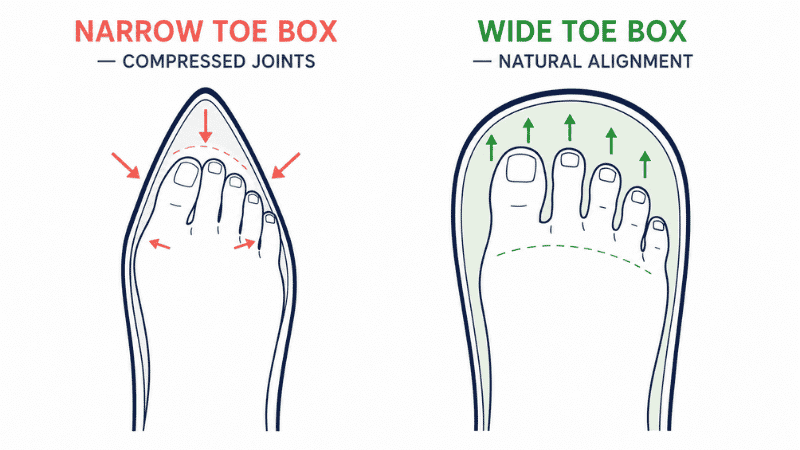
- Toe box shape and overall width are different measurements. A shoe can be wide at the midfoot but still taper at the toes — which is where most people actually need the room.
- The simplest indicator of whether you need a wider toe box: look at your toes after removing your shoes. If they’re compressed inward rather than lying naturally spread, your toe box is too narrow.
- New Balance, Brooks, Altra, and Hoka consistently offer the most reliable wide and extra-wide options in the walking shoe category.
How to Know If You Have Wide Feet (Or Just Need a Wider Toe Box)
Before buying anything, this is the question worth actually answering — because the solution is slightly different depending on which problem you have.
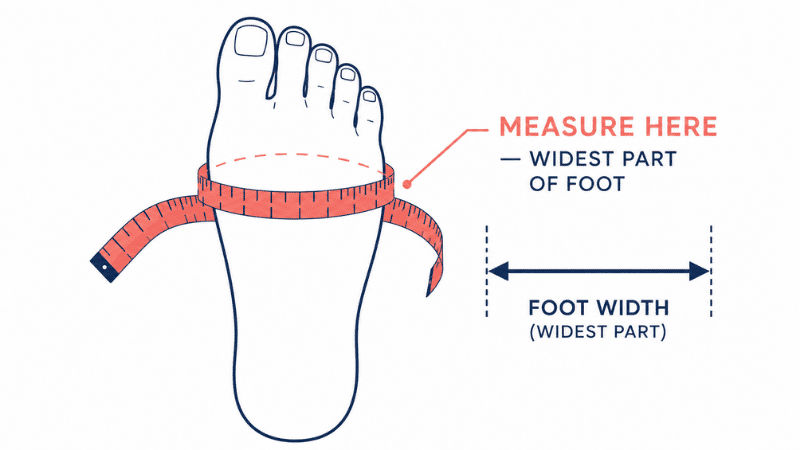
The tape test for foot width: Measure the widest part of your foot across the ball (just behind the base of the toes) using a flexible measuring tape or a strip of paper. Compare to the chart below. This tells you your actual foot width — not the width of your shoes, not what you’ve always assumed.
| Foot Width (mm) | Men’s Width | Women’s Width |
|---|---|---|
| Under 90mm | Narrow (2A/B) | Narrow (2A) |
| 90–97mm | Standard (D) | Standard (B) |
| 97–103mm | Wide (2E) | Wide (D) |
| 103mm+ | Extra Wide (4E) | Extra Wide (2E) |
If your measurement puts you in wide or extra-wide territory, you genuinely need shoes offered in those widths — not just shoes described as “roomy” or “comfortable.”
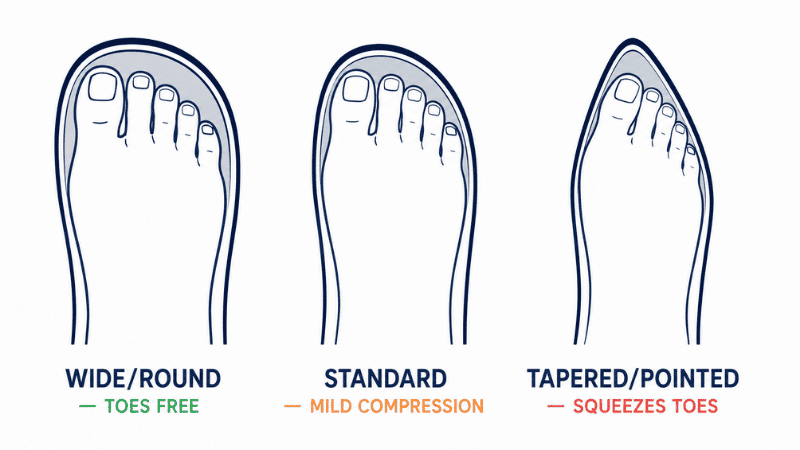
The toe box test — separate from width: Take off your shoes at the end of the day and look at your toes. Are your smaller toes angled inward toward the big toe? Is there a red mark or pressure line on the outer side of your little toe, or on top of your second or third toe? Do your toes feel relief when you spread them after taking your shoes off?
If yes to any of these — your toe box is too narrow, regardless of what the width label says. This is the more common problem, and it affects people with normal-width feet just as often as those with genuinely wide feet.
Editor’s take: Most shoe brands taper their toe box to look sleeker. Even shoes labeled “wide” often only add volume through the midfoot while keeping the toe area similarly tapered. A wide shoe that still tapers at the toes is solving the wrong problem for many people.
What Shoe Width Letters Actually Mean (2E, 4E, D — Decoded)
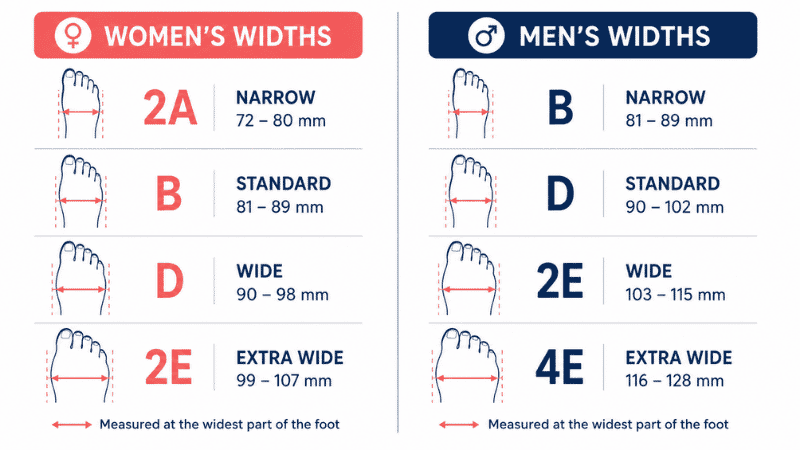
The width labeling system is one of the most confusing things in footwear retail, and most sales staff can’t explain it clearly either. Here’s what it actually means:
For women’s shoes:
- 2A (or AA) — Narrow
- B — Standard/medium (the default in most women’s shoes)
- D — Wide
- 2E — Extra wide
For men’s shoes:
- B — Narrow
- D — Standard/medium (the default in most men’s shoes)
- 2E (or EE) — Wide
- 4E (or EEEE) — Extra wide
The critical point: what counts as “standard” is different for men and women. A woman wearing a men’s shoe in the same labeled size will typically find it significantly wider — because men’s standard (D) is equivalent to women’s wide (D). This is why some women with wide feet find better luck in men’s styles.
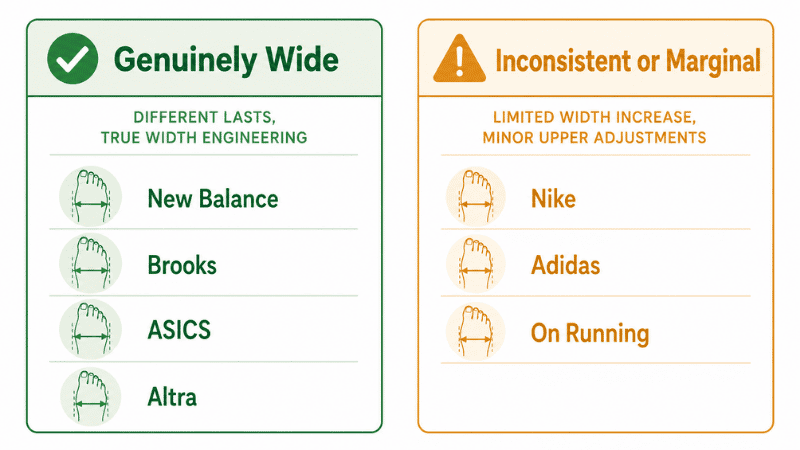
The second critical point: these width designations only apply when a brand actually manufactures in those widths. Many brands use the letters as marketing labels without genuinely building different lasts. New Balance is one of the few brands that genuinely engineers different molds for each width designation — their 2E and 4E shoes are actually built wider from the ground up, not just stamped differently.
Why Narrow Toe Boxes Cause More Than Just Discomfort
This isn’t just about comfort during the walk. The consequences of consistently compressed toes accumulate over years.
Bunions — the bony protrusion at the base of the big toe — are significantly worsened by narrow toe boxes, even if the underlying predisposition is genetic. Research published in Arthritis Care & Research found that wearing shoes narrower than the foot was associated with bunion pain and progression in both men and women. The toe box compresses the metatarsophalangeal joint inward, and over years, the joint adapts to that compressed position.
Hammertoes — where the middle joint of a toe bends downward — develop partly from toes being forced into a curled position by a too-short or too-narrow shoe. Morton’s neuroma, which causes sharp burning pain between the third and fourth toes, is directly aggravated by lateral compression of the metatarsal heads — exactly what a narrow toe box does.
None of this means a wide toe box shoe will reverse existing conditions. But it does mean that continuing to wear narrow shoes when your foot is telling you something is wrong is a choice with long-term consequences, not just daily discomfort.
Wide Toe Box Walking Shoes for Women
Finding shoes for wide feet as a woman used to mean choosing between orthopedic-looking shoes and giving up on comfort entirely. That’s changed significantly in the last few years, with several mainstream brands now offering genuine wide options that don’t look like medical equipment.
For Daily Walking and Commuting
New Balance Fresh Foam 860v14 in Wide (D) is one of the most consistently reliable walking shoes for women with wide or wide-ish feet. The wide version genuinely widens the last — not just the upper — and the toe box has enough volume for toes to sit naturally. Available in D (wide) width. Medial support makes it appropriate for flat feet as well.
Brooks Adrenaline GTS in Wide (D or 2E) offers a wider toe box than most stability shoes, with genuine width available up to 2E. The toe box shape is less tapered than most athletic shoes, with a rounder profile that accommodates wider forefoot shapes.
Altra Torin is worth mentioning separately because Altra builds all their shoes on a foot-shaped last by design — the toe box is wide by default, not as an afterthought. The Torin is their road walking/running model with generous cushioning. If you’ve struggled with athletic-style toe boxes feeling too narrow, Altra’s geometry is genuinely different.
Hoka Bondi in wide widths has a notably large toe box — wider than most Hoka models — combined with maximum cushioning. For women who stand long hours and have wide feet, this combination is particularly effective.
For Professional and Semi-Formal Settings
This is where wide-footed women consistently get the worst deal. Most dress shoes and professional footwear narrow significantly at the toe, regardless of width designation. The most reliable options:
Clarks Cloudsteppers in wide fit offer a genuinely rounded toe box in styles that work for office environments. Not every style is available wide, but the collection is large enough to find options.
Vionic makes several professional-appropriate styles with wide toe boxes and built-in orthotic support — useful if you have both wide feet and arch issues.
For women who need to wear heels in professional settings: look for block heels specifically rather than stilettos, and prioritize round or almond toe shapes over pointed. A wide-fitting round-toe block heel is categorically more manageable than any pointed toe shoe, regardless of width labeling.
Wide Toe Box Walking Shoes for Men
Men’s options are somewhat more straightforward because the standard men’s last is already slightly wider than the standard women’s last — but wide and extra-wide men’s shoes are still far from universally available.
For Daily Walking and All-Day Wear
New Balance 990v6 in 2E or 4E is the benchmark for men’s wide walking shoes. New Balance is arguably the most committed mainstream brand to genuine width engineering — their 4E is measurably wider than their standard, built on a different last. The 990 series specifically has a rounded toe box and is available up to 4E. It also comes in leather colorways that work in casual professional settings.
Brooks Beast 20 is designed specifically for men who need maximum width and motion control. Available up to 4E, with a wide platform and firm stability features. It’s a heavy shoe — not for everyone — but for men with wide flat feet doing long daily walks or standing shifts, it’s one of the few shoes that genuinely addresses both problems simultaneously.
ASICS Gel-Kayano in 2E offers wide availability in their flagship stability shoe. The 2E version has a noticeably wider forefoot than standard and a toe box that accommodates wider toe spreads without the compression that narrower ASICS models produce.
Saucony Echelon is consistently underrated in the wide shoe conversation. Available in 2E, with a particularly accommodating toe box for the width — wider than most competing shoes at the same designated width.
For Casual and Lifestyle Wear
New Balance 574 in 2E — one of the most versatile casual sneakers available in wide widths. The classic silhouette looks nothing like a “wide shoe” while actually delivering genuine width. For men who want something that looks like a normal sneaker rather than a orthopedic shoe, this is often the best answer.
Merrell Moab Speed in wide is worth considering for men who walk significant distances on varied terrain — a trail-adjacent shoe with a wide toe box that doesn’t sacrifice the appearance of a normal hiking-style sneaker.
The “Wide Fit” Brands That Actually Deliver vs. The Ones That Don’t
Not all wide width claims are equal. Based on consistent fit patterns across multiple models:
Brands that genuinely engineer wide widths (different lasts, not just marketing):
- New Balance — most committed brand to true width engineering across the widest range of widths
- Brooks — reliable wide options in key walking and running models
- ASICS — 2E available in most flagship models, genuinely wider
- Altra — wide toe box by design on all models, no separate width designation needed
Brands where “wide” is inconsistent or marginal:
- Nike — wide version is minimally different from standard in many models; toe box remains tapered
- Adidas — limited true wide options; some models run naturally wider but it’s model-specific
- On Running — generally narrow fitting; wide options limited and not dramatically different
- Skechers — wide options available and reasonably reliable, but quality control varies significantly by model
If You’ve Tried Wide Shoes and They Still Don’t Fit
If you’ve genuinely tried wide-designated shoes from reliable brands and still have fit issues, a few possibilities:
Your foot may be extra-wide (4E) when you’ve only tried wide (2E). The difference between these two widths is significant — if 2E still feels snug across the ball of the foot, 4E is the next logical step. New Balance and Brooks both offer 4E in key models.
The width is right but the toe box shape is wrong. Some feet have specific toe shapes — a longer second toe, a very wide forefoot with narrower heel — that standard lasts don’t accommodate even in wide versions. Altra’s foot-shaped last and certain Hoka models tend to have more accommodating geometry for unusual toe shapes.
You may need a custom orthotic that’s taking up internal volume. If you wear orthotics, they displace internal shoe volume and effectively make the shoe fit tighter. When adding orthotics, you typically need to go up half a size or choose a shoe with a higher volume interior specifically.
See a podiatrist if: you have visible deformity (bunion, hammertoe, overlapping toes) that’s worsening, persistent numbness or tingling in the toes, or if properly fitted wide shoes still cause pain after two to three weeks of wear. Structural foot issues may require custom orthotics or, in some cases, surgical consultation.
Frequently Asked Questions
How do I know if I have wide feet? Measure the widest part of your foot across the ball using a flexible tape. For women, over 97mm typically indicates wide feet; for men, over 103mm. The more practical indicator: if you consistently experience lateral compression, red marks on the outer toes, or relief when spreading your toes after removing shoes, your current shoe width is too narrow.
What is a wide toe box and why does it matter? A wide toe box is the front section of a shoe that allows toes to splay naturally rather than being compressed together. Most conventional shoes taper toward the toe for aesthetic reasons. A wide toe box maintains more of the foot’s natural width at the toe area, which reduces pressure on the metatarsal heads, allows normal toe function, and reduces the risk of bunion progression and hammertoe development.
What’s the difference between wide fit and wide toe box? Wide fit refers to overall shoe width, measured across the ball of the foot. Wide toe box refers specifically to the shape of the front section of the shoe. A shoe can be wide in overall width but still taper significantly at the toes. Conversely, some shoes have naturally generous toe box shapes without being designated as wide width. Ideally, you want both — but if you have to choose, toe box shape often matters more for day-to-day comfort.
Do wide shoes look different from standard shoes? Better than they used to, and increasingly not at all. New Balance’s wide-fit lifestyle models look identical to standard models from any distance. Brooks and ASICS wide options are visually indistinguishable. The categories where wide options still tend to look more “clinical” are dress shoes and professional footwear — though even here, brands like Clarks and Vionic have improved significantly.
Can I stretch my current shoes to fit wide feet? Leather shoes can be stretched marginally — a cobbler can use a stretcher to add a small amount of width, typically 3–5mm. Synthetic and mesh shoes don’t stretch meaningfully. Stretching is a temporary solution for shoes that are slightly too narrow; it won’t fix a shoe that’s fundamentally the wrong shape for your foot.
Why do my wide shoes feel fine in the morning but tight by afternoon? Feet swell throughout the day — by as much as half a size in volume. A shoe that fits your morning foot may compress your afternoon foot. For all-day wear, always try shoes in the afternoon or evening, and if buying online, measure in the afternoon and use those measurements for sizing.
The Bottom Line
Wide toe box walking shoes have gotten genuinely better across the market in the last several years — more options, better aesthetics, more reliable width engineering. But “wide fit” on a label still doesn’t guarantee adequate toe room, and the inconsistency between brands means you can’t rely on width designations alone.
Measure your foot width. Know your number. Stick to brands that genuinely build different lasts for different widths — not just wider uppers on the same last. And prioritize toe box shape alongside overall width, because they’re solving related but distinct problems.
If you’re also dealing with flat feet on top of wide feet — a very common combination — our guide on shoes for flat feet and high arches covers how to layer arch support needs on top of width requirements. And if you’re on your feet all day in a professional setting, our standing shoes guide has specific recommendations for wide-footed nurses, retail workers, and teachers.
References
- Menz, H.B., & Morris, M.E. “Footwear characteristics and foot problems in older people.” Gerontology, 2005.
- Golightly, Y.M., et al. “Factors associated with hallux valgus in a community-based cross-sectional study of adults with and without osteoarthritis.” Arthritis Care & Research, 2015.
- Riskowski, J.L., et al. “Measures of foot function, foot health, and foot pain are associated with shoe wear in older adults.” Journal of Gerontology, 2011.
- Chaiwanichsiri, D., et al. “Foot health and footwear in Thai elderly.” Journal of the Medical Association of Thailand, 2009.
- American Podiatric Medical Association (APMA). Proper Shoe Fit and Foot Health. apma.org
- Torkki, M., et al. “Surgery vs orthosis vs watchful waiting for hallux valgus.” JAMA, 2001.