
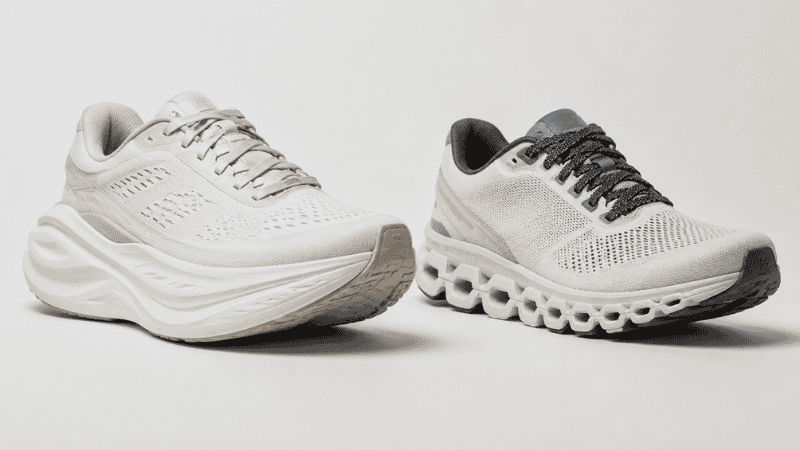
Both brands are everywhere. Both get glowing reviews. Both cost around $150. And somehow, every article comparing them ends with “it depends on personal preference” — which is about as useful as telling someone who’s lost that they’re “somewhere on Earth.”
Here’s the honest version: Hoka and On Cloud are not just different brands making similar shoes. They’re built around fundamentally different philosophies about what a shoe should do, and those differences are significant enough that the wrong choice genuinely matters. The person who thrives in On Cloud shoes is often not the same person who thrives in Hoka shoes. Getting this wrong isn’t a small inconvenience — it’s $150 and weeks of foot adjustment.
This guide gives you an actual answer. Not “both are great in their own way,” but a clear framework for figuring out which one belongs on your foot based on your foot type, your primary use case, and what you’ve been dealing with in previous shoes. We’ll cover the real differences in construction, the scenarios where each brand wins decisively, the specific model comparisons that matter, and the situations where neither is actually the right answer.
Key Takeaways
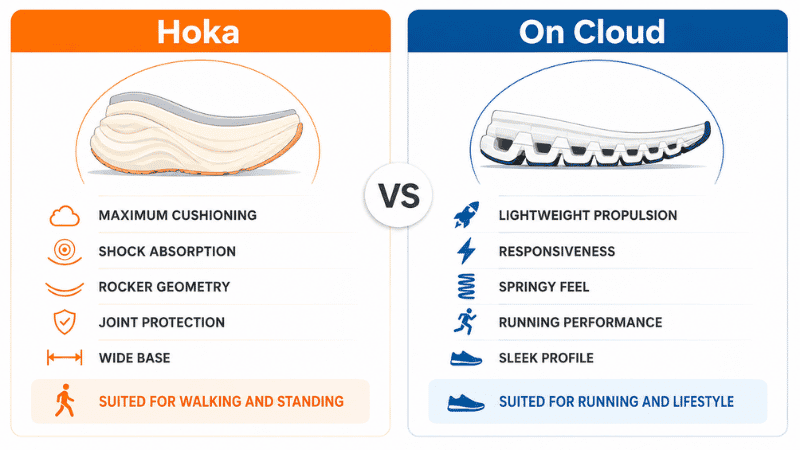
- Hoka and On Cloud are built around opposite design philosophies: Hoka maximizes cushioning and shock absorption, On Cloud maximizes lightweight responsiveness and propulsion.
- On Cloud’s CloudTec pods — the hollowed rubber sections on the sole — provide a distinctive bouncy feel on soft surfaces but can feel uneven and unstable on very hard floors.
- On Cloud runs narrower than Hoka across most models. If you have wide or even medium-wide feet, this is not a minor caveat — it’s a reason the shoe may not work for you at all.
- For plantar fasciitis, flat feet, or extended standing shifts: Hoka wins. For neutral-footed runners who prioritize lightness and aesthetics: On Cloud is competitive.
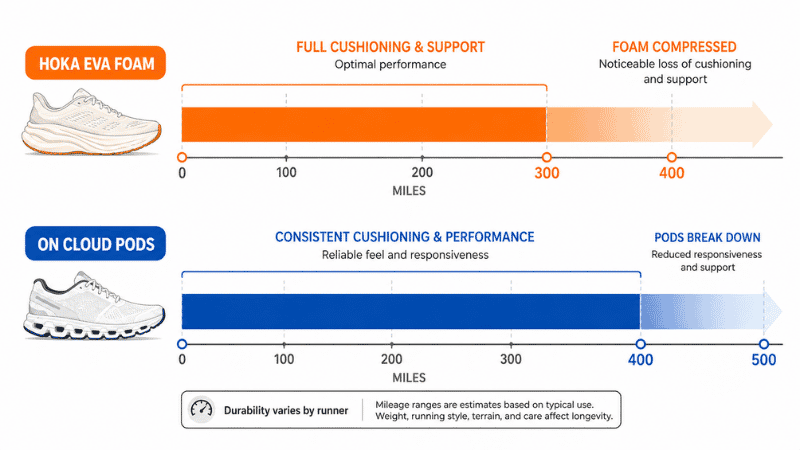
- Hoka’s midsole foam compresses faster than On Cloud’s outsole pods — real-world durability comparisons consistently show On Cloud lasting longer before feeling “dead.”
- At similar price points (~$140–160), Hoka delivers more cushioning per dollar. On Cloud delivers more style per dollar. Both are legitimate value propositions for different buyers.
The Core Difference: Cushioning vs Responsiveness
Before comparing specific models or scenarios, it helps to understand what each brand is actually optimizing for — because once you grasp this, most of the individual comparisons become obvious.
Hoka’s design philosophy: maximum cushioning, reduced peak impact. Hoka started as a shoe for ultrarunners who needed to protect their joints over 50+ mile efforts. The brand’s engineering priority has always been absorbing impact, distributing load, and reducing stress on joints and soft tissue. The thick foam stack, the rocker geometry, the wide platform base — all of these are in service of one goal: making each step as gentle on the body as possible. This is why Hoka became beloved by healthcare workers, retail staff, and older runners before it crossed into mainstream fashion.
On Cloud’s design philosophy: lightweight propulsion, minimal interference. On Cloud started from the other direction — engineered for runners who wanted a fast, light shoe that felt almost like running barefoot, but with just enough cushioning to protect from pavement. The CloudTec pods (those distinctive hollow rubber sections on the sole) are designed to compress on landing and spring back during push-off, creating a propulsive sensation. The shoe is designed to get out of your way and let your foot move naturally, rather than absorbing and redirecting energy the way Hoka does.
These aren’t minor stylistic differences. They’re opposite approaches to the same problem — and they produce radically different experiences underfoot.
On Cloud Shoes: What They’re Actually Like to Wear
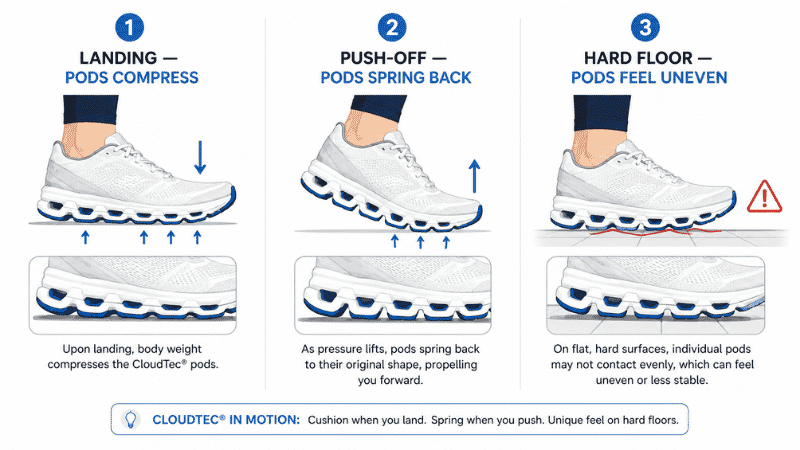
The CloudTec pods are what make On Cloud distinctive, and they’re also what divides people most sharply. The experience is genuinely different from any other shoe on the market, and reactions tend to land in one of two categories.
People who love them describe a springy, energetic feel — each step has a distinctive pop that feels propulsive rather than cushioned. The shoe is light (most models are 7–8 oz), which reduces leg fatigue over longer distances. The upper materials are generally excellent — breathable, well-fitted, and in most models, premium feeling.
People who dislike them often focus on two things. First, the CloudTec pods can feel slightly uneven on very hard, smooth floors — like walking on a surface with subtle texture bumps. On soft ground (grass, tracks, packed dirt) this mostly disappears. On polished tile or concrete, some wearers notice it consistently. Second, the pods provide a different type of cushioning than foam — they’re good at providing spring but less good at absorbing diffuse impact across the whole foot, which matters for all-day standing more than for running.
On Cloud’s fit reality: Most On Cloud models run narrow. This isn’t a minor caveat buried in footnotes — it’s a significant factor that affects a substantial percentage of people. On Cloud’s toe box is notably tighter than Hoka’s across equivalent models, and even people with standard-width feet sometimes find On Cloud tight through the forefoot. If you have wide feet, medium-wide feet, or any tendency toward forefoot spreading during extended wear, try On Cloud in person before buying online.
Hoka Shoes: What They’re Actually Like to Wear
The first time most people put on a Hoka, they either think “this is incredible” or “this feels weird.” The height of the midsole stack creates a sensation that’s genuinely different from standard shoes — you’re higher off the ground than you’re used to, and the rocker geometry creates a rolling motion from heel to toe that takes a few minutes to feel natural.
After that adjustment, the feedback from Hoka wearers is remarkably consistent: the cushioning is real, it lasts through long days in a way that most other shoes don’t, and the impact reduction is genuinely felt in the knees and hips for people who’ve struggled with joint pain. Healthcare workers, retail staff, and teachers consistently cite Hoka — particularly the Bondi and Clifton — as the shoe that made long shifts manageable after years of foot pain.
The trade-offs are real too. Hoka runs wider than On Cloud (which is an advantage for most people but can feel roomy for very narrow feet). The aesthetic reads as clearly athletic — some people love this, others find it too chunky for their everyday wear. And as we covered in our running shoe lifespan guide, Hoka’s EVA foam compresses faster than some competitors, which means the cushioning degrades more quickly for heavy daily users.
Hoka vs On Cloud for Walking
This is where the comparison gets most decisive, and where most comparison articles fail to take a position.
For walking, Hoka wins — and it’s not close.
Walking is a sustained, low-speed activity with prolonged loading on the midsole. The qualities that make a great walking shoe are: midsole foam that maintains its cushioning under sustained compression (not just impact), a stable base that doesn’t create uneven loading, and arch support appropriate for your foot type.
On Cloud’s CloudTec pods are engineered for the impact-and-spring cycle of running. During walking, where each foot contact is longer and more static, the pods don’t generate the same spring response — you’re essentially standing on hollow rubber sections, which provides less distributed support than a solid foam midsole. For short walks, this doesn’t matter much. For all-day walking or standing on hard floors, the difference accumulates.
Hoka’s rocker geometry and foam stack are well-suited to walking mechanics. Research published in Gait & Posture found that rocker-sole shoes reduce peak knee joint loading during walking by up to 19% compared to standard shoes — which is meaningful for commuters, walkers, and anyone whose knees feel the end of a long day.
The exception: If aesthetics matter for your walking context (commuting in professional clothing, everyday lifestyle wear), On Cloud is genuinely better-looking in ways that Hoka isn’t. If you need your walking shoe to pass as a fashionable sneaker, On Cloud has a clear advantage. But if your priority is how your feet and knees feel at the end of a long day, Hoka is the answer.
Hoka vs On Cloud for Running
This is where On Cloud becomes more competitive, and the answer depends on what kind of running you’re doing.
For easy daily miles and long runs: Hoka wins. The cushioning advantage is most meaningful at slower paces and longer distances, where cumulative impact becomes the primary concern. Hoka Clifton for lighter cushioning needs, Hoka Bondi for maximum protection over long distances.
For tempo runs, 5K–10K racing, and faster paces: On Cloud is competitive. The lighter weight and propulsive pod sensation suit faster running better than Hoka’s heavier, more cushioned design. On Cloudstratus and On Cloudsurfer are the most capable models for this type of running.
For injury-prone runners (knee pain, plantar fasciitis, shin splints): Hoka. The cushioning and rocker geometry provide more mechanical protection than On Cloud’s pod system. If you’ve been dealing with running injuries, this is not the race to optimize for lightness.
For runners who overpronate: Neither brand has a particularly strong stability offering, but Hoka’s Arahi provides better medial support than anything in On Cloud’s current lineup. If stability is your primary need, Brooks or ASICS are better starting points — see our overpronation shoes guide.
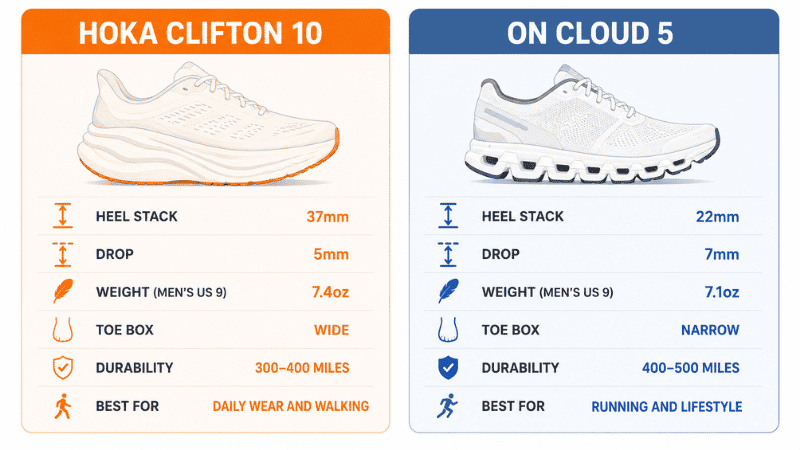
Hoka Clifton vs On Cloud 5: The Direct Model Comparison
These are the most commonly compared models — each brand’s everyday shoe at similar price points.
Hoka Clifton 10
- Stack height: 37mm heel / 29mm forefoot
- Heel drop: 5mm
- Weight: ~7.4 oz (women’s 8)
- Toe box: Wide, roomy
- Feel: Soft, cushioned, rolling motion from rocker geometry
- Durability: 300–400 miles before meaningful foam compression
- Best for: All-day wear, walking, easy running, joint protection
On Cloud 5
- Stack height: ~22mm heel / 15mm forefoot
- Heel drop: 7mm
- Weight: ~7.1 oz (women’s 8)
- Toe box: Narrow to standard — try before buying if you have wide feet
- Feel: Springy, propulsive, lighter sensation underfoot
- Durability: 400–500 miles before pod performance degrades
- Best for: Running, fitness walking, lifestyle wear
The verdict: For most people asking “which should I buy for daily wear and walking,” the Clifton is the better answer — more cushioning, wider fit, more joint-friendly. For runners who prioritize lightness and already have a separate walking shoe, the Cloud 5 is competitive.
Hoka Bondi vs On Cloudmonster: Maximum Cushion Comparison
For people who want the most shoe possible from each brand:
Hoka Bondi 9
- Stack height: 43mm heel / 37mm forefoot (among the highest of any non-racing shoe)
- Weight: ~10.8 oz (men’s 9)
- Feel: Maximum plush, rocker geometry, wide base
- Best for: Healthcare workers, maximum joint protection, high-mileage walkers
On Cloudmonster 2
- Stack height: ~38mm heel
- Weight: ~9.5 oz (men’s 9)
- Feel: Soft but more propulsive than Bondi, less rocker geometry
- Best for: Runners who want maximum cushion with more energy return than standard Hoka
The verdict: The Bondi 9 wins on cushioning volume and joint protection. The Cloudmonster is more appropriate if you want a high-stack shoe for running rather than all-day wear. For nurses and people doing long standing shifts, the Bondi is the more purposeful choice.
Hoka vs On Cloud for Specific Situations
For Standing All Day
Hoka wins clearly. The midsole foam maintains its cushioning under sustained static load better than CloudTec pods. If you’re standing 8–12 hours on hard floors, the Hoka Bondi SR (the slip-resistant healthcare version) is purpose-built for exactly this. Our shoes for standing all day guide covers the specific requirements in detail.
For Plantar Fasciitis
Hoka wins. Higher heel drop options (Hoka Arahi, Hoka Gaviota) reduce fascial tension better than On Cloud’s geometry. The foam’s support under the arch is more consistent than CloudTec pods, which can create uneven loading at the heel attachment point. See our plantar fasciitis shoes guide for the full breakdown.
For Wide Feet
Hoka wins significantly. On Cloud’s narrow fit is a genuine barrier for wide-footed buyers. Hoka’s standard models run wider by default, and Hoka offers more wide-designated sizing across its range. If you have wide feet, On Cloud is a gamble that often doesn’t pay off.
For Everyday Lifestyle Wear and Aesthetics
On Cloud wins. The streamlined silhouette and premium materials make On Cloud look like a fashion sneaker in ways that Hoka’s chunky platform can’t match. If you’re buying a shoe primarily to wear with regular clothes in a variety of social contexts, On Cloud’s aesthetic versatility is a real advantage.
For Running Under 10K at Faster Paces
On Cloud is competitive. The lighter weight and propulsive pod sensation suit faster running better than Hoka’s heavier construction. For tempo work, intervals, and shorter races, On Cloud’s performance characteristics are appropriate.
Are On Cloud Shoes Worth the Money?
This question comes up constantly, and the honest answer is: it depends entirely on what you’re using them for.
For running at moderate to fast paces with neutral foot mechanics: yes, On Cloud delivers a distinctive and genuinely enjoyable running experience that justifies the price. The Cloudstratus and Cloudsurfer in particular are well-regarded running tools.
For walking, all-day wear, or any foot condition that requires substantial cushioning or support: no — Hoka delivers more functional value per dollar for these use cases. On Cloud’s premium materials and design are real, but they’re in service of a running philosophy that doesn’t translate as well to walking mechanics.
For people with wide feet or any foot condition: try before buying. The return rate on On Cloud for wide-footed buyers is high enough that ordering online without a try-on is a significant risk.
If You’ve Tried One and It Didn’t Work
If Hoka didn’t work for you: The most common complaints are the rocker feeling unstable or disorienting, the shoe feeling too bulky for everyday wear, and — for very narrow-footed people — the toe box feeling too roomy. If any of these apply, On Cloud’s narrower, lower-profile design may suit you better.
If On Cloud didn’t work for you: The most common complaints are the toe box feeling too narrow, the pods feeling uneven on hard floors, and inadequate cushioning for all-day standing. If any of these apply, Hoka’s foam-based cushioning and wider geometry addresses all three issues directly.
If neither has worked: The problem may be foot-type specific — overpronation that neither brand adequately addresses, or a structural issue that requires custom orthotics. Brooks and ASICS have more developed stability lineups than either Hoka or On Cloud for significant pronation issues.
Frequently Asked Questions
Which is more comfortable, Hoka or On Cloud? For most people in most situations, Hoka is more comfortable — particularly for walking, standing, and any use case involving sustained load rather than running-specific impact. The cushioning volume and rocker geometry provide more mechanical comfort across a wider range of activities. On Cloud is comfortable for running at moderate to fast paces but is less versatile for all-day wear.
Do On Cloud shoes run narrow? Yes — On Cloud runs notably narrower than Hoka and narrower than most mainstream running shoe brands. This affects standard-width feet in some models and is a significant issue for medium-wide or wide feet. If your feet are at all wide, try On Cloud in person before purchasing.
Hoka vs On Cloud for plantar fasciitis — which is better? Hoka. The higher heel drop options (Arahi, Gaviota) and foam-based cushioning at the heel attachment zone are more appropriate for plantar fasciitis than On Cloud’s pod geometry. The foam provides more consistent support at the heel than CloudTec pods, which can create slightly uneven loading.
Which lasts longer, Hoka or On Cloud? On Cloud’s outsole pods generally last longer before feeling “dead” than Hoka’s EVA foam midsole. Real-world comparisons consistently show On Cloud reaching 400–500 miles before significant performance degradation, while Hoka foam compresses meaningfully by 300–400 miles for average-weight daily runners. This doesn’t make Hoka worse overall — the superior cushioning while it lasts often outweighs the slightly shorter lifespan.
Are Hoka shoes better than On Cloud for nurses? Yes, for most nurses. The Hoka Bondi SR is purpose-built for healthcare environments with a slip-resistance rating, maximum cushioning, and easy-clean uppers. On Cloud doesn’t have an equivalent purpose-designed healthcare shoe, and the CloudTec pods are less appropriate for the sustained standing on hard floors that nursing requires.
The Bottom Line
Hoka vs On Cloud isn’t a close call for most buyers — it only feels that way because both brands are popular and well-reviewed.
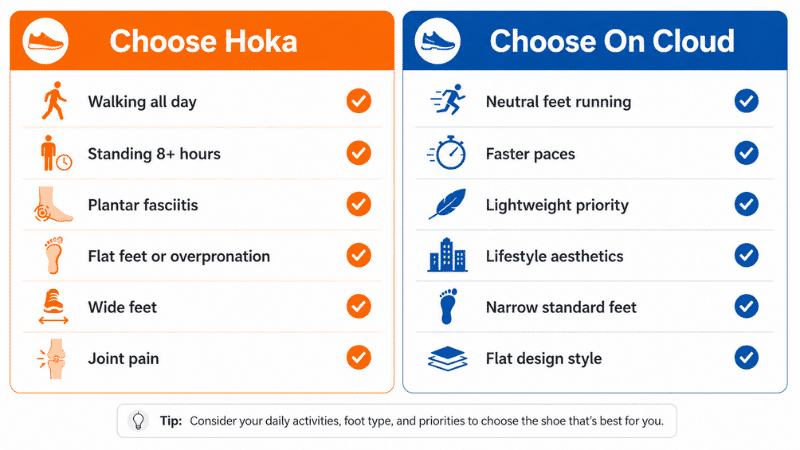
Choose Hoka if: You walk or stand all day, have joint pain, plantar fasciitis, flat feet or overpronation, wide feet, or your primary goal is foot and joint comfort over aesthetics and lightness.
Choose On Cloud if: You’re a neutral-footed runner who runs moderate-to-faster paces, you prioritize lightness and propulsion over maximum cushioning, aesthetics matter for how you’ll wear the shoe, and your feet are standard-width or narrow.
If you’re still deciding between brands and haven’t figured out your foot type yet, that’s where to start. Our flat feet vs high arches guide takes you through the self-assessment that determines which brand’s design philosophy actually matches your mechanics.
References
- Sobhani, S., et al. “Biomechanics of slow running and walking with a rocker shoe.” Gait & Posture, 2013.
- Nigg, B.M., et al. “The role of footwear on foot and lower limb biomechanics.” Footwear Science, 2015.
- Menant, J.C., et al. “Optimizing footwear for older people at risk of falls.” Journal of Rehabilitation Research & Development, 2008.
- American Podiatric Medical Association (APMA). Athletic Footwear. apma.org
- Verdejo, R., & Mills, N.J. “Heel-shoe interactions and the durability of EVA foam running-shoe midsoles.” Journal of Biomechanics, 2004.