
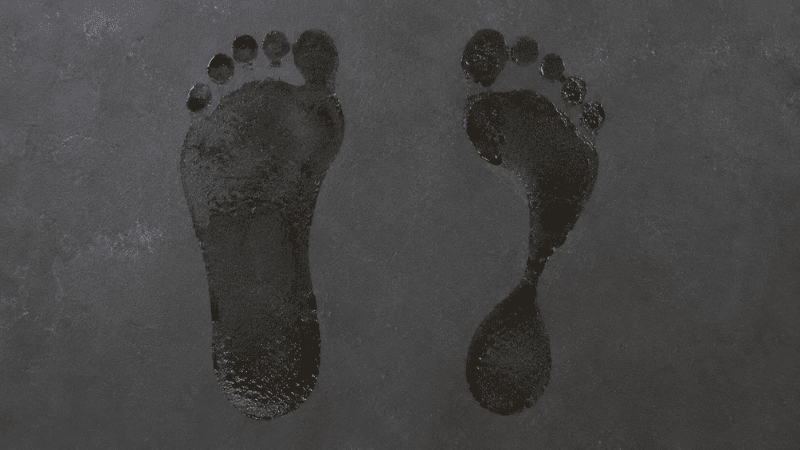
You’ve bought three pairs of “supportive” shoes in the past two years. They all felt fine in the store. They all started hurting within a month. And somewhere between the second and third pair, you started wondering whether the problem is the shoes — or your feet.
Here’s what’s probably happening: “supportive” is a marketing word, not a technical specification. A shoe can be marketed as supportive and be completely wrong for your specific foot type. For someone with flat feet, the right support means one thing. For someone with high arches, it means something almost entirely different. Put those two people in the same “supportive” shoe and one of them will likely be in pain.
This guide covers both foot types — flat feet and high arches — because they’re mirror problems that get confused constantly, and because the shoe solution for one is often exactly wrong for the other. We’ll start with how to figure out which one you actually have, then get into what each foot type actually needs from a shoe, and why so many otherwise decent shoes fail the moment they meet the wrong foot.
Key Takeaways
- Flat feet (overpronation) and high arches (supination/underpronation) require fundamentally different shoe structures — a stability shoe that helps one actively harms the other.
- Research from the Journal of Foot and Ankle Research found that approximately 26% of adults have flat feet, with rates increasing significantly with age and body weight.
- The wet foot test is a reliable first indicator of your arch type — and takes under 60 seconds to do at home.
- Flat feet need motion control and medial support. High arches need maximum cushioning and flexibility. Neutral arches need neither extreme.
- Shoe choice is only part of the equation. Insoles — matched to your foot type — often make a more immediate difference than the shoe itself.
- Most people don’t know their actual foot type. They know they have “foot pain” — which is a symptom, not a diagnosis.
How to Tell If You Have Flat Feet or High Arches (The Wet Foot Test)
Before anything else — do you actually know which foot type you have? Not what you’ve assumed, not what a shoe salesperson told you once, but what your foot actually does when it bears weight?
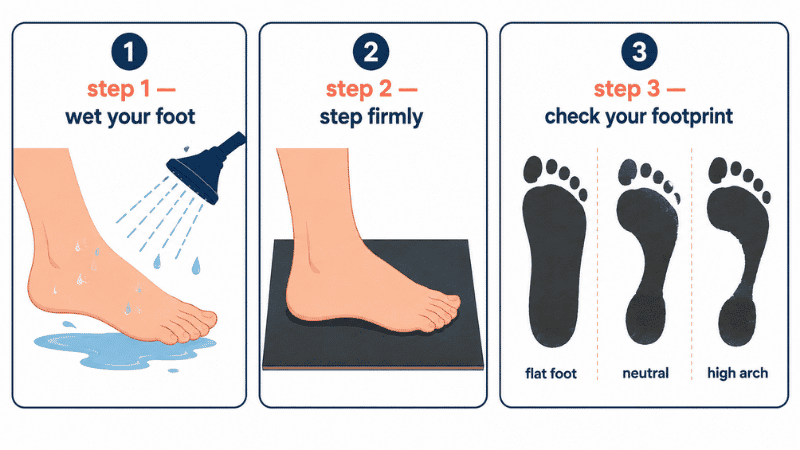
The fastest way to find out is the wet foot test. It takes one minute and requires only a piece of dark paper or cardboard, or a dry tile floor.
Wet the sole of your foot and step firmly onto the surface. Step off and look at the imprint.
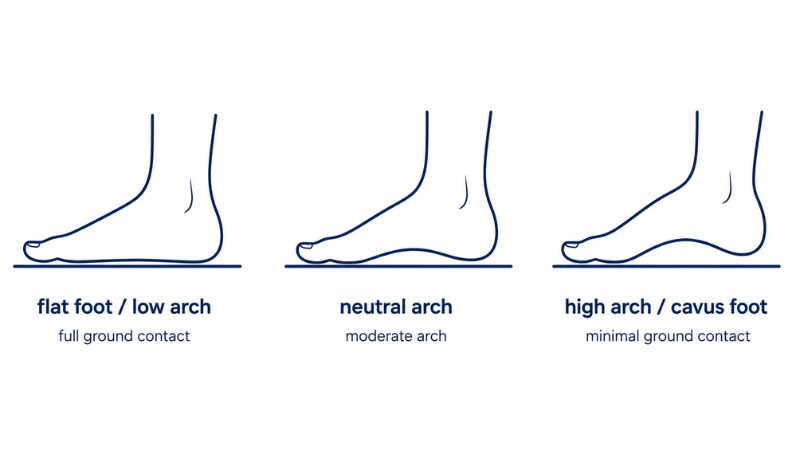
If you see a full, complete footprint — from heel to toe with almost no curve inward on the inner edge — you have flat feet, or low arches. The arch collapses under your body weight.
If you see a thin strip or almost no connection between the heel and ball of the foot — just the outer edge of the foot — you have high arches. The arch stays elevated even under full load.
If the inner curve is moderate — present but not extreme in either direction — your arches are neutral.
One important nuance: there’s a difference between having a low arch at rest (which you can see in a non-weight-bearing position) and having an arch that collapses under load. The second type — called flexible flat feet — is the more common and more clinically relevant version. If your arch looks normal when you’re sitting but disappears when you stand, you have flexible flat feet, and the shoe recommendations in this guide apply to you.
What Flat Feet Actually Do to Your Body (And Why the Wrong Shoe Makes It Worse)
Flat feet don’t hurt in isolation. What they cause is a chain reaction through the leg.
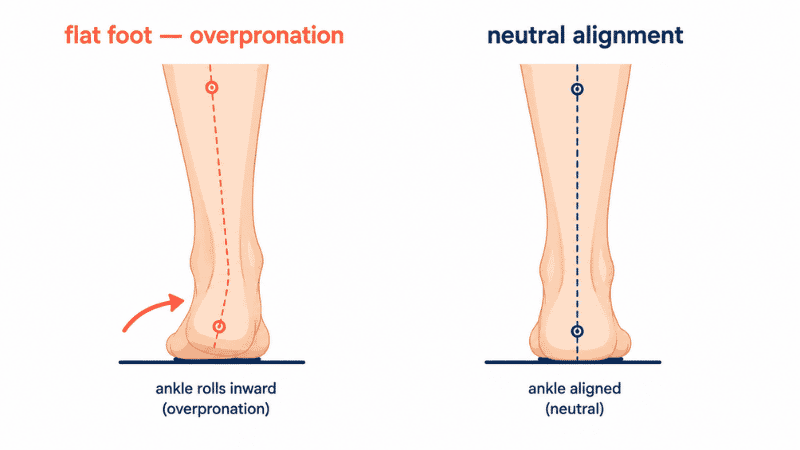
When the arch collapses inward during walking, it creates a motion called overpronation — the ankle rolls inward past its neutral position. That inward roll rotates the tibia (shin bone) internally, which in turn affects knee tracking, which creates compensatory hip and lower back adjustments. This is why people with flat feet often don’t just have foot pain — they show up with knee pain, shin splints, hip tightness, and lower back ache that seems unrelated until you look at the whole picture.
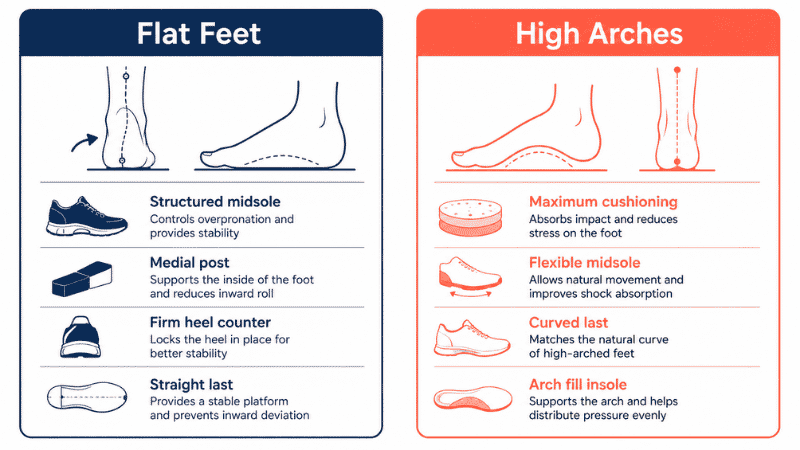
A stability shoe for flat feet works by resisting that inward collapse at the point where it happens — the medial (inner) side of the midsole. The technical term is a medial post: a firmer section of foam on the inner midsole that provides a physical barrier against excessive inward rolling. When this works correctly, it keeps the ankle in a more neutral position throughout the gait cycle, which reduces the cascade of compensatory movements up the leg.
The problem is that not all flat feet are the same, and not all “stability” shoes are built equally.
Mild vs Severe Flat Feet: The Support Level That Matches
Mild flat feet — your arch is low but your foot doesn’t roll dramatically inward — respond well to a light stability shoe or a neutral shoe with a supportive aftermarket insole. You don’t need maximum motion control. Over-correcting mild pronation with an aggressive stability shoe can actually create new problems by forcing the foot into an overcorrected position.
Moderate flat feet — your arch collapses clearly under weight and you notice inward ankle roll — are the sweet spot for standard stability shoes. Brooks Adrenaline GTS, ASICS Gel-Kayano, and New Balance 860 are consistently reliable in this range. These have meaningful medial support without being rigid.
Severe flat feet — significant collapse with noticeable inward roll and often associated knee or hip pain — may require motion control shoes, which have a reinforced midsole structure that’s firmer and more resistant to pronation than standard stability. The Brooks Addiction Walker and New Balance 928 fall into this category. Many people with severe flat feet ultimately benefit from custom orthotics prescribed by a podiatrist, which can be used inside a variety of shoes.
Shoes for Flat Feet: What to Look For
The features that matter, in order of priority:
Medial post or dual-density midsole. This is the non-negotiable for flat feet. Look for language like “stability,” “motion control,” or “GuideRails” (Brooks’ term) in the shoe description. If the manufacturer doesn’t specifically mention overpronation support, assume the shoe is neutral and won’t provide what you need.
Firm heel counter. The heel counter is the stiff structure around your heel. For flat feet, a firm heel counter helps keep the rearfoot in a neutral position at heel strike, before the midfoot pronation happens. Press the back of any shoe you’re considering — it should resist crushing.
Moderate to firm midsole. Counter-intuitively, very soft, plush midsoles are often wrong for flat feet. A highly cushioned neutral midsole collapses under an already-pronating foot and gives the arch no resistance. The midsole needs enough firmness to provide structure.
Wider base. Flat feet tend to spread laterally under load. A shoe with a wider platform (visible when you look at the sole from behind) provides better stability than a narrow base, even if both are “stability” shoes.
What High Arches Do to Your Body (And Why They Need the Opposite Shoe)
High arches create the opposite problem from flat feet — and this is where the confusion between foot types costs people the most money.
A high-arched foot (called a cavus foot) is rigid. It doesn’t pronate enough — it tends to supinate, rolling slightly outward rather than inward. Because it doesn’t flatten and flex to absorb shock during the gait cycle, the impact energy from walking and running has nowhere to go except straight into the bones, joints, and soft tissues.
People with high arches tend to show up with pain on the outer edge of the foot, stress fractures (particularly in the metatarsals and lateral foot bones), ankle instability, and tight calves and Achilles tendons — because the shortened arch creates tightness throughout the posterior chain. Plantar fasciitis is also disproportionately common in high-arched feet, though for different mechanical reasons than in flat feet.
The shoe a high-arched foot needs is almost the opposite of what a flat foot needs: maximum cushioning, a flexible midsole (not rigid or structured), and enough interior volume to accommodate the elevated arch without pressing down on it from above.
What high-arched feet need in a shoe:
Maximum cushioning with high energy return. The foot isn’t absorbing shock naturally, so the shoe has to do it. Look for thick, high-rebound midsoles. Hoka’s Bondi and Clifton lines, New Balance Fresh Foam More, and On Cloudmonster are strong options in this range. The foam should be soft and responsive, not firm and structured.
Neutral or slightly curved last. A straight last (the mold around which the shoe is built) — typical of stability shoes — pushes the foot into a flatter, more pronated position. High arches need a semi-curved or curved last that follows the foot’s natural shape without fighting it.
Flexible midsole. Hold the shoe at heel and toe and bend it. A high-arched foot needs the shoe to flex with it. A rigid midsole — appropriate for severe flat feet — will conflict with the foot’s natural movement and increase lateral stress.
Wide toe box. High arches often create claw-toe or hammer-toe tendencies because the intrinsic foot muscles work harder to compensate for the reduced contact with the ground. A wide, roomy toe box lets the toes spread and function properly.
Removable insole with arch fill. Most off-the-shelf shoes don’t fill the internal volume of a high arch, leaving a gap between the insole and the arch. An insole designed for high arches — Superfeet Green, Powerstep Pinnacle High Arch — fills that space and provides contact throughout the foot’s shape.
The Insole Question: When the Shoe Isn’t Enough
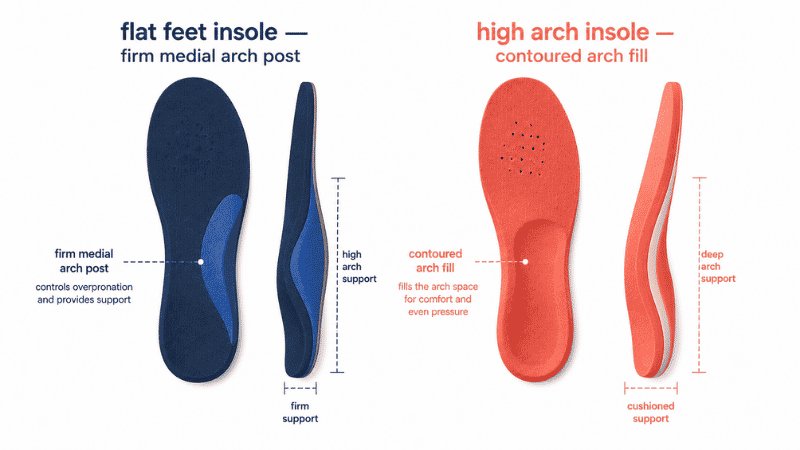
For both foot types, the insole is often a faster and cheaper first intervention than buying new shoes.
Most shoes ship with a thin, flat foam insole that provides minimal structural support. Replacing this with a purpose-built insole — matched to your foot type — can make a significant difference within the first few days of wear.
For flat feet: Look for insoles with a deep heel cup, a firm arch post on the medial side, and a semi-rigid base. Superfeet Green and Blue are reliable workhorses. Powerstep Pinnacle is a good middle-ground option with slightly more cushioning.
For high arches: Look for insoles with a contoured arch fill that matches the height of your arch, maximum cushioning under the heel and forefoot, and a softer, more flexible base. Superfeet Carbon and Powerstep ProTech Full Length are worth trying.
One important note: an insole is not a substitute for the right shoe structure. Putting a flat-feet insole in a neutral shoe helps. Putting a high-arch insole in a motion control shoe is counterproductive — the shoe and the insole end up working against each other. The base shoe and the insole should address the same foot type.
Shoes for Flat Feet vs High Arches: Side-by-Side
| Feature | Flat Feet Need | High Arches Need |
|---|---|---|
| Midsole type | Structured, dual-density | Soft, high-cushion, flexible |
| Arch support | Medial post (firm inner side) | Arch fill (contoured, not corrective) |
| Last shape | Straight | Semi-curved or curved |
| Heel counter | Very firm | Moderately firm |
| Midsole flexibility | Less flexible (more control) | More flexible (follows foot motion) |
| Insole type | Deep heel cup, firm medial arch | Contoured arch fill, cushioned |
| Brands that do this well | Brooks, ASICS, New Balance (stability lines) | Hoka, On Running, New Balance (Fresh Foam More) |
Flat Feet Walking Shoes: Specific Scenarios
For Daily Walking and Commuting with Flat Feet
The Brooks Adrenaline GTS is the most consistently recommended shoe for moderate flat feet across multiple use cases — daily walking, commuting, light exercise. The GuideRails system provides medial support without being overly corrective, and it’s available in standard and wide widths. For people who need something that looks less overtly athletic, the New Balance 990v6 in a leather colorway provides genuine stability in a more lifestyle-appropriate silhouette.
For men with flat feet who spend long hours on hard floors, the Brooks Addiction Walker in wide widths is purpose-built for exactly that scenario — firm, structured, durable, and available up to 4E width.
For Exercise and Running with Flat Feet
Flat feet in a running context are more demanding of the shoe than walking. The ASICS Gel-Kayano 32 and Brooks Adrenaline GTS 25 are both strong options for moderate overpronation. For severe pronation, the ASICS GT-2000 and New Balance 860 provide more aggressive medial support.
For High-Arch Walking Shoes
For all-day wear with high arches, Hoka’s Bondi series provides the stack height and cushioning that high-arched feet need, with a wide toe box and a midsole soft enough to absorb the impact a rigid foot can’t. The On Cloudtilt is a strong option for people who want something more lifestyle-appropriate. Brooks’ Ghost line — designed for neutral feet — also works well for high arches because it doesn’t add pronation correction, just cushioning.
If You’ve Changed Your Shoes and Still Have Pain
Two to three weeks is a fair evaluation period for any shoe change. If you’ve genuinely switched to an appropriate shoe for your foot type and the pain hasn’t improved, consider:
Your overpronation may need orthotic-level correction. Off-the-shelf stability shoes correct for a range of pronation severity. If yours exceeds what a retail shoe can handle, a podiatrist can prescribe custom orthotics that provide precise correction.
The pain may not be purely biomechanical. Plantar fasciitis, stress fractures, Morton’s neuroma, and other conditions produce foot pain that appropriate footwear can help but not resolve. If pain is sharp, localized to one specific point, or doesn’t respond to shoe changes within a month, get it evaluated.
See a podiatrist if:
- You have foot pain that wakes you up at night
- You notice visible deformity — bunions, hammer toes, significant inward ankle collapse
- Pain radiates up the ankle, shin, or knee
- You’ve had a recent increase in activity and pain developed suddenly
- You’re diabetic — foot issues in diabetes require specialist management
Frequently Asked Questions
Do I have flat feet or high arches? The wet foot test is your fastest answer. Wet your foot and step on dark cardboard or a dry tile floor. A complete footprint (almost no arch curve) indicates flat feet. A very thin connection between heel and forefoot indicates high arches. A moderate curve is neutral. Measure while standing with full weight on both feet — not sitting or on one foot only.
Can flat feet be corrected with the right shoes? Shoes can control the mechanical consequences of flat feet — reducing overpronation, improving alignment, reducing pain — but they don’t change the underlying structure of the foot. The arch doesn’t grow with supportive shoes. What good shoes do is manage the load pattern so the foot functions better and hurts less.
Are stability shoes good for high arches? No — and this is one of the most common and costly shoe-buying mistakes. Stability and motion control shoes are designed to resist inward rolling (overpronation). High-arched feet tend to roll outward (supinate). A stability shoe pushes a supinating foot further in the wrong direction, increasing lateral stress and potentially worsening pain.
What happens if I wear flat-feet shoes with high arches? The medial post in a flat-feet shoe creates an uneven platform under the foot that forces the arch into a more pronated position. For a high-arched, supinating foot, this is incorrect loading — it can cause inner ankle pain, arch strain, and accelerate wear on the medial side of the shoe in a pattern that doesn’t match your actual gait.
Can I use the same insole for both flat feet and high arches? No. Flat-feet insoles have a firm medial arch post designed to resist inward collapse. High-arch insoles have a contoured fill designed to support an elevated arch without correcting its position. Using the wrong insole is worse than using no insole at all — a flat-feet insole in a high-arched foot creates the same problem as a stability shoe.
How do I know if my overpronation is severe enough for motion control shoes? Look at the heel of your current shoes. Significant wear on the inner heel edge, combined with foot, knee, or hip pain during or after walking, is a strong indicator of moderate to severe overpronation. If your ankle visibly collapses inward when you stand or walk — especially noticeable when someone looks at your feet from behind — your pronation is likely in the range that benefits from motion control or custom orthotics.
The Bottom Line
Flat feet and high arches are opposite problems that require opposite solutions. A stability shoe that genuinely helps an overpronating flat foot will actively work against a supinating high-arched foot — and vice versa. Getting this wrong is why so many people go through two or three pairs of “supportive” shoes and still end up in pain.
Start with the wet foot test. Know your foot type before you buy. Then match the shoe’s structure — medial support for flat feet, maximum cushioning and flexibility for high arches — to what your foot actually needs, not what the marketing says.
If you’re unsure about your foot width on top of your arch type, our foot measurement guide covers both length and width measurement in detail. And if you’re a nurse, retail worker, or anyone standing all day whose flat feet are making shifts genuinely painful, our guide on shoes for standing all day covers exactly which features matter most for your specific situation.
References
- Shibuya, N., et al. “Epidemiological characteristics of flatfoot in the United States.” Journal of Foot and Ankle Surgery, 2010.
- Menz, H.B., et al. “Foot problems as a risk factor for falls in community-dwelling older people.” Journal of the American Geriatrics Society, 2006.
- Rome, K., et al. “Foot orthoses and physiotherapy in the treatment of patellofemoral pain syndrome.” British Medical Journal, 2008.
- Kaufman, K.R., et al. “The effect of foot structure and range of motion on musculoskeletal overuse injuries.” American Journal of Sports Medicine, 1999.
- Williams, D.S., et al. “Lower extremity mechanics in runners with a converted forefoot strike pattern.” Journal of Applied Biomechanics, 2000.
- American Orthopaedic Foot & Ankle Society (AOFAS). Flatfoot Deformity. aofas.org