
Most people buy running shoes for walking. Not because they’ve thought about it carefully — but because running shoes are everywhere, they get good reviews, and nobody in the store mentions that the shoe engineered for forward propulsion at speed might not be the best tool for eight hours of daily commuting or a twelve-hour nursing shift.
The difference between walking shoes and running shoes is real, and it matters more than most people realize. It’s not about branding or price. It’s about biomechanics — how your foot moves when you walk versus when you run, and how the shoe needs to be built to support each motion correctly.
This is the complete guide to walking shoes: what makes them different, what features actually matter, how to match them to your foot type, and when to replace them. Every section links to a deeper guide if you need more on a specific topic — but if you read this one, you’ll know enough to walk into any shoe store and make a confident decision.
Key Takeaways
- Walking and running create fundamentally different foot mechanics — and shoes built for one don’t automatically work for the other.
- The average person takes 8,000–10,000 steps per day, generating cumulative impact forces that add up to hundreds of tonnes of load on the feet annually.
- Walking shoes need different flex points, heel geometry, and midsole structure than running shoes — not just different cushioning levels.
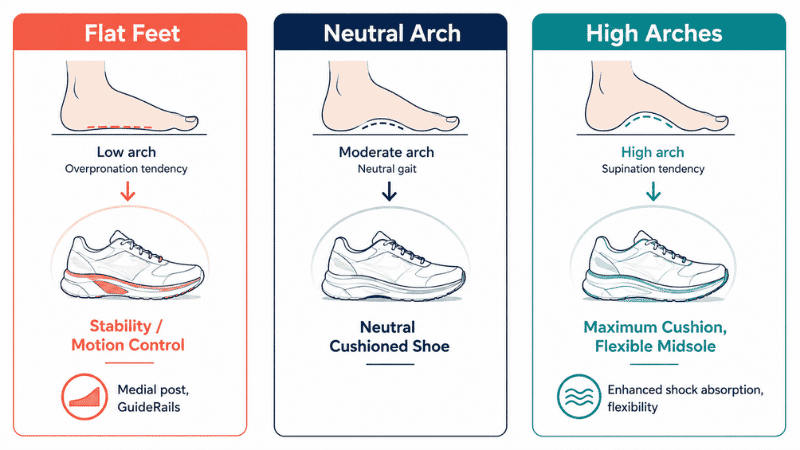
- Your foot type — flat, neutral, or high-arched — changes what “support” means and which shoe features you actually need.
- Most walking shoes need replacing every 300–500 miles, or roughly 6–12 months for daily walkers, regardless of how the upper looks.
- The right walking shoe is the one that matches your foot type, your daily demands, and your floor surface — not the one with the most impressive marketing.
Walking Shoes vs Running Shoes: The Actual Difference
This is the question that trips people up most often, and the answer matters.
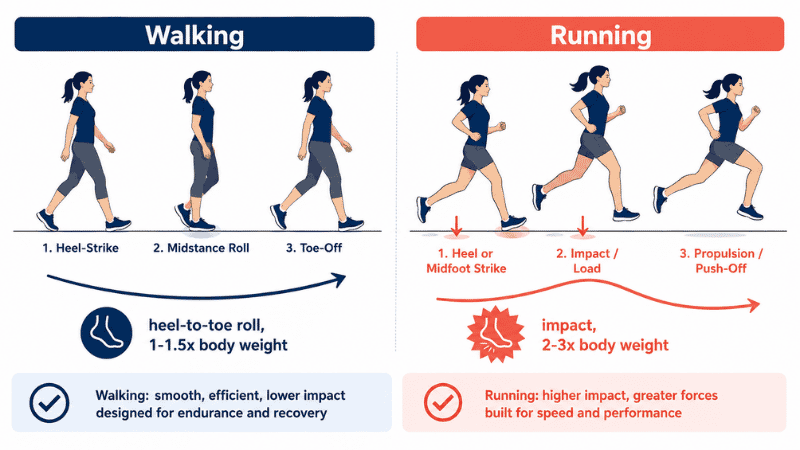
When you run, your foot strikes the ground with 2–3 times your body weight in impact force. Your body compensates by landing on the midfoot or forefoot and using the calf, Achilles, and arch as a spring system. Running shoes are engineered around this: they prioritize impact absorption at high force, energy return for the push-off, and a flex pattern that supports the running gait cycle.
When you walk, your foot strikes heel-first and rolls forward through the arch to the ball, then pushes off the toes. Impact forces are lower — roughly 1–1.5 times body weight — but the duration of that force is longer and more sustained, especially during standing. The gait cycle is completely different.
This creates three specific design differences between walking and running shoes:
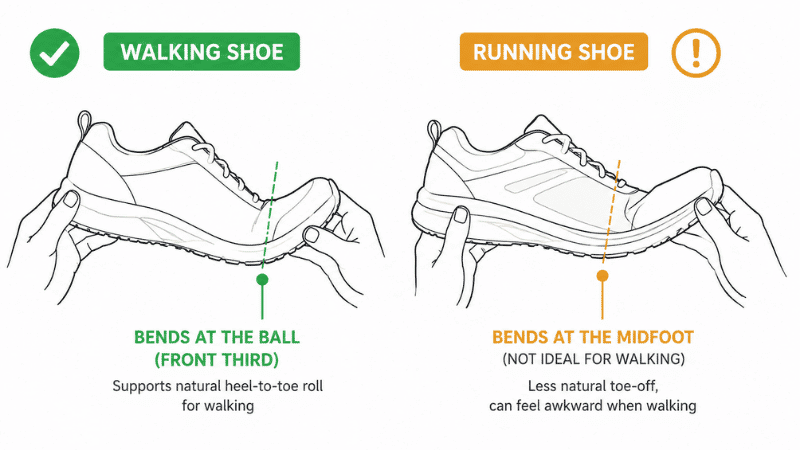
Flex point location. A walking shoe should flex at the ball of the foot — the widest part, just behind the toes. A running shoe often flexes further back, under the arch, to support the midfoot strike pattern of running. Wearing a running shoe for walking means your foot is bending in a different place than the shoe — which creates friction, fatigue, and pressure on the wrong joints.
Heel geometry. Running shoes often have a flared heel — a wider base at the heel that stabilizes lateral impact during a running stride. For walking, that flared heel can actually interfere with the natural heel-to-toe rolling motion. A well-designed walking shoe has a slightly beveled heel — angled to encourage smooth heel-to-toe transition rather than creating a flat platform that interrupts the roll.
Midsole structure. Running shoes prioritize energy return — a bouncy, propulsive foam that springs back quickly. Walking shoes prioritize sustained support — a foam that maintains its cushioning properties under prolonged load without compressing flat. The best walking shoe midsole is resilient under sustained static and rolling pressure, not just momentary impact.
None of this means you absolutely cannot walk in running shoes. Many people do, and for casual use it’s fine. But for extended walking, commuting, long shifts, or anyone with existing foot issues, these differences become significant.
What to Look for in Walking Shoes: The Five Features That Matter
1. Flex Point at the Ball of the Foot
Hold any shoe you’re considering at the heel and toe and press the toe down. The shoe should fold at the widest part — approximately one third of the way from the front. If it folds at the middle of the shoe (under the arch) or resists bending entirely, it’s not designed for walking mechanics.
This test takes ten seconds and eliminates a large percentage of otherwise appealing shoes immediately.
2. Heel-to-Toe Drop Matched to Your Needs
Heel drop is the height difference between the heel and the forefoot inside the shoe. Standard walking shoes typically have a drop of 8–12mm. Zero-drop shoes have equal heel and forefoot height.
For most walkers, a drop of 8–10mm provides a good balance between heel cushioning and natural gait. Higher drops (10–12mm) are beneficial for plantar fasciitis and Achilles issues because they reduce tension in the posterior chain. Lower drops (4–6mm) distribute weight more evenly — useful for people with forefoot pain from prolonged standing.
Zero-drop shoes are appropriate for experienced minimalist footwear users, but transitioning too quickly from standard shoes to zero-drop can cause Achilles and calf strain. If you’re new to lower-drop shoes, reduce the drop incrementally rather than switching overnight.
3. Midsole Foam Resilience
Press your thumb firmly into the forefoot of the midsole and watch how quickly it rebounds. Fast rebound means the foam will maintain its cushioning properties throughout the day. Slow rebound means the foam compresses and stays compressed — and by hour six, you’re walking on a depleted midsole.
This matters more for walking than running because walkers spend more total time in contact with the midsole under sustained load. A foam that feels perfect in a ten-minute jog may be noticeably degraded after eight hours of walking.
4. Arch Support Matched to Your Foot Type
Not all arch support is the same, and the wrong type of arch support is actively harmful. The three foot types need different things:
Flat feet / overpronation: You need medial post support — a firmer section of foam on the inner midsole that resists the inward collapse of the arch during the gait cycle. Look for shoes described as “stability” or featuring GuideRails (Brooks), medial post, or motion control designations. Neutral cushioned shoes without this structure will allow your arch to collapse with every step, creating fatigue that travels up to the knee, hip, and lower back.
High arches / supination: You need maximum cushioning and a flexible midsole that follows your foot’s natural motion rather than correcting it. A stability shoe designed for flat feet will push a supinating foot further in the wrong direction. Look for neutral-designated shoes with high stack heights and responsive foam.
Neutral arches: You have the most options. A neutral cushioned shoe works well. Focus on the other features — flex point, heel drop, toe box — rather than arch support specifically.
If you’re not sure which foot type you have, the wet foot test takes under a minute. Step on a piece of dark cardboard with a wet foot. A complete footprint indicates flat feet. A thin strip connecting heel and forefoot indicates high arches. A moderate curve is neutral. For a full guide to identifying your foot type and the shoes that match it, read our flat feet vs high arches guide.
5. Toe Box Width
Your feet swell throughout the day — sometimes by up to half a size in volume. A toe box that feels comfortable in the morning may compress your toes by afternoon, causing forefoot pain, nail bruising, and the compression that contributes to bunion progression over time.
The toe box should allow all five toes to lie flat without lateral pressure. Press the outer edge of the shoe at the widest toe area — there should be slight give, not immediate resistance. For people with wider feet, this is the most commonly neglected feature in shoe selection.
Wide toe box walking shoes have improved dramatically in recent years. Our guide to wide toe box walking shoes covers how to measure your foot width, decode the 2E/4E width labeling system, and which brands genuinely engineer wide fits versus which ones just label them that way.
Walking Shoes for Women: What’s Different
Women’s walking shoes face a specific challenge that men’s don’t: the default “women’s fit” in most shoe categories prioritizes a narrower, more tapered silhouette that conflicts directly with what good walking mechanics require.
The result is a market full of shoes marketed as walking shoes for women that have narrow toe boxes, lower heel support, and midsoles calibrated for lighter loads than many women actually put on them. The brands that consistently do this right — that build women’s walking shoes on lasts designed for the functional demands of walking rather than the aesthetic demands of looking sporty — are worth knowing.
For neutral to high arches: Hoka Bondi (wide toe box, maximum cushioning, available in wide), Brooks Ghost (reliable neutral cushioning, available up to 2E), On Cloudtilt (lifestyle-appropriate silhouette, good forefoot room).
For flat feet: Brooks Adrenaline GTS (the most consistent recommendation across podiatrists and users, available in 2E), New Balance Fresh Foam 860 (genuine stability, true wide sizing), ASICS Gel-Kayano (higher heel drop, gel heel unit, excellent for PF concurrent with flat feet).
For professional environments: Vionic Ainsleigh (built-in orthotic arch support in a career-appropriate style), Clarks Cloudsteppers in wide fit (rounded toe box, office-appropriate, meaningfully better than standard dress shoes for all-day wear).
For women who stand all day in professional or healthcare settings, the demands are specific enough that our shoes for standing all day guide covers the breakdown in detail — including what nurses, teachers, and retail workers each need differently.
Walking Shoes for Men: What to Know
Men’s walking shoes have a broader range of genuinely functional options than women’s, partly because the men’s athletic market has historically valued performance over aesthetics in a way that produces better shoe structure. The main challenge for men is finding options that work for both walking demands and professional appearance.
For neutral to high arches: Hoka Clifton (versatile daily walker, lighter than Bondi), Brooks Ghost (the benchmark neutral walking shoe, available in wide), New Balance 1080 (maximum cushioning with excellent width options).
For flat feet: New Balance 990v6 (genuine stability, available in 4E, leather colorways for semi-professional use), Brooks Beast 20 (maximum width and motion control, purpose-built for severe flat feet), ASICS GT-2000 (lighter stability option, good for moderate overpronation).
For professional environments: New Balance 990v6 in leather or grey colorways works for casual professional settings without looking like gym shoes. Cole Haan ØriginalGrand puts a running shoe sole inside a dress shoe silhouette — not perfect for plantar fasciitis but significantly better than standard dress shoes for commuters who walk significant distances.
Matching Walking Shoes to Your Specific Situation
If Your Feet Hurt After Standing All Day
Foot pain from prolonged standing is often about metatarsal load and midsole resilience, not just arch support. A shoe that feels comfortable for a one-hour walk may completely fail at hour six of a standing shift because the foam has compressed and lost its cushioning effectiveness.
Key features for standing: midsole foam with high energy return (press the forefoot and check rebound speed), heel-to-toe drop under 8mm for even weight distribution, and a forefoot that maintains its thickness under sustained load. Our shoes for standing all day guide covers the mechanics in detail and includes specific recommendations for different floor surfaces and professions.
If You Have Plantar Fasciitis
Plantar fasciitis changes the shoe priorities significantly. The heel cushioning zone — specifically the posterior heel where the fascia attaches to the heel bone — needs to be both thick and resilient. Heel drop of 8–12mm reduces fascial tension during walking. Midfoot rigidity prevents the fascia from being stretched beyond a safe range under load.
Many people with plantar fasciitis make the mistake of buying very soft, plush shoes — and find that the pain doesn’t improve or gets worse. The explanation: highly cushioned but unsupported shoes allow the arch to collapse under load, which strains the fascia even if the impact feels cushioned. You need cushioning and structure together. Our plantar fasciitis shoes guide covers why this happens and what to look for specifically.
If You Have Wide Feet
The first thing to establish is whether you need a wider toe box, a wider overall shoe, or both — because the solution differs. Toe box shape and overall foot width are related but separate measurements.
Most people with wide feet have been sizing up in length to compensate for width, which changes the flex point and creates a different set of problems. The right fix is a shoe offered in a genuine wide width (2E or 4E for men, D or 2E for women) from a brand that actually engineers different lasts for different widths — not just attaches a wider label to the same mold. Our wide toe box walking shoes guide breaks down which brands deliver on genuine width engineering and which don’t.
If You Have Flat Feet or High Arches
This is the most important variable in walking shoe selection, and the most commonly misunderstood. Flat feet and high arches need almost opposite shoe structures — a stability shoe that helps an overpronating flat foot will actively harm a supinating high-arched foot.
Start by identifying your foot type with the wet foot test, then match the shoe’s stability designation to what your foot actually needs. Our flat feet vs high arches guide covers the full picture including self-testing, the specific features each foot type needs, and insole options for when the shoe alone isn’t enough.
If You’re Deciding Between Hoka and Brooks
These are the two brands that come up most in walking shoe discussions, and they represent genuinely different design philosophies — not just different aesthetics. Hoka starts with maximum cushioning and builds from there. Brooks starts with motion control and stability and adds cushioning on top.
The short version: flat feet go Brooks, high arches go Hoka, and wide feet need to check actual width availability in each brand. Our Hoka vs Brooks walking guide gives the full comparison including specific model-by-model analysis of Clifton vs Ghost and Bondi vs Glycerin.
How Long Do Walking Shoes Last?
This is the question most people only ask after their feet start hurting again — which usually means the answer is “longer than they should have.”
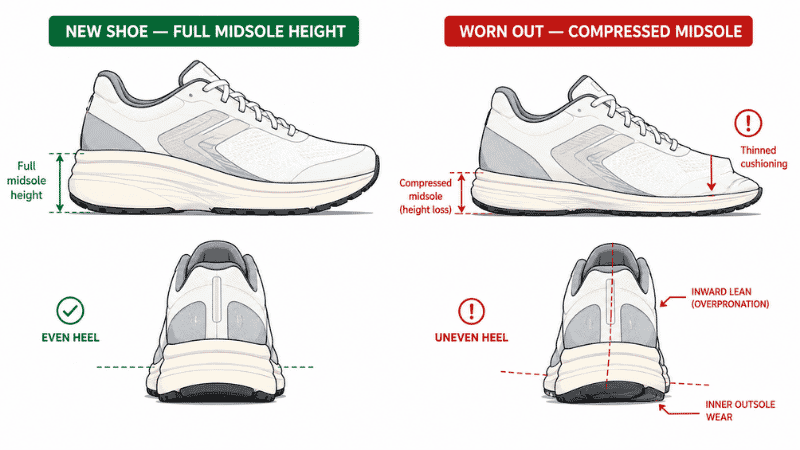
The foam in a walking shoe’s midsole — the part that does the actual cushioning and support work — has a finite compression lifespan. Most quality walking shoe midsoles are designed to last 300–500 miles of use. For someone walking 10,000 steps per day (roughly 5 miles), that’s 60–100 days of continuous daily use. For lighter walkers, it’s proportionally longer.
The problem is that midsole degradation isn’t visible from the outside. The upper of a shoe can look perfectly fine while the midsole has compressed to a fraction of its original thickness and is providing essentially no cushioning. This is why “my shoes still look good” is not a reliable indicator of whether they’re still doing their job.
Signs your walking shoes need replacing:
Your feet ache in ways they didn’t when the shoes were new — particularly in the heel and ball of the foot by the end of the day. The midsole looks compressed when you view the shoe from the back — the foam has visibly thinned. The shoe folds easily where it used to have more resistance. You’ve been wearing them daily for more than 8–12 months. The outsole shows significant wear through to the midsole layer.
For anyone standing 8+ hours daily, the effective lifespan is shorter — 4–6 months in many cases — because sustained standing compresses the midsole faster than the dynamic compression of walking.
The Walking Shoe Buying Checklist
Before committing to any walking shoe, run through these five checks — takes under five minutes in the store or when the box arrives:
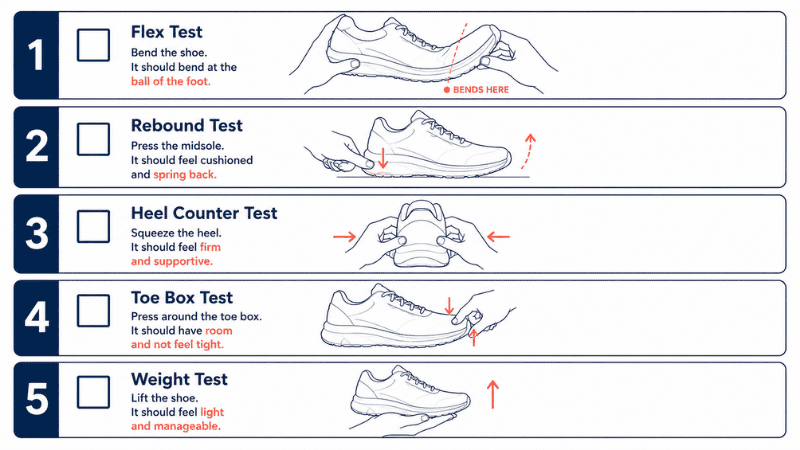
The flex test. Press the toe down while holding the heel. The shoe should fold at the ball, not the midfoot. ✓
The rebound test. Press your thumb firmly into the forefoot midsole and release. Fast rebound = resilient foam. Slow rebound = compresses under sustained load. ✓
The heel counter test. Squeeze the back of the shoe. It should feel firm and resist crushing. A soft heel counter allows heel movement that creates friction and fatigue. ✓
The toe box test. Press the outer edge of the shoe at the widest toe. There should be give — not immediate resistance. Your toes need room to spread, especially by the end of the day. ✓
The weight test. Pick the shoe up. Heavier than you expected? That weight travels with every step — lighter shoes reduce leg fatigue over long distances, all else being equal. ✓
If you’re buying online, measure your feet in the afternoon (when they’re at their largest) and use those measurements for sizing. Our foot measurement guide covers the full process including arch length measurement — the step most people miss that determines whether a shoe bends at the right place for your specific foot.
Frequently Asked Questions
What’s the difference between walking shoes and running shoes? Walking shoes are built for heel-to-toe rolling motion at lower impact forces sustained over long periods. Running shoes are built for midfoot or forefoot impact at higher forces with more emphasis on energy return. The key structural differences: walking shoes flex at the ball of the foot (running shoes often flex further back), have a beveled heel for smooth rolling (running shoes have a flared heel for lateral stability during running), and prioritize midsole resilience under sustained load rather than spring-back energy return.
Do I need special shoes for walking, or can I use running shoes? For casual walking, running shoes work fine. For extended daily walking, commuting, long shifts, or any existing foot condition, the differences matter enough to choose purposefully. Running shoes engineered for forward propulsion at speed have a different flex point and heel geometry than what walking mechanics require — which creates fatigue and pressure in the wrong places over time.
How long do walking shoes last? 300–500 miles for the midsole, which translates to roughly 6–12 months of daily use for average walkers. For people standing 8+ hours daily, expect 4–6 months before the midsole loses meaningful support. The upper often looks fine long after the midsole has degraded — don’t judge shoe life by appearance.
When should I replace my walking shoes? When you notice increased foot fatigue or pain that wasn’t present when the shoes were newer, when the midsole looks visibly compressed from the back, or after 8–12 months of daily use — whichever comes first. If you walk significant daily mileage, track it and replace at 400 miles regardless of feel.
What’s the most comfortable walking shoe? There’s no universal answer because comfort is foot-type dependent. Hoka Bondi and Clifton are the most consistently cited for cushioning comfort across neutral to high-arched feet. Brooks Adrenaline GTS is the most cited for comfort among flat-footed walkers because it addresses the root cause of their fatigue rather than just adding foam. The most comfortable shoe for you is the one that matches your foot mechanics — not the one with the highest cushioning rating.
Is walking in heels or dress shoes bad for your feet? Yes, for extended daily use. High heels shift body weight onto the metatarsals and shorten the Achilles and calf. Pointed-toe dress shoes compress the metatarsal heads and toes. Flat dress shoes with no arch support allow the plantar fascia to work without mechanical assistance. For occasional wear, these are fine. For daily commuting or extended standing, they accumulate measurable damage over years. If you must wear dress shoes professionally, look for options with removable insoles (so you can add arch support) and the lowest heel practical for your workplace.
The Bottom Line
Walking shoes exist as a category for a reason — they’re engineered around walking biomechanics in ways that running shoes aren’t, and those differences matter most when you’re on your feet for extended periods.
The most important variable is your foot type. Get that right and most other decisions become clearer. Flat feet need stability and medial support. High arches need cushioning and flexibility. Wide feet need genuine width engineering, not just wide labels. Everything else — brand, price, aesthetic — is secondary to getting the structural match correct.
Start with the flex test. Check the heel drop. Match the arch support to your foot type. Make sure the toe box has room for your feet at their end-of-day size. Then give the shoes two to three weeks of consistent wear before evaluating — your feet need time to adapt to new support patterns.
The guides below go deeper on every specific situation covered in this article:
- Foot pain from standing: Shoes for Standing All Day
- Foot type identification: Flat Feet vs High Arches Guide
- Wide feet and toe box: Wide Toe Box Walking Shoes
- Heel and arch pain: Plantar Fasciitis Shoes Guide
- Brand comparison: Hoka vs Brooks for Walking
- Sizing and measurement: How to Measure Your Foot Size
- Ball of foot pain: Why Does the Ball of My Foot Hurt
References
- Kerrigan, D.C., et al. “Moderate-heeled shoes and knee joint torques relevant to the development and progression of knee osteoarthritis.” Archives of Physical Medicine and Rehabilitation, 2005.
- Stacoff, A., et al. “Ground reaction forces in alpine skiing, cross-country skiing and ski jumping.” Journal of Biomechanics, 1996.
- Nigg, B.M. “The role of impact forces and foot pronation: a new paradigm.” Clinical Journal of Sport Medicine, 2001.
- American Podiatric Medical Association (APMA). Proper Shoe Fit. apma.org
- Wearing, S.C., et al. “The pathomechanics of plantar fasciitis.” Sports Medicine, 2006.
- Menz, H.B., & Morris, M.E. “Footwear characteristics and foot problems in older people.” Gerontology, 2005.
- Van Gent, R.N., et al. “Incidence and determinants of lower extremity running injuries in long distance runners.” British Journal of Sports Medicine, 2007.