
It’s 4pm. You haven’t sat down since your shift started. The balls of your feet are burning, your heels feel like they’ve been hit with a hammer, and you’ve got four more hours to go. You glance down at your shoes — the ones you bought because they looked supportive, the ones that felt fine in the store — and you wonder if you made a terrible mistake.
You probably didn’t buy the wrong brand. You probably bought the wrong type of shoe for what your body is actually doing. Standing all day — especially on concrete, tile, or any hard commercial floor — is a completely different physiological demand than walking a few miles or going to the gym. Most shoes aren’t built for it. And most people buying shoes for all-day standing don’t know what to look for beyond “cushioned” and “comfortable,” which is about as useful as buying a car because it “drives well.”
This guide is built around one question: what does a shoe actually need to do when you’re on your feet for 8 to 12 hours straight? We’ll cover the mechanics, the features that matter, how different foot types change the equation, and what distinguishes a shoe that holds up through a double shift from one that fails by noon. There are specific recommendations throughout — but the goal is to help you understand why they work, so you can make the right call for your own feet.
Key Takeaways
- Standing puts 1.0–1.5 times your body weight on your feet continuously — unlike walking, which distributes load through motion. Static standing is actually harder on feet than moderate walking.
- The single biggest predictor of all-day comfort isn’t cushioning thickness — it’s how well the shoe’s midsole maintains its structure after 4–6 hours of compression.
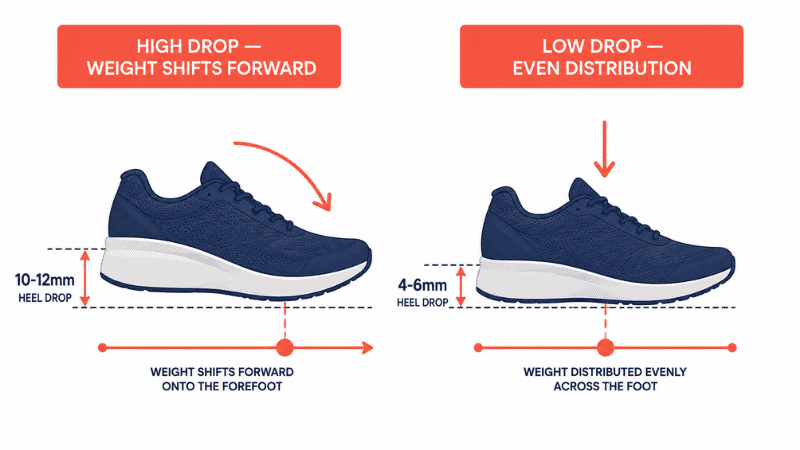
- Heel drop matters more than most people realize. A high heel drop (10mm+) shifts weight forward onto the metatarsals during standing; a lower drop (4–8mm) distributes load more evenly.
- According to research in the Applied Ergonomics journal, workers who wore inappropriate footwear for prolonged standing reported significantly higher rates of lower back pain, knee pain, and foot fatigue compared to those in purpose-appropriate shoes.
- Your floor surface changes everything. Concrete requires more midsole structure. Rubberized or cushioned flooring gives you more flexibility in shoe choice.
Why Shoes Built for Standing All Day Are Different from Regular Sneakers
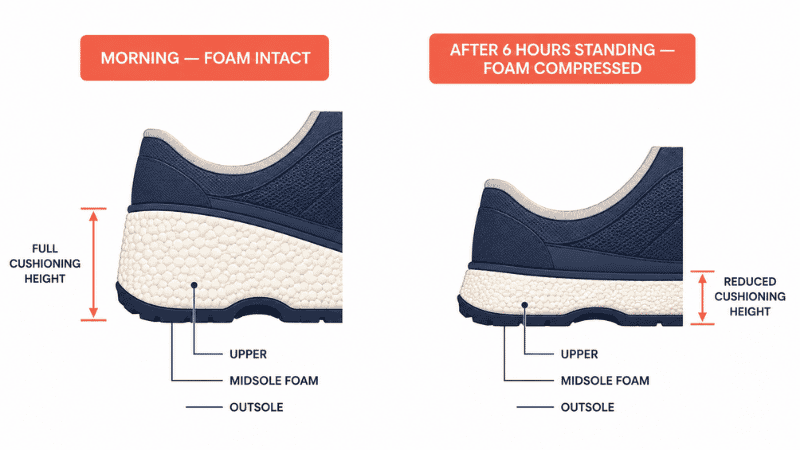
Most athletic shoes are designed around movement — the cushioning is calibrated for impact absorption during walking or running strides, where each foot gets a moment of relief as the other takes a step. Standing is a different problem entirely.
When you stand in place, your feet bear continuous compressive load with no recovery phase. The midsole foam — the material between your foot and the ground — compresses under that constant weight. In a walking or running shoe optimized for motion, that foam may compress noticeably after a few hours of static standing, losing much of its cushioning effectiveness precisely when you need it most.
What a good standing shoe needs is midsole foam that’s resilient under sustained compression — not just soft on first contact. This is a technical distinction that shoe manufacturers don’t always highlight in marketing materials. Words like “plush,” “ultra-cushioned,” and “cloud-like” describe initial feel. They don’t tell you how the shoe behaves at hour six.
The second difference is structure. A shoe designed for forward motion can be relatively flexible in the midfoot because the foot is always moving through its range of motion. A shoe for standing needs to maintain its shape through hours of static load — which means a firmer, more structured midsole and a more supportive heel counter than you’d necessarily need for casual walking.
The Five Things That Actually Matter in Shoes for Standing All Day
1. Midsole Foam Resilience (Not Just Softness)
Press your thumb firmly into the forefoot area of any shoe you’re considering. A soft, immediately squishy response feels nice — but notice how quickly it rebounds. A foam that bounces back quickly (high energy return) will maintain more of its cushioning properties throughout the day than a foam that stays compressed.
EVA foam (used in most budget shoes) compresses and recovers more slowly. PEBA-based foams like Hoka’s CMEVA or ASICS’ FlyteFoam have better resilience under sustained load. This doesn’t mean you need to spend $200 on a shoe — but it does mean that a $40 foam sneaker will likely feel noticeably worse by hour five than a $110 shoe with better foam technology.
Editor’s take: If you’ve ever noticed that a new pair of shoes felt great for the first week and then seemed to lose their cushioning suddenly, you’ve experienced foam compression fatigue. It’s real, it’s predictable, and it’s the primary reason “comfortable” shoes stop being comfortable.
2. Heel Drop — The Number Nobody Checks
Heel drop is the height difference between the heel and the forefoot inside the shoe. Standard running shoes typically have a drop of 8–12mm. Zero-drop shoes have an equal heel and forefoot height.
For all-day standing, heel drop affects how your weight distributes across the foot. A higher drop tilts your weight forward onto the metatarsals — fine for forward motion, but problematic for extended standing because it concentrates load on the ball of the foot. A drop in the 4–8mm range tends to distribute standing weight more evenly from heel through midfoot.
This doesn’t mean zero-drop is automatically better. People who’ve spent years in heeled shoes have shortened Achilles tendons and calves — transitioning too quickly to flat shoes causes its own issues. The practical takeaway: if you currently wear standard athletic shoes and your forefoot hurts after standing all day, trying a lower-drop option is a logical first experiment.
3. Arch Support Matched to Your Foot Type
Generic arch support helps some people and actively hurts others. The critical variable is your foot type — and most people have never properly assessed theirs.
If you have flat feet or overpronate: Your arch collapses inward under load, shifting pressure to the inner forefoot and increasing stress on the knee and hip on that side. You need a shoe with medial post support or a stability designation — a firmer wedge of foam on the inner midsole that resists that inward collapse. Neutral cushioned shoes without this structure will feel comfortable initially but will worsen fatigue and pain patterns as the day goes on.
If you have high arches: Your foot is rigid and doesn’t absorb shock efficiently. You need maximum cushioning — more than most — and a shoe with enough volume in the toe box and midfoot to accommodate your foot’s shape without compression. Motion control shoes designed for flat feet are actively wrong for high arches.
If your arches are neutral: You have the most options. A neutral cushioned shoe with good overall support works well. Focus on the other factors — foam resilience, drop, toe box — rather than arch support specifically.
4. Toe Box Width
Eight hours of standing means eight hours of blood pooling in your feet, which means your feet will be measurably larger by the end of your shift than they were at the start. A toe box that feels fine in the morning will feel tight by afternoon.
The toe box should have enough room that you can wiggle all five toes without lateral compression. If you’re unsure, the standard recommendation from podiatrists is a thumb’s width between your longest toe and the end of the shoe — and that measurement should be taken at the end of the day, not the beginning.
Women are disproportionately affected by this because women’s dress shoes and many fashion-oriented athletic shoes default to narrower toe boxes. For women who stand all day in professional environments, the shoe options that balance appearance with genuine toe box room are limited — but they exist.
5. Outsole Grip for Your Specific Floor Surface
Slip resistance matters enormously in healthcare, food service, and retail environments — and it’s genuinely dangerous when it’s inadequate. But it’s also not a one-size-fits-all specification.
Rubber outsoles with multidirectional lug patterns perform best on wet tile and commercial kitchen floors. Flatter, smoother outsoles may actually be more appropriate for dry hardwood or carpet-covered floors where lug patterns can catch and trip.
If you work in an environment with wet floors — healthcare, kitchens, food retail — look for shoes with explicit slip-resistance ratings (ASTM F2913 is the US standard). Don’t assume a chunky-looking outsole is slip-resistant; check the specification.
What Nurses, Teachers, and Retail Workers Actually Need (It’s Not the Same)
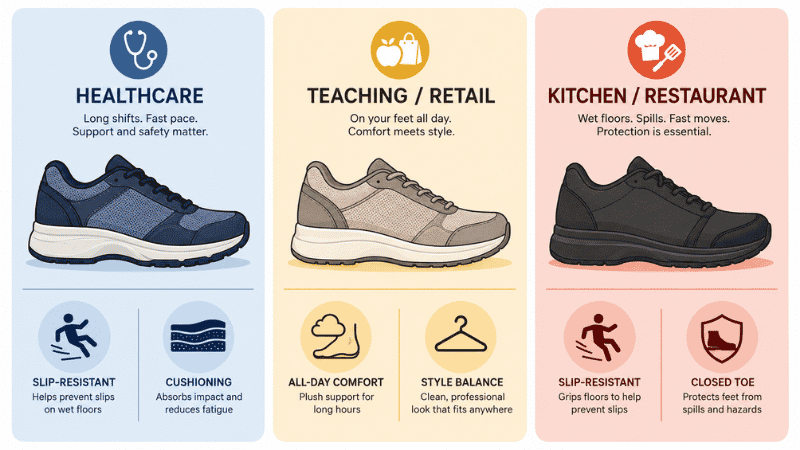
The umbrella term “shoes for standing all day” covers very different occupational demands. Getting specific about your environment changes the recommendation significantly.
Shoes for Nurses and Healthcare Workers
Twelve-hour shifts on hospital-grade floors — a combination of tile, linoleum, and sealed concrete — demand slip resistance, easy cleaning, and sustained cushioning. The healthcare environment also often involves quick direction changes and occasional short sprints that a pure standing shoe doesn’t account for.
What works: a shoe with a textured, slip-resistant rubber outsole, a removable insole (so you can swap in a custom orthotic if needed), and a midsole with genuine resilience — not just initial softness. Hoka’s Bondi SR is purpose-built for exactly this: it has a slip-resistance rating, a thick resilient midsole, and it’s actually designed to be wiped down. The Dansko Professional clog is a longtime healthcare staple for a reason — the rocker sole reduces forefoot fatigue on long standing shifts — but it has almost no lateral support, which matters if your work involves moving quickly.
For nurses with wide feet, New Balance’s 990 series in wide sizes and Brooks’ Addiction Walker in 2E and 4E are worth trying before committing to a single option.
Shoes for Teachers and Retail Workers
Eight hours on classroom or retail floors — typically a combination of hard floors and occasional carpet — is a different demand profile. Slip resistance is less critical. Appearance often matters more. And the walking-to-standing ratio is higher than in healthcare.
A shoe that transitions well between standing and moderate walking — with good forefoot cushioning and a supportive but not overly stiff midsole — is the priority. ASICS Gel-Kayano for stability needs, Brooks Ghost for neutral feet, and On Cloudtilt for people who want something that looks less like a running shoe are consistently strong performers in this category.
For men in professional environments who need something that doesn’t look like a gym shoe: the New Balance 574 in a leather upper or the Cole Haan ØriginalGrand (which has a running shoe sole inside a dress shoe silhouette) are worth looking at. Neither is a purpose-built standing shoe, but both perform meaningfully better than standard dress shoes for extended wear.
Shoes for Restaurant and Kitchen Workers
Wet floors, tight spaces, constant movement. Slip resistance is non-negotiable. So is a closed toe. And because kitchen work involves actual physical labor — not just standing — the shoe needs to handle lateral movement, crouching, and occasional heavy load carrying.
The Skechers Felton is a common recommendation in this space and holds up well for the price. Birkenstock’s Profi Birki clog is popular in professional kitchens for its slip resistance and easy cleaning, though its complete lack of heel retention makes it inappropriate for environments where quick movement is needed. For a more athletic option, the Hoka Bondi SR again performs reliably.
Shoes for Standing All Day: What to Check Before You Buy
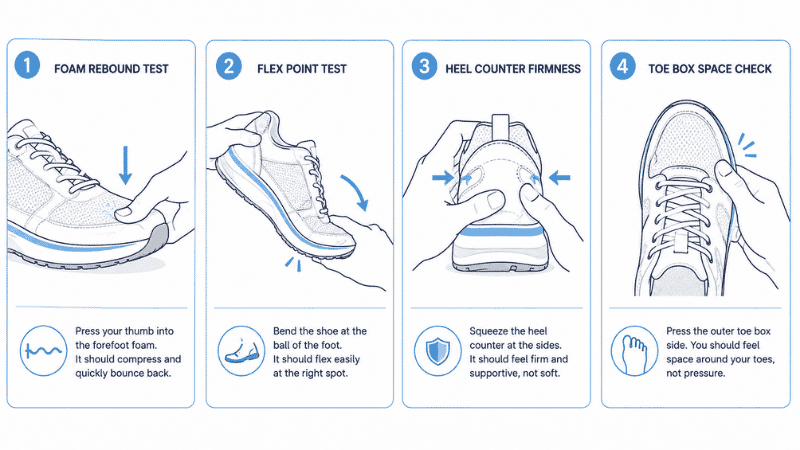
Before committing to any shoe for all-day wear, run through this in under 10 minutes — in the store or when the box arrives:
The foam press test. Press your thumb firmly into the forefoot midsole. Release. Watch how quickly it rebounds. Slow rebound = faster compression fatigue throughout the day.
The flex point test. Hold the shoe at heel and toe, press down. It should flex at the ball of the foot (widest part), not the middle.
The heel counter squeeze. Squeeze the back of the shoe where your heel sits. It should feel firm — not crushable. A soft heel counter means your heel will move inside the shoe during standing, which creates friction and fatigue.
The toe box press. Press the outer side of the shoe at the widest toe area. There should be slight give — not immediate resistance. If it’s rigid there, your toes will be under lateral compression all day.
The late-afternoon rule. If you’re buying in-store, go in the afternoon — your feet are closer to their end-of-day size. If you’re buying online, measure your feet in the afternoon and size to that measurement.
If Your Current Shoes Aren’t Working and You Can’t Replace Them Yet
Sometimes you can’t buy new shoes immediately. Here’s what you can do today:
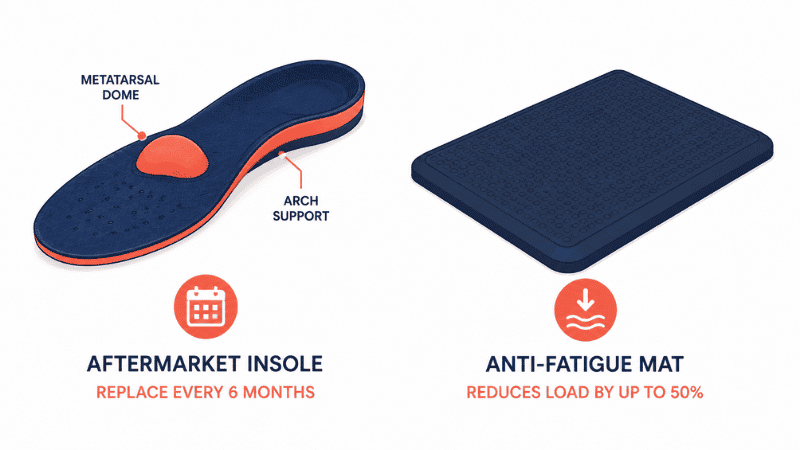
Replace the insole. Most shoes ship with a thin foam insole that compresses within weeks. A $20–35 aftermarket insole — Superfeet Green for high arches, Superfeet Blue for neutral, Powerstep Pinnacle for flat feet — makes a measurable difference in a shoe that’s lost its support. This is the single fastest and cheapest intervention for standing fatigue.
Add a metatarsal pad. If your forefoot specifically hurts, a small adhesive metatarsal dome placed just behind the ball of the foot shifts load off the metatarsal heads. It costs under $10 and works within the first shift.
Rotate two pairs. Wearing the same shoe every day gives the foam no recovery time between uses. If you have two pairs — even if one is cheaper — alternating daily extends the effective cushioning life of both significantly.
When Shoe Changes Aren’t Enough
If you’ve genuinely improved your footwear and foot pain persists after two to three weeks, the shoe was never the whole problem. Possibilities worth investigating:
Compression socks. Lower limb swelling from prolonged standing responds well to graduated compression socks (15–20 mmHg). Reducing fluid accumulation in the foot and ankle reduces the internal pressure that contributes to fatigue pain.
Anti-fatigue mats. If you have any control over your floor surface — a standing desk, a kitchen prep station, a retail counter — a proper anti-fatigue mat (not a thin rubber mat) significantly reduces the compressive load on your feet. Research published in Ergonomics found that anti-fatigue mat use reduced reported discomfort by up to 50% compared to standing on hard flooring.
See a podiatrist if: pain is localized to one specific point, you feel numbness or tingling, pain radiates up the ankle or leg, you’ve developed visible swelling that doesn’t resolve overnight, or symptoms have persisted for more than three weeks despite shoe changes. These patterns suggest structural or medical causes — plantar fasciitis, stress fractures, nerve compression — that require assessment beyond footwear.
Frequently Asked Questions
What shoes are best for standing on concrete all day? Concrete is the hardest common floor surface and requires maximum midsole resilience. Look for shoes with a thick, high-rebound midsole (stack height of 28mm+ at the heel), a firm heel counter, and a structured midsole that won’t compress flat by midday. Hoka’s Bondi series, Brooks Adrenaline GTS, and New Balance 1080 consistently perform well on concrete.
Do nurses prefer clogs or sneakers for long shifts? It depends heavily on the individual’s foot type and shift demands. Clogs — particularly rocker-sole designs like Dansko — reduce forefoot fatigue during extended standing but offer minimal lateral support for quick movement. Athletic sneakers with slip-resistant outsoles offer better overall support for shifts that combine standing with significant walking and direction changes. Many experienced nurses rotate between both depending on the day’s demands.
What makes a good shoe for standing all day at work? Five things: midsole foam that rebounds quickly under sustained compression, a heel drop of 4–8mm for even weight distribution, arch support matched to your foot type, a toe box with room for end-of-day swelling, and an outsole appropriate for your floor surface. Cushioning thickness alone is not a reliable indicator — a thick soft foam that compresses flat by hour four is less useful than a moderately cushioned foam that maintains its structure all day.
How long do shoes for standing all day actually last? For people standing 8+ hours daily, the effective cushioning life of most shoes is 4–6 months — significantly shorter than the 300–500 miles typically cited for running shoes. The midsole compresses faster under sustained static load than under dynamic impact. If your shoes are more than six months old and you wear them for all-day standing, the foam is likely meaningfully degraded regardless of how the upper looks.
Are expensive shoes worth it for standing all day? In this specific use case, yes — more than for casual wear. The difference in foam technology between a $50 shoe and a $120–150 shoe is genuinely meaningful for sustained standing. That said, spending over $150 doesn’t reliably buy proportionally better performance. The $110–140 range from Brooks, ASICS, and New Balance covers the majority of needs without premium pricing.
Can the wrong shoes cause back pain from standing? Yes, and the mechanism is well-documented. Poor foot support during prolonged standing alters alignment up the kinetic chain — overpronation shifts the tibia inward, which affects knee tracking, which affects hip positioning, which creates compensatory lumbar strain. Lower back pain that appears or worsens during standing shifts and resolves with rest is a common symptom of footwear-related alignment issues. Addressing foot support often produces measurable back pain improvement.
The Bottom Line
The shoes most people buy for all-day standing fail not because they’re low quality — they fail because they’re the wrong tool for the job. A running shoe optimized for forward motion, a fashion sneaker optimized for aesthetics, or a work shoe optimized for appearance all make compromises that become painful over eight to twelve hours of sustained standing.
What your feet need for all-day standing is specific: resilient foam that doesn’t compress flat, appropriate heel drop, arch support matched to your structure, enough toe room for afternoon swelling, and floor-appropriate grip. Once you know what to look for, the options become much clearer — and so does the reason your previous shoes didn’t work.
If you’re dealing with ball-of-foot pain specifically from standing, our guide on why the ball of your foot hurts and how shoes cause it covers the mechanics in detail. And if you’re still figuring out your foot type before making a decision, our foot measurement guide will walk you through everything you need to know in under ten minutes.
References
- Madeleine, P., et al. “The effect of prolonged standing on lower extremity discomfort.” Applied Ergonomics, 2018.
- Cham, R., & Redfern, M.S. “Heel contact dynamics during slip events on level and inclined surfaces.” Safety Science, 2002.
- Thiese, M.S., et al. “Shoe type, floor surface, and lower extremity musculoskeletal disorders.” Journal of Occupational and Environmental Medicine, 2014.
- American Podiatric Medical Association (APMA). Workplace Foot Health. apma.org
- Rys, M., & Konz, S. “Standing.” Ergonomics, 1994.
- Zander, J.E., et al. “Effect of insole features on comfort, leg fatigue and leg pain of standing workers.” Applied Ergonomics, 2004.