
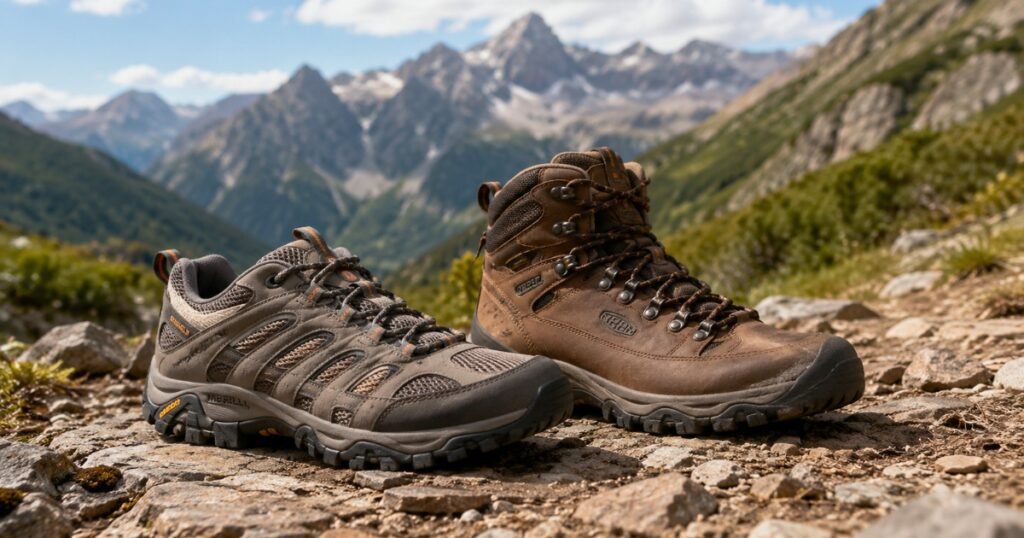
outdoor store and you’ll probably hear that boots offer the best protection, while a quick look online will tell you everything from “trail runners are all you need” to “never hike without boots.” No wonder choosing your first pair—or replacing an old one—can feel more confusing than it should.
The truth is, there isn’t one right answer. The best choice depends on where you hike, how much you’re carrying, the weather, and even how your feet are built. A rocky backpacking trip with a heavy pack calls for something very different from an easy day hike on well-maintained trails.
In this guide, we’ll compare hiking shoes vs boots in the areas that actually matter: comfort, support, weight, durability, waterproofing, and fit. You’ll also learn when trail runners make sense, how to choose for your foot shape, and the beginner mistakes that lead to sore feet and wasted money—so you can buy the right footwear with confidence.
Overview: The Quick Answer
Hiking shoes are the better choice for most day hikers on moderate trails, while hiking boots make more sense for heavy packs, rough terrain, cold or wet conditions, and multi-day backpacking trips. Neither one is objectively superior — they’re built for different jobs.
Quick decision card:
- Choose hiking shoes if: you’re doing day hikes, walking well-maintained trails, carrying a light pack (under roughly 20 lbs), or prioritizing comfort and low fatigue.
- Choose hiking boots if: you’re backpacking with a heavy load, crossing rough or uneven terrain, hiking in cold or snowy conditions, or you simply feel more confident with ankle coverage.
- Consider trail runners instead if: you want maximum weight savings, you hike frequently in warm weather, or you’re comfortable with less structured support.
| Factor | Best Fit |
|---|---|
| Easy to moderate trails | Hiking shoes |
| Rocky, uneven, or alpine terrain | Hiking boots |
| Day hikes, light pack | Hiking shoes |
| Multi-day backpacking, heavy pack | Hiking boots |
| Hot, dry climate | Non-waterproof shoes |
| Cold, wet, or snowy climate | Waterproof boots |
| Beginner hikers | Often shoes, unless carrying heavy gear |
| Fast-paced or fastpacking hikers | Trail runners or lightweight shoes |
This table is a starting point, not a rulebook — plenty of experienced hikers break these patterns based on personal preference. The sections below explain the reasoning so you can make the call with confidence.
Hiking Shoes vs Boots: What’s the Real Difference?
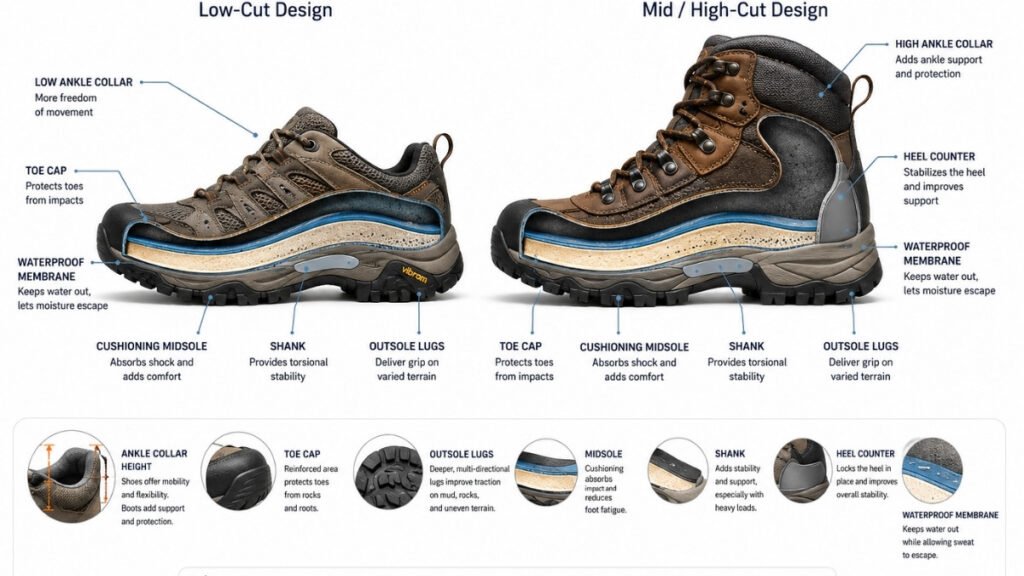
Hiking shoes and hiking boots are designed for different kinds of hikes. Understanding their key differences is the easiest way to choose the right pair for your trail, terrain, and hiking style.
Hiking Shoes Overview
Hiking shoes are low-cut, lightweight, and designed for flexibility. They typically weigh less, require little to no break-in, and feel closer to a supportive sneaker than a stiff outdoor boot. They’re built for day hikes, well-marked trails, and hikers who prioritize agility and reduced fatigue over maximum protection.
Hiking Boots Overview
Hiking boots are mid-cut or high-cut, with stiffer midsoles, more structured ankle coverage, and reinforced toe boxes. They’re heavier, often need a break-in period, and are designed to handle rough terrain, heavier loads, and multi-day trips where durability and protection matter more than speed.
| Feature | Hiking Shoes | Hiking Boots |
|---|---|---|
| Cut height | Low-cut | Mid to high-cut |
| Typical weight | Lighter | Heavier |
| Stability | Moderate | High |
| Cushioning | Trail-focused | Load-focused |
| Protection | Basic | Reinforced |
| Durability | Good for moderate use | Built for heavy, rugged use |
| Price range | Generally lower | Generally higher |
| Break-in needed | Minimal | Often required |
Beginners walk into an outdoor store, see a sturdy-looking boot, and assume it’s automatically the “correct” hiking purchase. In reality, many end up with sore, overheated feet on trails that never actually demanded that much boot. Matching the shoe to the trail — not to how rugged it looks — is what actually improves the hiking experience.
Hiking Shoes vs Boots: The Differences That Matter Most
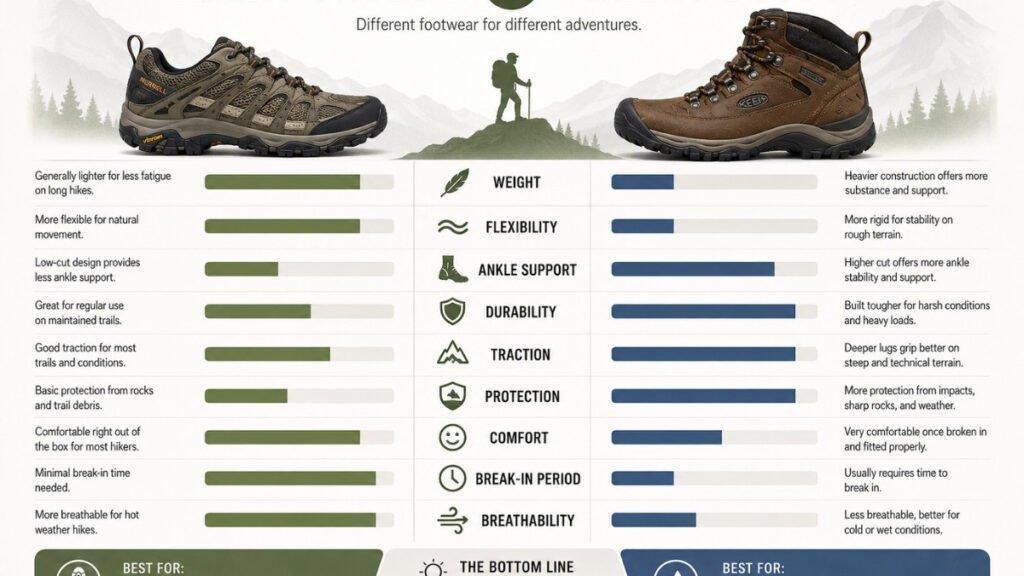
Some differences stand out the moment you start hiking, while others only become noticeable after a few miles. The factors below have the biggest impact on comfort, stability, and overall trail performance.
Weight vs Energy Savings
There’s a well-known principle among hikers: a pound on your feet costs roughly the same energy as five pounds on your back. Footwear weight matters more than most people expect, especially over long distances, because your legs lift that weight thousands of times per hike.
Protection vs Flexibility
Hiking boots offer more protection from rocks, roots, and impact, thanks to stiffer midsoles and reinforced uppers. Hiking shoes trade some of that protection for flexibility, which lets your foot move more naturally and reduces overall fatigue on moderate terrain.
Midsole Support and Foot Fatigue
A stiffer midsole reduces foot flex, which can help on rocky terrain but may feel restrictive on smoother trails. Softer, more flexible midsoles feel more natural for shorter hikes but offer less support under a loaded pack.
| Category | Hiking Shoes | Hiking Boots |
|---|---|---|
| Energy efficiency | Higher | Lower |
| Foot protection | Moderate | Higher |
| Trail feel | More natural | More structured |
| Long-day comfort | Strong for light loads | Strong for heavy loads |
| Rocky terrain stability | Fair | Better |
Common for people to underestimate how tiring heavier footwear feels by the end of a long day. What seems like a minor weight difference at the store can translate into noticeably more fatigue eight or ten miles in — particularly for hikers who aren’t used to boots.
Does a High-Cut Boot Really Prevent Ankle Injuries?
High-cut boots do not prevent ankle sprains the way most people assume. They can improve stability and confidence on uneven ground, but ankle injury prevention depends far more on muscle strength, trail awareness, and hiking technique than on boot height alone.
The Myth of Ankle Support
The idea that a taller boot “locks” the ankle in place and stops rolls is mostly mechanical folklore. In practice, ankle stability comes from the muscles and tendons surrounding the joint, not from fabric or leather wrapped around it. Boots can limit range of motion slightly, but they don’t eliminate the forces that cause a sprain.
What Boots Actually Protect Against
Where boots genuinely help is in protecting against impact, abrasion, and debris — things like sharp rocks, thorny brush, or cold exposure at the ankle. They can also improve a hiker’s sense of stability, which matters psychologically even if the mechanical support is limited.
Who Benefits Most from Boots
Hikers carrying heavy packs, walking on loose scree, or dealing with unpredictable terrain often do benefit from the added structure boots provide, simply because a stiffer platform reduces how much the foot has to work to stay steady under load.
Many experienced hikers actually prefer low-cut shoes even on technical trails, because they’ve built up enough ankle strength and trail awareness that added boot height feels unnecessary — and sometimes restrictive. Trekking poles, meanwhile, often provide more real-world stability on uneven ground than boot height ever will.
Which Works Better for Different Terrain, Distance, and Pack Weight?
Terrain and pack weight tend to matter more than mileage. A short but steep, loaded backpacking trip often calls for more support than a long, flat day hike.
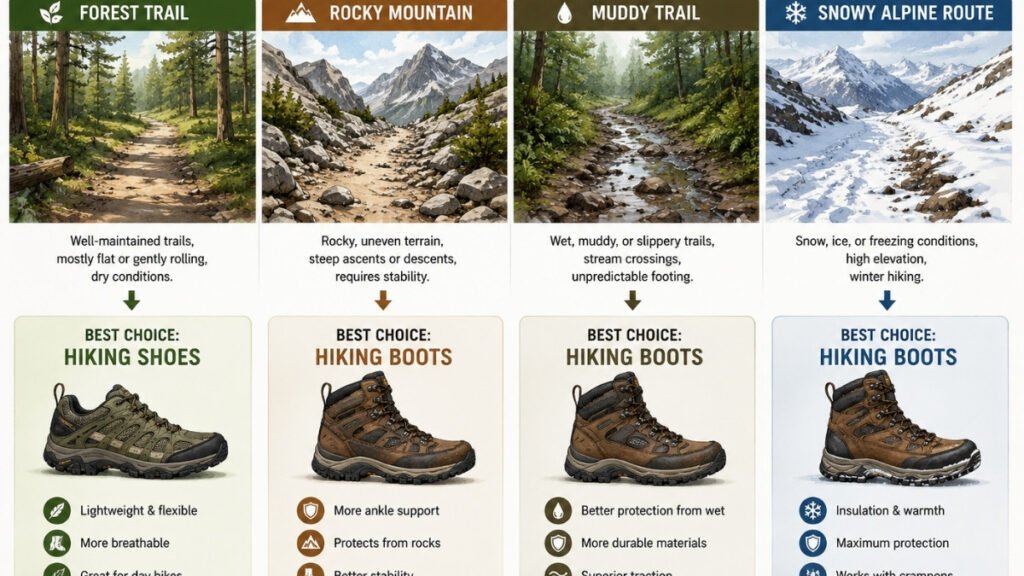
| Situation | Recommended Footwear |
|---|---|
| Easy day hike, light pack | Hiking shoes or trail runners |
| Rocky or technical terrain | Hiking boots |
| Muddy or loose scree trails | Hiking boots with good tread |
| Alpine or high-elevation routes | Hiking boots |
| Snow or icy conditions | Insulated, waterproof boots |
| Multi-day backpacking, heavy pack | Hiking boots |
| Fastpacking or ultralight trips | Trail runners |
Simple decision guide:
- Is your pack heavy (25+ lbs) or your terrain rough? → Choose boots.
- Is your trail well-maintained and your pack light? → Choose hiking shoes.
- Do you prioritize speed and minimal weight over structure? → Consider trail runners.
A common regret people describe is buying stiff, heavy boots for casual weekend day hikes, then finding them overkill — hot, heavy, and unnecessary for the terrain. The opposite mistake also happens: hikers head into rocky, multi-day backcountry trips in lightweight shoes and end up with sore feet and less stability than they need under a full pack.
Waterproof vs Non-Waterproof: Which Is Actually Better?
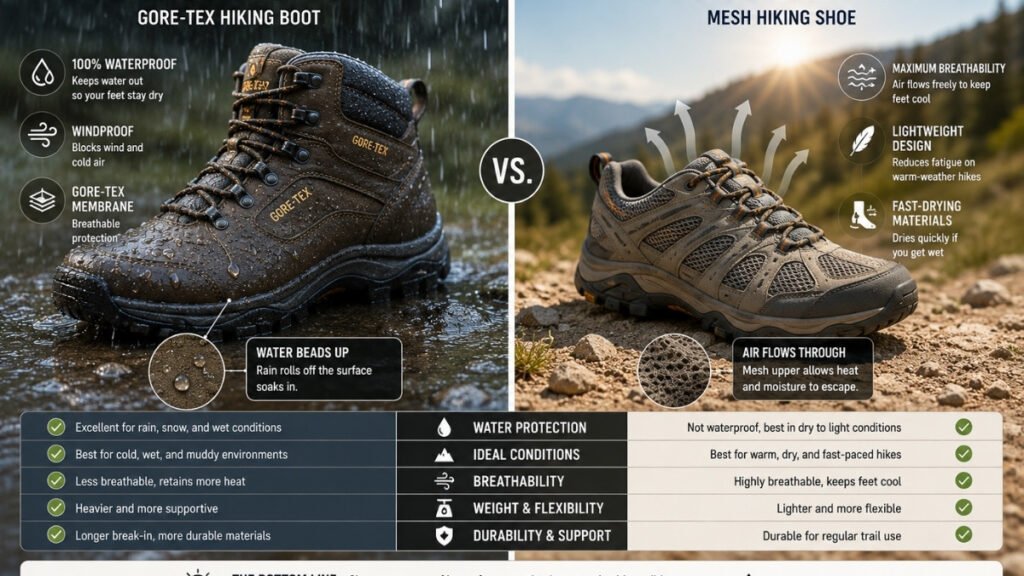
waterproof footwear is worth it in cold, wet, or muddy conditions, while non-waterproof footwear is usually more comfortable in warm or dry climates.
Benefits of Waterproof Footwear
Waterproof membranes like Gore-Tex keep water out during light rain, dew-covered grass, and shallow puddles. They also tend to retain some warmth, which is useful in cold-weather hiking.
Benefits of Non-Waterproof Shoes
Mesh and non-waterproof footwear breathe better, dry faster, and generally run cooler. In hot weather, that breathability often prevents more discomfort than a waterproof membrane prevents from moisture.
Best Choice by Climate
| Condition | Better Option |
|---|---|
| Hot, dry climate | Non-waterproof (mesh) |
| Cold, wet climate | Waterproof (GTX) |
| Frequent stream crossings | Non-waterproof (dries faster) |
| Light rain, cool weather | Waterproof |
| Humid, sweaty conditions | Non-waterproof |
A detail that surprises a lot of hikers: once waterproof footwear takes on water from a deep crossing or gets soaked through from above, it often stays wet far longer than non-waterproof shoes, since the same membrane that keeps water out also slows water from escaping. In hot, humid conditions, waterproof shoes can also trap sweat, leading to damp socks and a higher chance of blisters.
Choosing the Right Fit for Your Foot Shape
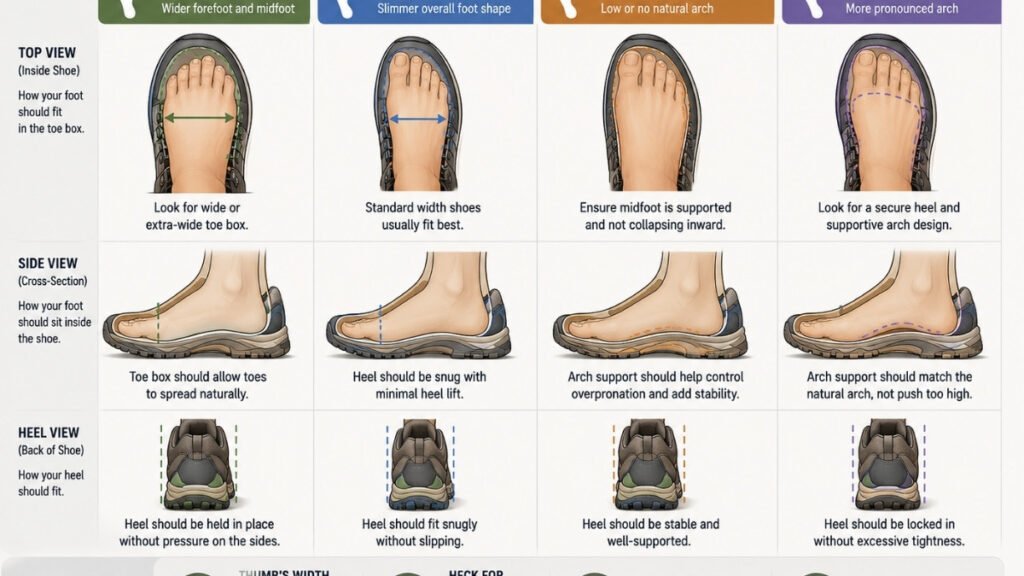
Fit matters more than brand, price, or reputation. The right footwear should match your specific foot shape — width, arch height, and toe box needs — rather than a generic “average” last.
Wide Feet
Hikers with wide feet often need a roomier toe box and a wider forefoot to avoid pinching, numbness, or black toenails on descents. If you frequently deal with this, a [wide toe box walking shoes] guide can help you shortlist better-fitting models before you even try boots on.
High Arches
High arches usually benefit from firmer arch support and cushioned insoles that prevent pressure buildup along the midfoot.
Flat Feet
Flatter feet often do better with more structured stability features and motion control to avoid overpronation-related fatigue.
Narrow Heels
A narrow heel paired with a wider forefoot can be tricky to fit — look for models with adjustable lacing systems and a secure heel lock to prevent slipping.
| Foot Type | Recommended Footwear Traits |
|---|---|
| Wide feet | Wide toe box, roomier forefoot |
| Narrow feet | Snug heel lock, adjustable lacing |
| High arches | Firm arch support, cushioned insole |
| Flat feet | Stability features, motion control |
| Swelling-prone feet | Slightly roomier fit, room to size up |
A poor match between foot shape and shoe last is one of the most common (and most preventable) causes of blisters — even in premium, expensive footwear. If you’re unsure where you fall, comparing your arch type against a [flat feet vs high arches guide] and confirming your exact measurements with a proper [how to measure your foot size] check are two of the simplest ways to avoid an expensive fitting mistake.
Men’s vs Women’s Hiking Shoes and Boots: Does It Matter?
Yes — but not because of color or styling. Men’s and women’s hiking footwear are typically built on different lasts, with real differences in heel width, forefoot volume, and cushioning tuning.
Women’s-specific models generally feature a narrower heel, a lower-volume forefoot, and softer midsole tuning that accounts for average differences in stride and weight distribution, including Q-angle considerations. Men’s models tend to have a wider forefoot and firmer cushioning built for a different average weight and stride pattern.
| Factor | Men’s Design | Women’s Design |
|---|---|---|
| Heel width | Wider | Narrower |
| Forefoot volume | Higher | Lower |
| Cushioning | Firmer | Softer |
| Weight | Slightly heavier build | Slightly lighter build |
| Fit philosophy | Broader average last | Narrower average last |
These are averages, not rules. Some hikers achieve a noticeably better fit by shopping outside the traditional gender category altogether — a woman with a wider forefoot may fit better in a men’s model, and a man with a narrower heel may prefer a women’s last. The label on the box matters far less than how the shoe actually fits your foot.
How to Find the Right Fit Before You Buy
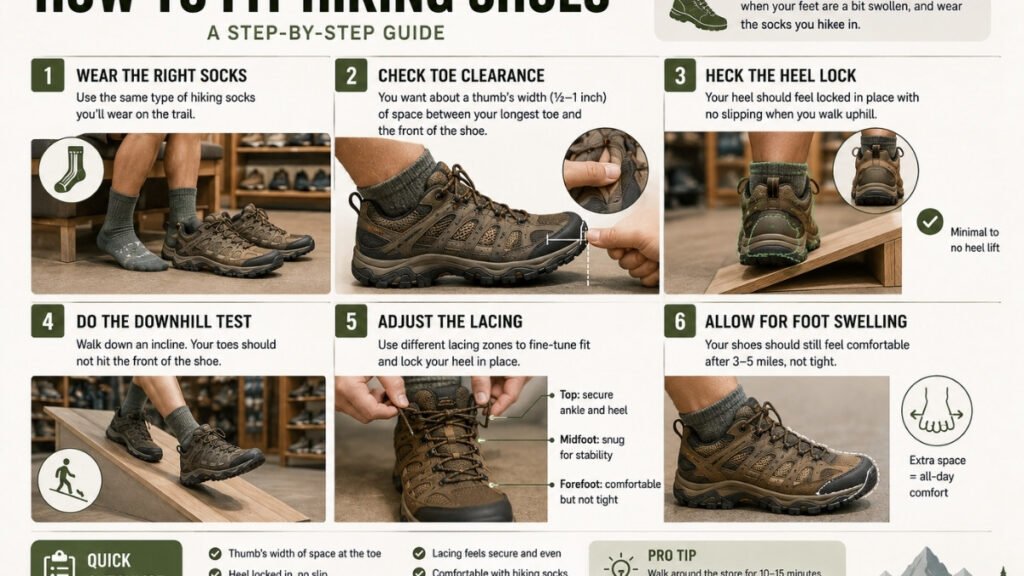
A hiking shoe can feel great in the store but completely different on the trail. Spending a few extra minutes checking the fit now can save you from blisters, sore feet, and an expensive mistake later.
In-store fitting checklist:
- Try shoes on in the afternoon, when feet are naturally more swollen (closer to trail conditions).
- Wear the hiking socks you actually plan to use.
- Check for a snug heel lock with no slipping when you walk.
- Confirm about a thumb’s width of toe clearance in front of your longest toe.
- Walk on a downhill incline or decline ramp if the store has one, to test for toe-bumping.
- Adjust the lacing and re-test fit — don’t judge a shoe based on factory lacing alone.
- Leave a little room for foot swelling on long hikes, especially in warm weather.
- Confirm the store or retailer’s return policy in case the fit feels wrong after a short walk at home.
One of the most useful things you can do in-store is the downhill toe-bump test: walk down an incline and pay attention to whether your toes hit the front of the shoe. If they do, that same movement will likely cause discomfort or black toenails on a real descent — a much cheaper lesson to learn in a shoe store than five miles into a hike.
Common Beginner Mistakes to Avoid
Most footwear problems come from mismatched expectations rather than defective products. These are the mistakes that come up again and again.
Beginner mistakes checklist:
- Assuming boots eliminate ankle injuries — leads to overconfidence on technical terrain instead of building actual ankle strength.
- Buying waterproof footwear for every trip — often causes overheating and sweaty feet in warm-weather hikes.
- Ignoring break-in periods — stiff boots worn straight out of the box on a long hike are a common cause of blisters and hot spots.
- Switching to zero-drop shoes too quickly — sudden changes in heel-to-toe drop can strain calves and Achilles tendons before the body adapts.
- Choosing hiking shoe size based on casual sneakers — hiking footwear often fits differently and needs more room for swelling and thicker socks.
- Ignoring foot swelling on long hikes — a shoe that fits perfectly at home can feel painfully tight eight miles in.
- Underestimating footwear weight — an extra pound per shoe adds up over a full day of hiking, especially on longer trails.
Many beginners notice these issues only after a few uncomfortable hikes, which is exactly why they show up so often in hiking discussions. Recognizing them ahead of time is the fastest way to skip the trial-and-error phase entirely.
Choosing the Right Hiking Shoes or Boots for Your Hiking Style
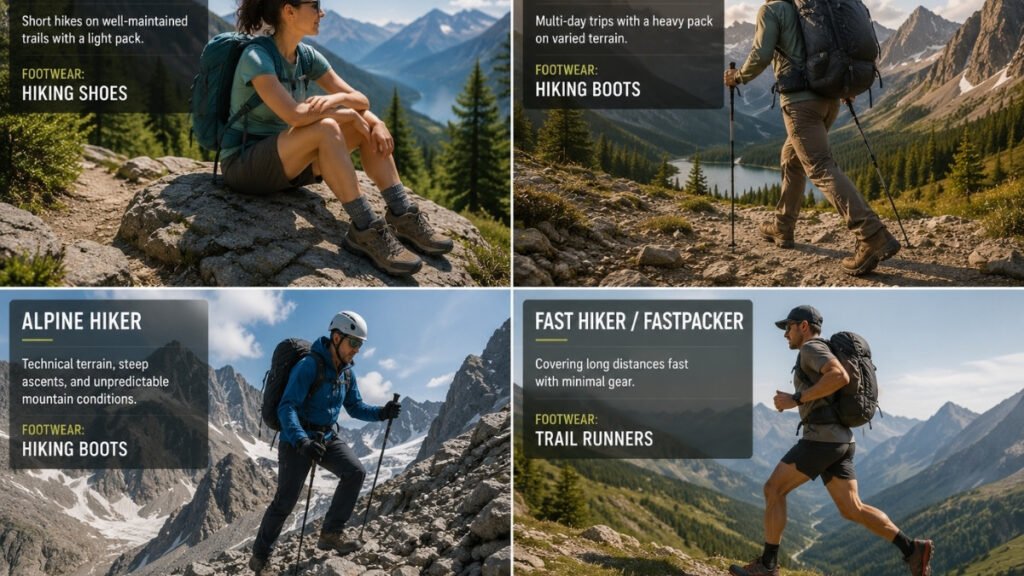
The best hiking footwear isn’t the same for everyone. A lightweight day hiker, a weekend backpacker, and someone tackling rocky mountain trails all need different levels of support, protection, and durability.
| Category | What to Look For |
|---|---|
| Best overall hiking shoe | Balanced cushioning, moderate weight, versatile tread |
| Best hiking boot | Reinforced ankle support, stiffer midsole, durable outsole |
| Best budget pick | Solid tread and cushioning without premium materials |
| Best for wide feet | Roomier toe box, wide-fit last |
| Best for backpacking | High-cut support, load-rated stability |
| Best lightweight option | Minimal weight, flexible midsole |
| Best waterproof option | GTX membrane, reinforced seams |
| Best women’s model | Narrower heel, softer cushioning tuning |
| Best men’s model | Wider forefoot, firmer support |
No single shoe excels in every hiking scenario — a boot built for heavy backpacking will rarely feel as comfortable on a casual day hike, and an ultralight shoe built for speed won’t hold up the same way on a multi-day trip with a loaded pack. Choosing based on how you actually hike, rather than a “best overall” label, consistently leads to better results.
FAQ
What is the difference between hiking shoes, hiking boots, and trail runners? Hiking shoes are low-cut and moderately supportive, hiking boots are mid-to-high-cut with more structure and protection, and trail runners are the lightest and most flexible of the three, designed for speed over maximum support. The right choice depends on terrain, pack weight, and personal preference. As a starting point, match footwear height to how rugged your terrain is and how much weight you’re carrying.
Do hiking boots really provide better ankle support than low-cut hiking shoes? Boots offer some added stability and protection, but they don’t mechanically prevent ankle sprains the way many people assume. Real ankle stability comes primarily from muscle strength and hiking technique. If you have weaker ankles or hike on rough terrain, boots can still add helpful confidence and protection.
Are trail running shoes good enough for long-distance backpacking or thru-hiking? Yes, for many hikers — trail runners are widely used on long-distance trails because of their weight savings and comfort, even under moderate packs. They may offer less structural support than boots, so hikers carrying heavier loads or navigating rough terrain should weigh that trade-off carefully.
Should I choose waterproof (Gore-Tex) or non-waterproof footwear for hiking? Choose waterproof footwear for cold, wet, or muddy conditions, and non-waterproof footwear for hot or dry climates where breathability matters more. Waterproof membranes also dry more slowly once soaked through, which is worth considering for frequent stream crossings.
When should beginners wear hiking boots instead of lighter shoes? Beginners should lean toward boots mainly when carrying a heavy pack, hiking on rough or uneven terrain, or hiking in cold or wet conditions. For flat, well-maintained day hikes, lighter hiking shoes are usually more comfortable and just as capable.
How do I decide between hiking shoes and trail runners for day hikes? For most maintained day-hike trails, either option works well; trail runners save more weight, while hiking shoes offer slightly more structure and durability. If you value speed and minimal fatigue, trail runners tend to edge ahead; if you want more support and protection, hiking shoes are the safer pick.
Do hiking boots last significantly longer than trail runners? Generally, yes — hiking boots are built with more durable materials and reinforced construction, so they tend to outlast trail runners, especially on rugged or rocky terrain. Trail runners wear out faster but cost less to replace, so the total cost difference is often smaller than it first appears.
How can I prevent blisters and heel pain when switching to new hiking footwear? Break in new footwear gradually with shorter walks before a long hike, wear proper hiking socks, and double-check fit around the heel and toe box. Persistent blisters in the same spot usually point to a fit issue rather than something you can simply “walk off.”
Final Thoughts
The best hiking footwear isn’t the one with the best reviews or the most rugged look — it’s the one that matches your terrain, pack weight, climate, foot shape, and hiking goals. Hiking shoes serve most day hikers well, while boots earn their weight on rougher terrain, heavier loads, and colder conditions. Rather than searching for a single “superior” option, the smartest approach is matching your footwear to how you actually hike.
🥾 Behind This Guide
Choosing between hiking shoes and boots isn’t as simple as picking the taller or more expensive option. The right choice depends on the trails you hike, the weight you carry, and what feels comfortable after hours on your feet.
That’s why this guide focuses on the questions beginners ask most—from support and waterproofing to fit, comfort, and when boots are actually worth it. Every recommendation is designed to help you compare the options clearly instead of relying on myths or marketing claims.
The goal isn’t to convince you that one style is better than the other. It’s to help you choose the footwear that fits your hiking style with confidence.
Continue Learning About Shoe Fit and Foot Comfort
Choosing the right hiking footwear is only one part of finding shoes that truly fit your needs. These guides can help you understand your feet, improve comfort, and make smarter footwear decisions in the future.
- Flat Feet vs High Arches Guide — Learn how your arch type affects comfort, support, and shoe selection.
- Wide Toe Box Walking Shoes — Discover why extra toe room can reduce pressure and improve all-day comfort.
- How to Measure Your Foot Size — Measure your feet correctly before buying shoes online or in-store.
- Shoe Wear Patterns Guide — Understand what uneven outsole wear can reveal about your walking and running mechanics.
- How to Clean Shoes Guide — Keep your hiking shoes and boots clean to extend their lifespan and maintain performance.
- How to Stretch Shoes Guide — Safe ways to make snug shoes more comfortable without damaging the materials.
❤️ A Final Note
Finding the right shoes shouldn’t be guesswork.
At KickVerdict, we create practical guides, honest comparisons, and real-world recommendations to help you choose the right footwear for your activities, foot shape, and everyday life.
Our goal is simple: helping you make smarter footwear choices with confidence.