
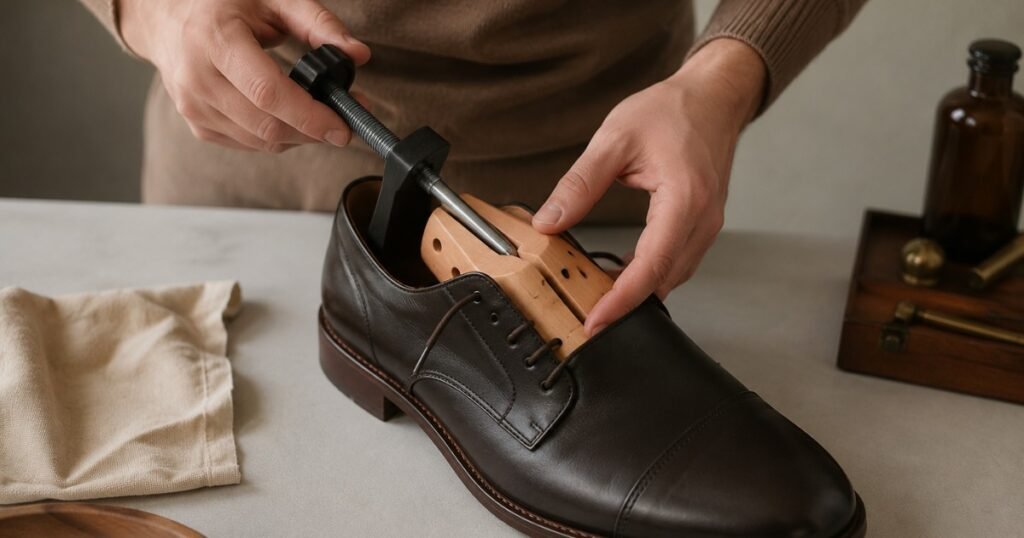
Few things are more disappointing than putting on a new pair of shoes and realizing they hurt after just a few minutes. Maybe the toe box feels too narrow. Maybe the leather presses against your little toe. Or maybe the shoes fit almost perfectly—except for one spot that refuses to break in.
At that point, most people start looking for ways to stretch their shoes. Unfortunately, the internet is full of advice that ranges from mildly helpful to genuinely destructive. Before trying any method, it’s worth understanding what your shoes are made of, how much they can realistically stretch, and when returning them is actually the smarter choice.
Here’s what most stretching guides won’t tell you: the question isn’t just how to stretch a shoe. The real question is whether the shoe is worth stretching at all — and if it is, which method won’t destroy it in the process. I’ve seen the Reddit threads full of cracked synthetic leather, deformed midsoles, and shoes that came out of the freezer looking like they’d been in an accident. Most of those outcomes were avoidable with about two minutes of understanding what the shoe is made of before doing anything to it.
This guide skips the gimmicks. It covers what actually works, what material you’re working with, when stretching is the right call, and when returning the shoes is the smarter move.
Before You Start
- Shoes can be stretched, but material determines method — real leather is the most forgiving, synthetic leather and mesh are the most fragile, and some materials should never be stretched at all.
- Width stretches; length does not. You can gain meaningful space across the toe box and forefoot. Stretching shoe length is largely a myth — half a size is an absolute ceiling, and usually the realistic gain is less.
- The safest stretching methods — thick socks with gradual wear, professional shoe stretching service, two-way shoe stretcher with stretching spray — work slowly and reliably. The DIY shortcuts (freezer, wet newspaper, alcohol) cause more damage than they fix.
- Shoes rubbing at the heel are almost never a stretching problem. They’re usually a length or volume problem — stretching the shoe won’t fix heel slip, and often makes it worse.
- According to the American Podiatric Medical Association, shoes that don’t fit correctly from the start are one of the leading causes of foot pain, blisters, and long-term structural foot problems. Stretching is a last adjustment, not a substitute for correct sizing.
- If a shoe requires more than half a size of stretching to feel comfortable, it is almost certainly the wrong size. No stretching method compensates for a fundamental fit mismatch.
The Truth Nobody Tells You: Shoes Don’t Stretch as Much as You Think
Can shoes actually become bigger?
Yes — in one direction. Shoes can gain width. The upper material, the side seams, and the toe box can all yield slightly to pressure over time, creating more lateral room. This is the mechanism behind the break-in period that new shoes have.
What shoes cannot do is grow longer. Length is determined by the last — the three-dimensional form the shoe was built around — and by the outsole, which doesn’t stretch. If your longest toe is pressing the front of the shoe, stretching won’t help you. Sizing up will.
Stretching width vs stretching length
Width stretching is real and achievable. Targeted pressure on the toe box, the forefoot, or a specific pressure point (like a bunion area) can create 3–6mm of additional width in a leather or suede shoe. Done correctly, this is a legitimate adjustment that makes a well-sized shoe more comfortable.
Length stretching is almost entirely a myth. What people sometimes perceive as the shoe “stretching longer” is actually the shoe conforming more closely to the foot’s arch shape over time, which changes the feel. The outsole length doesn’t change. If you’re trying to fix a length problem with a stretching method, you’re going to be disappointed.
Why half a size is usually the absolute limit
Every stretching method — mechanical, heat-based, or gradual wear — has a ceiling determined by the material’s elasticity. Real leather in good condition can yield roughly one half-size of width accommodation. Canvas and some textile uppers can go slightly further. Synthetic leather and knit materials vary dramatically and often revert after stretching.
The practical implication: if a shoe feels one full size too small in width, no stretching method will fix it. You need a wider size or a wider-last brand.
When stretching is simply the wrong solution
Stretching doesn’t fix the wrong size. It doesn’t fix a toe box that’s too shallow (not wide, but flat — pressing down on the toes). It doesn’t fix heel slippage caused by a shoe that’s too long. It doesn’t fix arch pain caused by insufficient support. And it doesn’t extend a shoe that’s been built for a different foot shape than yours.
If you’ve had shoes resoled, stretched, padded, and taped — and they still hurt — the shoe is wrong for your foot. No amount of modification changes that.
Step One: Know What Your Shoes Are Made Of
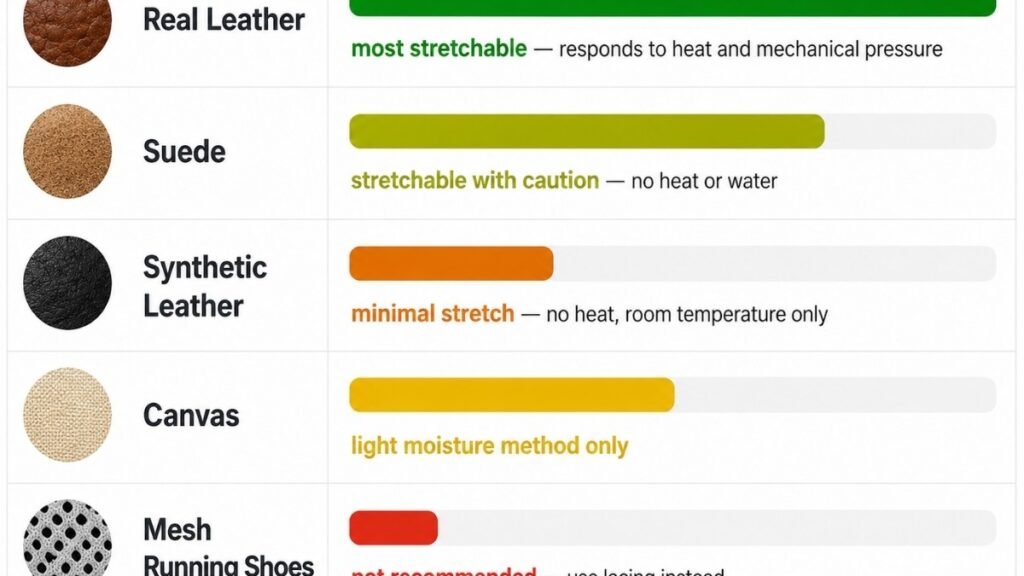
This is the part most guides skip, and it’s the most important. The same stretching method that works beautifully on leather will destroy synthetic leather or ruin the waterproofing on a running shoe. Before touching your shoes, identify the material.
| Problem | Stretch? | Better Solution |
|---|---|---|
| Toe box feels tight | ✅ Yes | Stretch |
| Shoe feels too narrow | ✅ Sometimes | Stretch or buy Wide |
| Toes touch the front | ❌ No | Exchange for a larger size |
| Heel slips | ❌ No | Heel grips or different size |
| Running shoe feels tight | ⚠️ Rarely | Change lacing |
Real leather
Real leather is the most stretch-friendly material. The collagen fiber structure of genuine leather responds well to heat, moisture, and mechanical pressure — it softens, yields, and then holds its new shape as it dries. A quality leather shoe can gain meaningful width from a shoe stretcher, thick-sock walking sessions, or professional stretching without any lasting damage.
After any water or heat exposure, leather needs conditioning. The stretching process depletes the natural oils that keep leather supple. Skip the conditioner and the leather dries out, cracks over time, and loses the flexibility that made it stretchable in the first place.
Suede
Suede is real leather, just with the surface buffed to expose the inner fiber — which makes it more delicate than smooth leather. It responds to gentle stretching with a stretcher or thick-sock sessions, but it’s significantly more vulnerable to heat and moisture. A hair dryer on suede can cause permanent color changes and surface damage. Water creates watermarks that are difficult or impossible to remove.
Stretch suede slowly, with mechanical pressure only. No hair dryer. No damp methods. Finish with suede protector spray after stretching.
Synthetic leather / Vegan leather
This is where most stretching disasters happen, and I’ve contributed one myself. I had a pair of vegan leather boots that were tight across the instep. I used a hair dryer on medium heat for about ninety seconds, the way I’d done with real leather before. The surface cracked in a pattern that looked like dried mud. The shoes were unwearable.
Synthetic leather is a fabric base coated with PU or PVC plastic. It doesn’t have the fiber structure of real leather, so it doesn’t yield to heat and pressure the way leather does. Instead, the coating softens and then cracks, peels, or separates from the base. The adhesives holding the sole to the upper are also vulnerable to heat.
For synthetic leather: gentle mechanical stretching only, at room temperature. No heat. No moisture beyond a very light spray of dedicated shoe stretching spray. Expect less yield than real leather and more reversion after the stretcher is removed.
Canvas
Canvas is a woven cotton fabric. It responds well to slight moisture — a very light misting before wearing with thick socks can help it relax and conform. What canvas doesn’t handle is being saturated with water, which can cause the fabric to shrink unevenly when it dries, the dye to bleed, and the board material in the insole to warp.
Light moisture, yes. Submersion or soaking, no.
Running shoe mesh and knit uppers
Mesh and engineered knit look like they should stretch easily — they’re soft, flexible, and give when you squeeze them. The reality is more complicated. Mesh fibers have elasticity, which means they’ll accommodate pressure temporarily and then spring back. Stretching a mesh upper doesn’t hold the same way stretching leather does.
More importantly, most running shoes are built with overlays, toe caps, and internal structure that limit how much the upper can actually expand. And the midsole foam — EVA or similar compounds — doesn’t benefit from any stretching process. In fact, excess pressure or heat on foam midsoles can compress or deform the cushioning cells permanently.
For running shoes, the lacing approach is almost always better than any stretching attempt. More on that below.
The Best Ways to Stretch Shoes (Ranked by Safety)
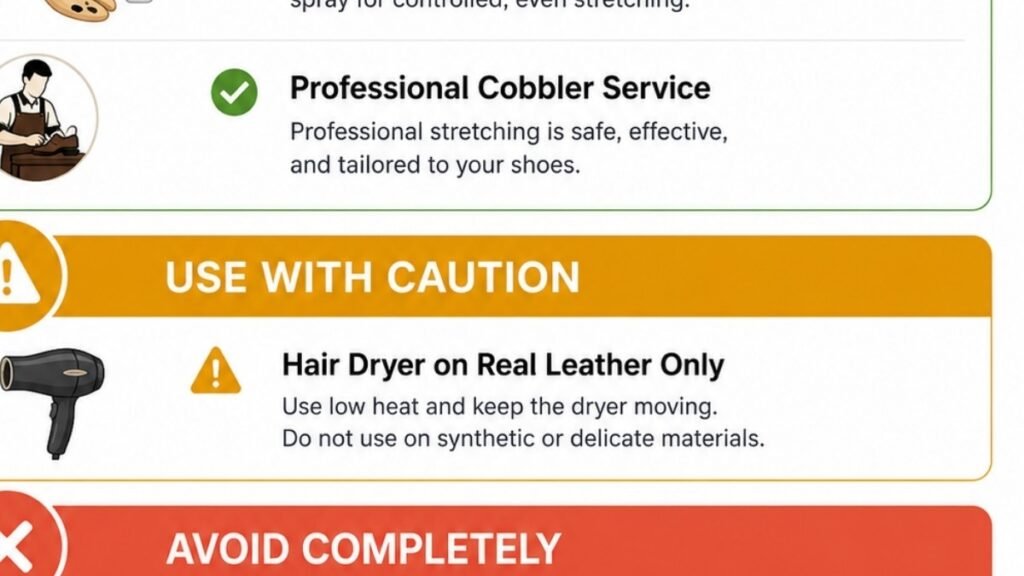
Safe and Recommended
Thick socks and gradual walking
The slowest method and the most reliable. Put on the thickest socks you own, force the shoes on, and wear them around the house for 20–30 minutes. Repeat daily. The combination of your foot’s heat, the pressure from the socks, and the movement gradually stretches the material in exactly the pattern your specific foot needs — which no mechanical stretcher can replicate precisely.
This works for any material except extremely rigid synthetic leather. It’s slow (expect a week of sessions), but the results hold because the material has conformed to your actual foot shape rather than to a generic stretcher form.
Two-way shoe stretcher with stretching spray
A quality two-way shoe stretcher is the most controlled method available outside of professional service. It applies pressure to both the length and width dimensions (though focus on the width, which actually changes), and you can add bunion plugs to apply targeted pressure to specific pressure points.
Stretching spray — usually a dilute isopropyl alcohol solution for leather — relaxes the fibers before mechanical expansion. Spray, insert the stretcher, expand to the point of moderate resistance, and leave for 24–48 hours. The longer, the better for leather.
This works well on leather and suede. Use with more caution on synthetic leather, and don’t apply heat from a stretching spray if the shoe is synthetic.
Professional shoe stretching service
Cobblers and shoe repair shops have industrial-grade stretching equipment and the experience to know how far a specific material can safely go. For expensive shoes — leather dress shoes, quality boots — professional stretching is worth the $15–25 cost. They can also add stretch compounds and conditioning treatments simultaneously.
Worth it when: the shoes are expensive, the material is delicate, or previous DIY attempts haven’t worked.
Use With Caution
Hair dryer method
The hair dryer method works on real leather specifically. Put on thick socks, wear the shoes, apply medium heat from a hair dryer to the tight areas while moving and flexing your foot, then keep the shoes on while they cool. The heat softens the leather, your foot shapes the stretch, and cooling with the foot inside sets the new shape.
What makes this dangerous: anything above medium heat can damage adhesives, cause synthetic materials to crack, and over-dry leather to the point of brittleness. This method requires genuine leather, medium heat only, continuous movement during heating, and conditioning immediately after. Used correctly on real leather, it’s effective. Used on the wrong material or at too high heat, it’s destructive.
Avoid Completely
The freezer trick
The internet loves this one: fill a plastic bag with water, put it inside the shoe, and freeze it. The water expands as it freezes and supposedly stretches the shoe. What actually happens: EVA foam midsoles don’t like extreme cold — the cellular structure can be permanently compromised. Waterproof membranes (Gore-Tex and similar) can crack. The bag leaks if it wasn’t sealed perfectly. And the water refreezes as the shoe defrosts, sometimes causing uneven pressure that deforms the shoe’s shape rather than expanding it evenly.
Skip it.
Wet newspaper
Stuffing shoes with wet newspaper overnight is an old trick that causes more problems than it solves. Newspaper ink transfers to the shoe lining. Wet paper expands unevenly. Shoes that dry with wet newspaper inside often develop a musty smell that doesn’t fully go away. The pressure from wet newspaper isn’t consistent enough to produce a meaningful stretch.
The potato trick
A potato placed inside a shoe overnight to stretch it. I’ve seen this recommended in good faith on Reddit, and I’ve watched the follow-up threads from people who came back to find their shoe smelled like rotting vegetable and their suede had a permanent moisture stain. This is a life hack that doesn’t actually work for stretching and creates new problems. Don’t.
How to Stretch Shoes for Wide Feet or Bunions
Why only one pressure point hurts
Wide feet don’t hurt uniformly — they hurt at specific pressure points. A bunion creates a bony prominence on the inner side of the foot at the base of the big toe. Hammertoes create pressure at the top of specific toes. Tailor’s bunions create pressure on the outer side at the base of the little toe.
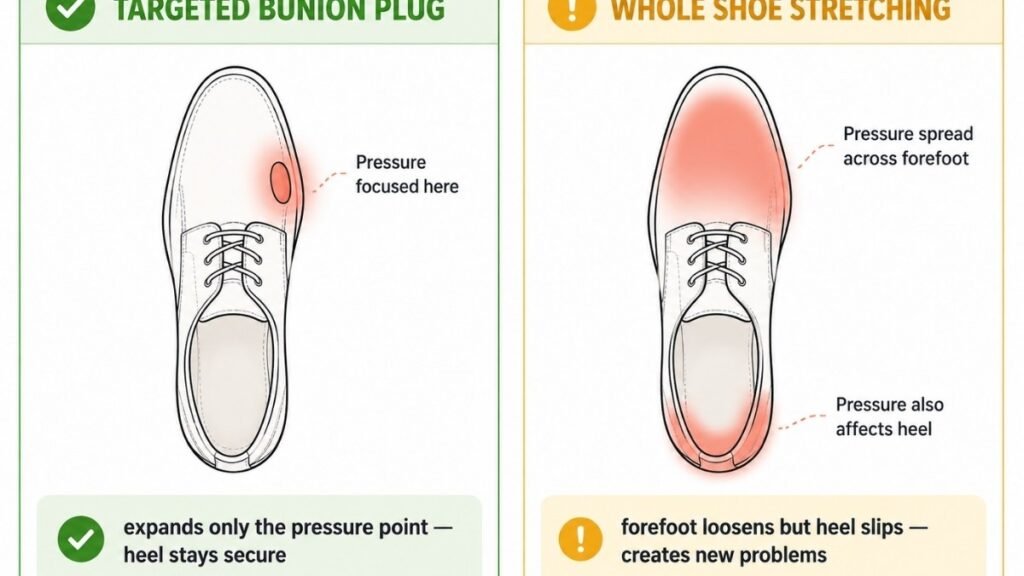
Trying to stretch the entire shoe to accommodate one pressure point is the wrong approach. It loosens the whole shoe, which creates heel slippage and changes the overall fit, while the specific pressure point may still not have enough room.
Using bunion plugs correctly
A two-way shoe stretcher with bunion plugs is designed for exactly this problem. The plug inserts into the specific location on the stretcher that corresponds to the pressure point on your foot — the inner forefoot for a bunion, the outer forefoot for a tailor’s bunion. The plug applies concentrated outward pressure at that point while leaving the rest of the shoe geometry relatively unchanged.
This is significantly more precise than stretching the entire shoe and avoids the tradeoff of loosening areas that already fit correctly.
Don’t make the heel loose
The most common outcome of over-stretching for a bunion or wide forefoot: the forefoot finally feels comfortable, but the heel has been loosened in the process. Now the shoe slips at the back with every step, creating the friction blisters at the heel that you were trying to avoid in the first place.
If heel slippage appears after stretching, a heel grip pad (a thin adhesive pad inside the heel cup) can restore the snug fit without reversing the forefoot stretch.
Stretching Running Shoes: Why It’s Usually a Bad Idea
Why EVA midsoles don’t like pressure
Running shoes are not leather shoes. The soft, cushioned feel that makes running shoes comfortable comes from EVA foam — a cellular foam structure that compresses under impact and rebounds. Mechanical pressure from a shoe stretcher applied to the upper translates to the midsole, and sustained pressure on EVA foam permanently collapses the cells. The shoe may look fine, but the cushioning will feel dead in the affected area.
Why Gore-Tex shoes should never be frozen
Gore-Tex and similar waterproof-breathable membranes work through billions of microscopic pores that allow vapor to pass while blocking liquid water. Freezing causes the membrane to contract and can crack these pores — permanently compromising the waterproofing. A Gore-Tex boot that’s been frozen is still a boot. It’s just no longer waterproof.
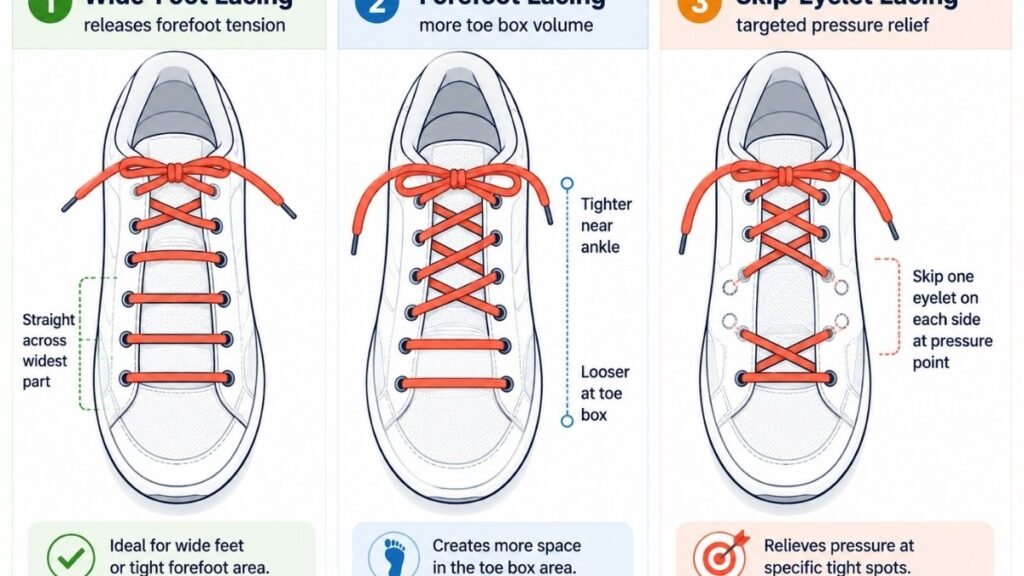
Use lacing instead of stretching
For running shoes that feel tight across the forefoot or in the toe box, lacing modifications almost always work better than any stretching attempt.
Wide-foot lacing: Skip the eyelets across the widest part of the forefoot, running the lace straight across those rows instead of crossing. This releases tension across the forefoot without loosening the heel.
Forefoot lacing: Start lacing from the toe, leaving the lower eyelets looser and tightening progressively toward the ankle. More volume in the toe box, more control at the heel.
Skip-eyelet lacing: Skip one eyelet on each side at the widest pressure point. The reduction in tension at that single row is often enough to eliminate the pressure point without affecting overall fit.
Common Stretching Mistakes That Destroy Shoes
Turning the stretcher too aggressively
A shoe stretcher turned two full rotations on the first session causes rapid, uneven stretching that can split seams and crack the upper material. The stretcher should be turned to the point of slight resistance — where you feel the material engaging — and then left. Crank it one more turn the next day. Patience is the difference between a successful stretch and a ruined shoe.
Using alcohol on dyed leather
Isopropyl alcohol relaxes leather fibers, which is why it’s used in professional stretching sprays. It also strips the surface dye from leather if applied too liberally or left in contact too long. The result: permanent pale spots or blotchy coloration that conditioning won’t fix. If using a DIY alcohol solution, test on an inconspicuous area first and don’t let it pool.
Too much heat
More heat does not mean faster or better stretching. Beyond medium heat from a hair dryer, leather dries out faster than it softens, adhesives weaken, and synthetic materials fail. The right amount of heat is enough to make the leather feel warm and slightly pliable — not hot.
Leaving shoes soaking wet overnight
Saturating leather shoes with water and leaving them to stretch overnight seems intuitive — wet leather is soft, it should stretch. What actually happens: the water penetrates the leather evenly, but it doesn’t dry evenly. The areas that dry faster contract faster. The result is a shoe that’s deformed rather than stretched, often with visible water lines and a stiff, dry texture that no conditioner fully reverses.
Trying to stretch a full size
I’ll be direct: if a shoe is a full size too small, no stretching method in this guide will fix it. You’ll damage the shoe trying, end up with a stretched-out heel, ruined upper material, and a shoe that’s still uncomfortable. Return it.
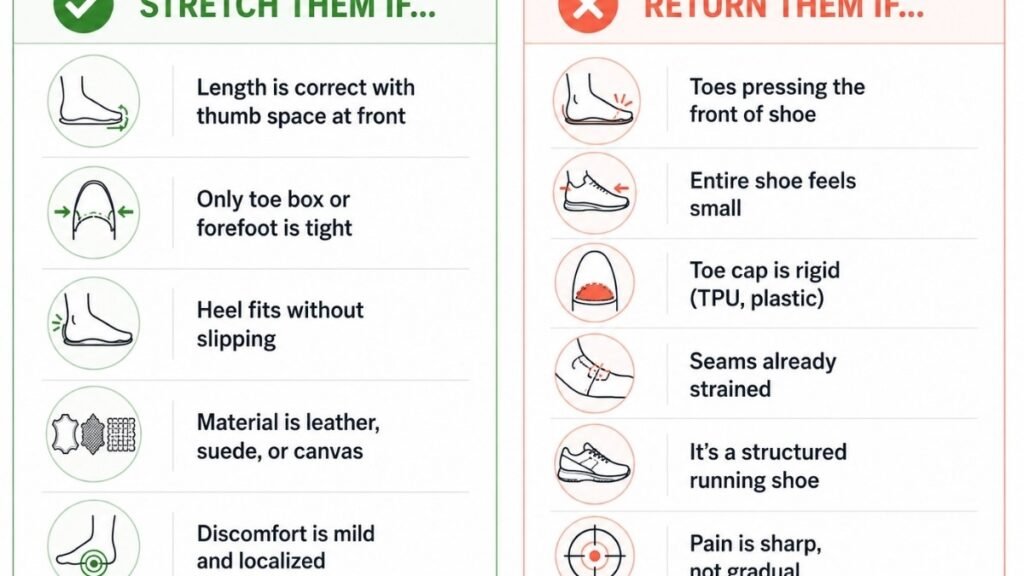
Should You Stretch Them or Return Them?
Stretch them if…
- The length is correct — your longest toe has a thumb’s width of space from the front
- Only the toe box or forefoot is tight, not the entire shoe
- The heel fits snugly without slippage
- The material is real leather, suede, or canvas
- The tightness is mild — uncomfortable, not painful
- You’ve worn them for 20–30 minutes and the discomfort is localized to one area
Return them if…
- Your toes are pressing the front of the shoe (length problem, not width)
- The entire shoe feels small — not just one area
- The toe cap is TPU or rigid plastic — it won’t stretch
- The stitching or seams are already visibly strained
- It’s a running shoe with a structured foam midsole
- The discomfort is sharp or causes immediate pain, not gradual pressure
- You’ve already stretched them once and the problem came back
The return option is worth taking seriously. I’ve spent more time, money, and effort trying to save shoes that didn’t fit than the shoes were worth. Sometimes the right call is acknowledging that a sale price doesn’t change a fit problem, and moving on.
A Better Long-Term Solution Than Stretching
The best stretching outcome still produces a shoe that was wrong to start with and needed fixing. A better investment than stretching techniques is understanding why shoes don’t fit in the first place — and buying correctly from the beginning.
Most fit problems come from three sources: incorrect length measurement, incorrect width assessment, or buying from a brand whose last doesn’t match your foot shape. Our shoe width chart guide covers width measurement and brand fit tendencies in detail — including which brands run narrow and which accommodate wider feet without requiring a wide designation. And if you haven’t measured your feet recently (feet change shape over time, often more than people expect), our foot measurement guide covers the full process in under five minutes.
The most successful stretching, in my experience, isn’t saving a shoe that was clearly wrong. It’s fine-tuning a shoe that was almost right — making a small adjustment that turns a 90% fit into a 100% fit. That’s what these methods are actually good at.
Frequently Asked Questions
Can you stretch shoes made from synthetic or vegan leather? Very limitedly, and only with gentle mechanical pressure at room temperature. Synthetic leather (PU or PVC coated fabric) doesn’t have the fiber structure of real leather and doesn’t respond to heat or moisture without cracking or peeling. A shoe stretcher at room temperature can produce small gains, but expect less yield than leather and more reversion after removing the stretcher. If the shoe is significantly too tight, synthetic leather shoes should be returned rather than stretched.
Does the hair dryer method permanently damage leather? Used correctly on genuine leather, no — but there’s a narrow margin. Medium heat, continuous movement, immediate conditioning after, and cooling with the shoe on all matter. Too much heat, holding the dryer in one spot, or forgetting to condition afterward can dry and crack the leather. On synthetic leather, the answer is yes — even moderate heat causes cracking and adhesive failure.
How long should I leave a shoe stretcher inside? For leather: 24–48 hours minimum per session. Longer is better. The material needs time to relax into the new shape, and removing the stretcher too quickly causes it to revert. For canvas or textile: 12–24 hours is usually sufficient. Don’t remove the stretcher while the leather is still warm from any heat application — let it cool completely first.
Can you stretch shoes a full size bigger? No. Half a size of width is the realistic maximum for real leather under ideal conditions. Attempting to stretch a full size damages the shoe’s structural integrity before meaningful size change occurs. If you need a full size, you need a different size.
What’s the safest way to stretch shoes for bunions? A two-way shoe stretcher with a bunion plug, used at room temperature with stretching spray on leather. The plug applies targeted pressure only at the bunion location rather than expanding the whole shoe. Proceed slowly — one turn per day — and check fit before each session.
Should I stretch running shoes or just change the lacing? Change the lacing. Running shoe uppers and midsoles don’t benefit from stretching methods the way leather does, and the risk of damaging the foam midsole or waterproof membrane is real. Wide-foot lacing, forefoot lacing, and skip-eyelet lacing address pressure points effectively without touching the shoe’s structure.
Why do my shoes become tight again after stretching? Material memory — especially in synthetic leather, canvas, and some leathers — causes the material to partially return to its original shape after the stretcher is removed. To minimize reversion: leave the stretcher in longer, use stretching spray, and wear the shoes immediately after removing the stretcher while the material is still pliable. Conditioning leather after stretching also helps maintain the new shape.
Final Thoughts
Stretching should be the last small adjustment that makes an almost-right shoe work — not a way to fix the wrong size.
Three principles, in order: material comes first (know what you’re working with before doing anything), stretch gradually (the methods that work take days, not hours), and know when to stop (some shoes aren’t worth saving, and the earlier you make that call, the less time you waste).
The most successful shoe stretching I’ve done has been on leather shoes that were almost perfect but slightly tight in the forefoot — the kind of fit where everything else works and one area needs five more millimeters. That’s what these methods are genuinely good for.
If a shoe needs more than that to be wearable, it’s probably not the right shoe. And at KickVerdict, we’d rather help you find the right shoe from the start than teach you increasingly elaborate ways to modify the wrong one.
👟 KickVerdict Notes: Why We Approach Shoe Stretching Differently
Stretching shoes isn’t about forcing them to fit at any cost.
In many cases, discomfort comes from choosing the wrong size, the wrong width, or the wrong shoe shape—not from shoes that simply need to “break in.”
That’s why this guide focuses on understanding materials, fit, and shoe construction before recommending any stretching method.
Inside KickVerdict, every sizing and fit guide is built around three principles:
- 👟 Understanding how different shoe materials actually behave
- 📏 Choosing the right fit instead of relying on fixes later
- 🦶 Helping different foot types—from wide feet to bunions—find shoes that work naturally
Because the best-fitting shoes usually need very little stretching at all.
Continue Learning About Shoe Fit
If you’re still trying to improve comfort, these guides may help:
👟 From the KickVerdict Team
Shoes are something most of us wear every day, yet finding the right fit is often harder than it should be.
Our goal is to make that process simpler with honest, practical advice based on real materials, real wear, and real comfort.
Thanks for trusting KickVerdict. We hope to help you make every step a little more comfortable.