
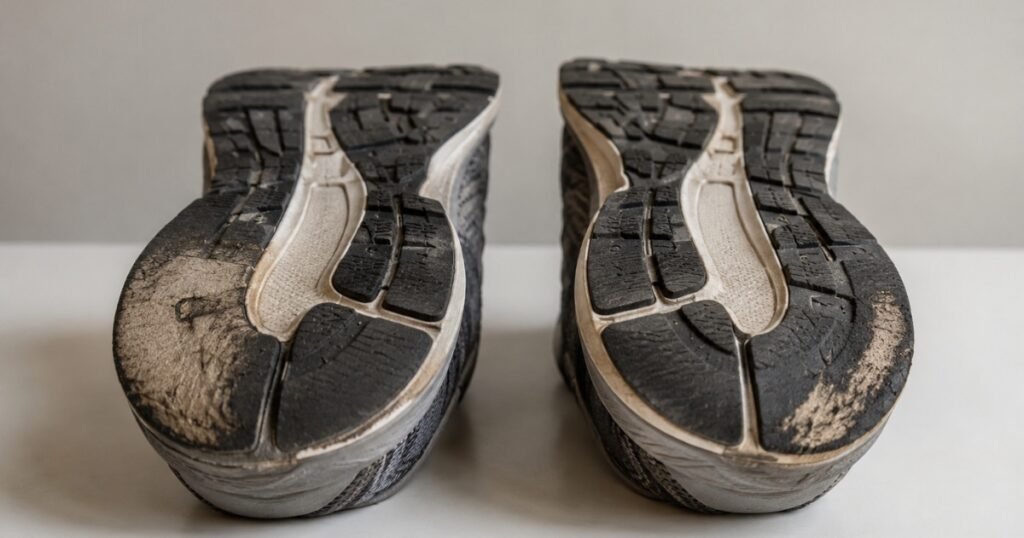
Flip your most-worn pair of shoes over and look at the sole. Spend thirty seconds actually looking at it — not a quick glance, but a real assessment of where the rubber has worn down, where it’s still thick, and whether the wear is symmetrical between left and right.
What you’re looking at is the most honest foot health report you’ll ever see. More accurate than a podiatrist visit based on a five-minute observation, more useful than any generic advice about arch type. The way your foot hits the ground, loads through the midfoot, and pushes off the toe — every step you’ve taken has left a record on that rubber. The pattern is specific to you, and it tells you things about your gait that you almost certainly don’t know.
Most people only look at shoe wear when they’re wondering if it’s time to replace them. That’s a waste of the information. Shoe wear patterns can tell you why your knees hurt, why you keep rolling your ankle, why certain shoes always feel uncomfortable after an hour, and — critically — what structural features your next pair actually needs. This guide decodes what you’re seeing and turns it into actionable shoe decisions.
Key Takeaways
- Shoe wear patterns are a reliable indicator of gait mechanics — how your foot contacts the ground, rolls through the stride, and pushes off. Each pattern corresponds to a specific foot mechanics type.
- Uneven shoe wear — one shoe wearing faster than the other, or significantly different patterns between left and right — is a signal worth investigating. It often indicates leg length discrepancy, a previous injury, or asymmetric muscle development.
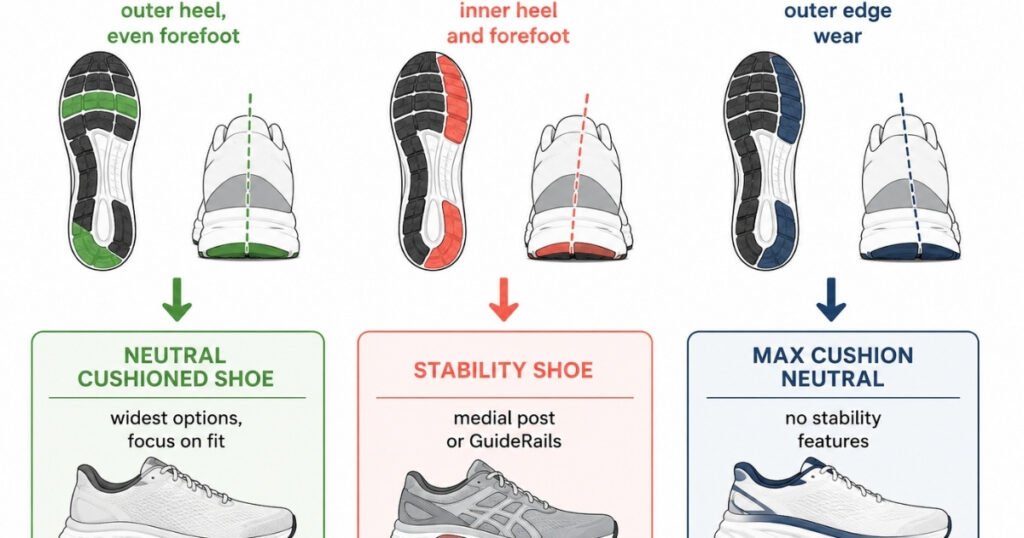
- The three primary wear patterns are: neutral (outer heel, even forefoot), overpronation (inner heel and inner forefoot), and supination (outer heel and outer forefoot running to the little toe edge). Each requires a different shoe response.
- According to research published in the Journal of Biomechanics, gait mechanics are consistent enough across individuals that shoe wear patterns correlate reliably with clinically measured pronation and supination angles.
- A shoe with more than 3–4mm of heel lean — visible when you place the shoe on a flat surface and look at it from behind — has degraded past functional support, regardless of how the upper looks.
- Wear patterns from running shoes and walking shoes should be assessed separately — the two activities load the foot differently and may produce different patterns from the same foot.
How to Read Your Shoe Wear: The Self-Assessment
Before interpreting any pattern, you need the right shoes to assess. The shoe should be one you’ve worn regularly for at least 3–6 months — enough time for a true wear pattern to develop. A nearly new shoe or one used infrequently won’t show enough differentiation to read accurately.
What to do:
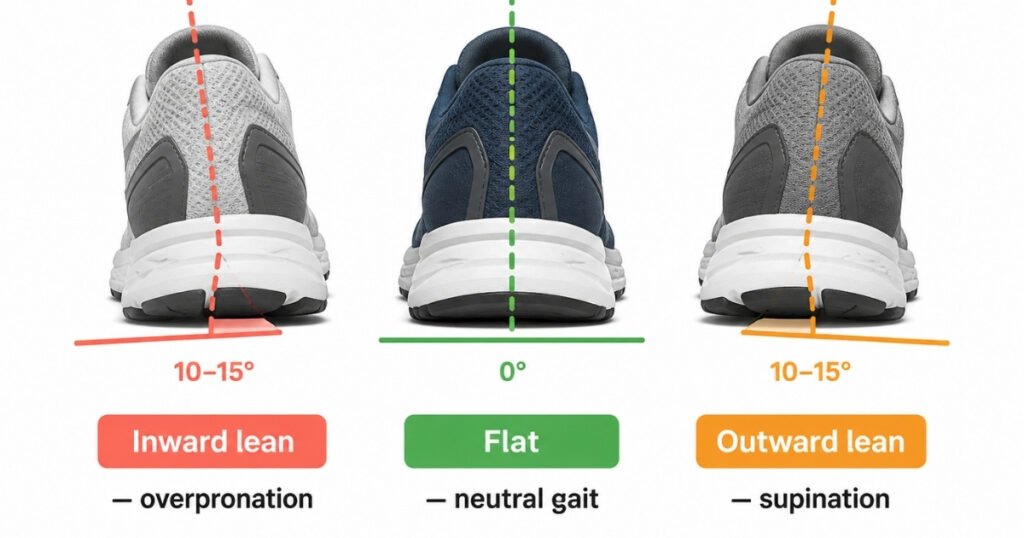
Remove both shoes and place them side by side on a flat table at eye level. This is the table tilt test — look from behind at the heel from a level angle. A neutral shoe sits flat. A worn shoe will show the heel leaning — inward toward the big toe side indicates overpronation, outward toward the little toe side indicates supination.
Then flip both shoes over and look at the outsole. Compare left to right — any significant difference in wear depth between the two shoes is as informative as the wear pattern itself.
Now look at specific zones:
Heel zone: Where on the heel has the rubber worn first? Outer heel wear is normal for most people (heel striking with the outside of the foot is typical). Heavy inner heel wear indicates overpronation. Outer heel wear that extends far to the side indicates supination.
Midfoot zone: Wear across the full midfoot suggests flat arches — the arch is making contact with the ground throughout the stride rather than lifting during midstance. Minimal midfoot wear suggests a higher arch that maintains its shape throughout loading.
Forefoot zone: Where the foot pushes off tells you about propulsion mechanics. Even wear across the forefoot with emphasis near the first and second toe is neutral. Heavy wear under the big toe side indicates supination or limited pronation — the push-off is happening on the inner edge. Heavy wear under the outer forefoot (fourth and fifth toe) indicates supination.
The Four Shoe Wear Patterns — Decoded
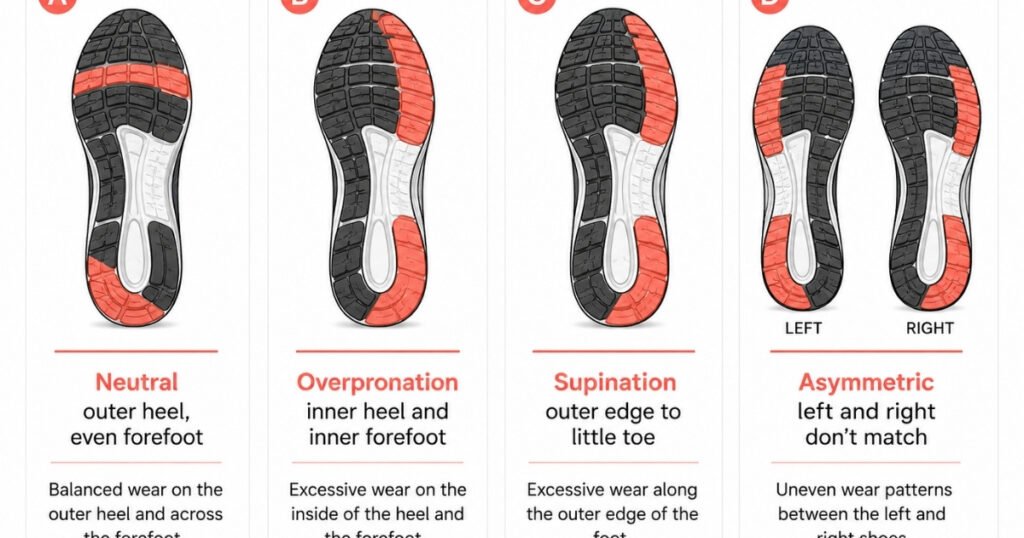
Pattern A: Neutral Wear — What Healthy Gait Looks Like
What you see: Moderate wear on the outer heel, transitioning to even wear across the forefoot with slight emphasis near the second and third toes. The shoe sits relatively flat on a surface. Left and right are approximately mirror images of each other.
What it means: Your foot is doing what feet are designed to do. The heel contacts the outer edge, the foot rolls slightly inward (normal pronation — not overpronation) to distribute load across the arch, and the push-off happens through the first and second toes. This gait cycle is mechanically efficient and doesn’t create excessive stress at any single point.
Shoe implication: The widest range of options applies to you. Neutral cushioned shoes work well. You don’t need stability features designed to correct overpronation — adding unnecessary medial support to a neutral foot can actually shift the gait pattern in ways that create new problems. Focus on cushioning level, heel drop, and fit rather than stability designation.
Pattern B: Overpronation Wear — The Most Common Pattern
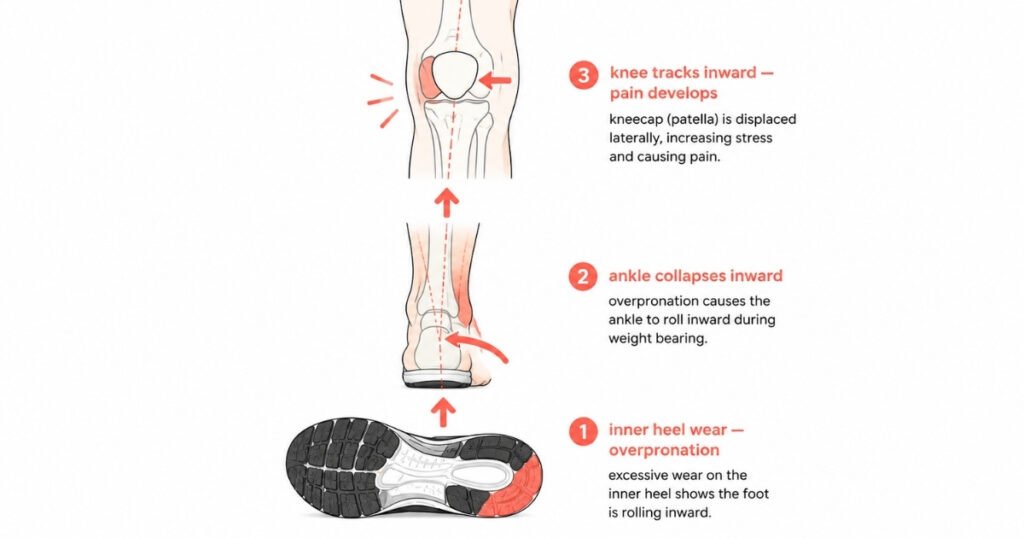
What you see: Significant wear on the inner heel edge and inner forefoot, especially under the big toe. The heel of the shoe, when placed on a flat surface, visibly leans inward. The inner midsole may look visibly compressed compared to the outer side.
What it means: Your foot is rolling excessively inward after heel contact — the arch is collapsing more than it should during the loading phase. This is overpronation, and it’s extremely common — more than half of the population shows some degree of it.
The downstream consequences accumulate over distance. The inward ankle roll internally rotates the tibia, which affects how the knee tracks. Persistent overpronation is associated with runner’s knee, shin splints, plantar fasciitis, and medial knee pain — not because it’s inherently dangerous, but because it concentrates load on structures that aren’t designed to absorb it repeatedly.
Who this typically affects: People with flat feet or low arches, people who spend long hours standing on hard floors, and anyone who has noticed that their shoes always seem to wear out on the inner side first.
Shoe implication: Stability shoes with medial post support are the appropriate category. The medial post — a firmer section of midsole foam on the inner side — resists the inward collapse during the loading phase. Brooks Adrenaline GTS, ASICS Gel-Kayano, and New Balance 860 are the most consistent options.
Avoid highly cushioned neutral shoes without structure — the extra foam compounds the instability problem by giving the collapsing arch more material to collapse into. Our overpronation shoes guide covers the full spectrum from mild to severe overpronation and what each degree requires.
Pattern C: Supination Wear — The Less Common But Harder to Fix Pattern
What you see: Wear concentrated on the outer edge of the shoe — from the outer heel, running along the outer forefoot toward the little toe. The shoe, placed on a flat surface, leans outward. The inner midsole shows almost no compression.
What it means: Your foot supinates — it rolls outward rather than inward during the loading phase. The arch doesn’t flatten enough to absorb impact, keeping the load concentrated on the lateral side of the foot and leg. This is the opposite mechanical problem from overpronation.
Supination is less common than overpronation but causes a distinct set of problems: lateral ankle instability (the foot rolling outward creates the conditions for ankle sprains), IT band syndrome from the lateral tension that runs up the leg, and stress fractures in the outer metatarsals from concentrated impact load.
Who this typically affects: People with high arches or rigid feet, people with a history of repeated ankle sprains on the same side, and runners who always seem to develop IT band problems.
Shoe implication: Maximum cushioned neutral shoes — not stability shoes. Stability features designed for overpronation push a supinating foot further in the wrong direction. The goal is to give the rigid, high-arched foot something to land in that provides shock absorption the foot isn’t providing itself. Hoka Bondi, Brooks Ghost, and ASICS Gel-Nimbus are consistent choices. Our flat feet vs high arches guide covers this foot type in detail.
Pattern D: Asymmetric Wear — When Left and Right Don’t Match
What you see: One shoe shows significantly more wear than the other, or the wear pattern is in completely different locations between left and right. Not a minor variation — a meaningful difference in depth or pattern location.
What it means: Something structural is creating asymmetry in how each foot loads. The most common causes:
Leg length discrepancy: Even a difference of 5–10mm between leg lengths changes how each foot contacts the ground. The shorter-leg side often shows more heel wear (it hits harder to compensate for the shorter reach). This is more common than people realize — true leg length equality is not universal.
Previous injury: An old ankle sprain that wasn’t fully rehabilitated, a knee injury that changed gait mechanics, or a hip issue can all create compensatory patterns that show up in asymmetric shoe wear years after the original injury.
Muscle imbalance: Significant strength or flexibility differences between left and right sides — common in athletes who have dominant-side sport patterns — can create different loading patterns even without structural differences.
When to take this seriously: Mild asymmetry (slightly more wear on one side) is normal for most people. Significant asymmetry — where one shoe looks like it’s had twice the use of the other — warrants a proper gait assessment by a podiatrist or sports medicine physician, particularly if it’s accompanied by hip, knee, or lower back discomfort that’s worse on one side.
What Shoe Wear Reveals About Specific Conditions
Shoe Wear Pattern and Flat Feet
Flat feet produce a specific wear pattern that’s distinct from regular overpronation: full midfoot contact wear (the arch area shows rubber wear rather than minimal contact), combined with inner heel and inner forefoot wear. The difference from standard overpronation is the midfoot — if you can see wear across the entire sole from heel to forefoot on the inner side, the arch is making full ground contact throughout the stride.
This pattern requires stability shoes with medial support AND attention to the midfoot zone — some people with severe flat feet find that standard stability shoes address the heel but not the sustained arch contact throughout midstance.
Shoe Wear Pattern and Knee Pain
If you’re experiencing knee pain and your shoe shows inner heel and forefoot wear, the connection is almost certainly mechanical. The inward ankle collapse from overpronation internally rotates the tibia, which displaces the kneecap laterally — creating the friction under the kneecap that produces patellofemoral pain. Our knee pain after running guide covers this kinetic chain in detail.
If you’re experiencing outer knee pain (IT band area) and your shoe shows outer edge wear, the supination pattern is concentrating lateral tension up the leg. Addressing the shoe — moving to maximum cushion neutral — is the first intervention before assuming training load is the cause.
Uneven Shoe Wear Between Left and Right
This is the pattern most people normalize because they don’t compare their shoes systematically. Place both shoes sole-up side by side and photograph them — the difference is often much more apparent in a photo than in person. If the difference is significant, note whether you have any chronic discomfort that’s consistently worse on the more-worn side. That correlation is clinically meaningful.
When to Replace Based on Wear Pattern — Not Appearance
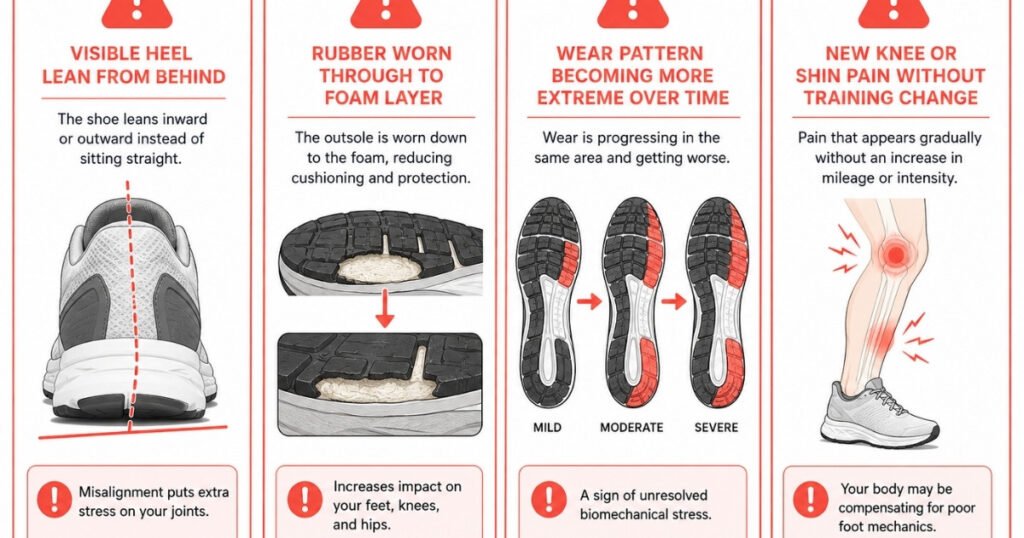
The appearance of the upper is almost useless as a replacement indicator. The relevant signal is the midsole and outsole condition.
Replace your shoes when:
The heel lean is visible from behind — place the shoe on a flat surface and look at it from behind at eye level. Any visible inward or outward lean indicates the midsole has compressed asymmetrically and is no longer providing neutral support.
The outsole rubber has worn through to the foam layer underneath — once the rubber is gone, you’re walking on midsole foam, which isn’t designed for ground contact and wears through quickly.
The wear pattern has become more extreme over time — if your first pair showed mild inner heel wear and your current pair shows heavy inner heel wear that’s spread to the forefoot, the shoe is amplifying the problem rather than managing it.
New pain has appeared without a change in training — particularly knee, shin, or hip pain. This is often the first signal that the midsole has degraded past its functional cushioning threshold, even when the outsole looks fine.
For the full picture on midsole lifespan and the physical tests that tell you when cushioning is gone, our when to replace running shoes guide covers the five-minute assessment in detail.
The 3-Minute Self-Assessment Summary
Do this now:
- Find your most-worn pair — 3+ months of regular use.
- Place both shoes on a flat surface, heels facing you at eye level. Note any lean direction.
- Flip over and compare outsoles side by side. Note wear location and whether left and right match.
- Identify your pattern: outer heel only (neutral), inner heel and forefoot (overpronation), outer edge running to little toe (supination), or significant asymmetry between shoes (investigate further).
- Match pattern to shoe category: neutral → neutral cushioned, overpronation → stability, supination → maximum cushion neutral, asymmetric → consider professional gait assessment.
Frequently Asked Questions
What does shoe wear pattern mean? Shoe wear patterns show where the rubber outsole has worn away from ground contact, revealing how your foot loads during walking or running. The location and distribution of wear indicates your gait mechanics — specifically whether you pronate normally, overpronate (roll inward), or supinate (roll outward). This information determines what structural features your next shoe needs.
What does it mean when shoes wear on the outside? Wear on the outer edge of the shoe — particularly running from the outer heel along the outer forefoot toward the little toe — indicates supination or underpronation. The foot is rolling outward rather than inward during the loading phase, concentrating impact on the lateral side. This pattern typically indicates high arches and benefits from maximum cushioned neutral shoes.
What does it mean when shoes wear on the inside? Inner heel and inner forefoot wear indicates overpronation — the foot is rolling excessively inward after heel contact. This is the most common gait pattern and is associated with flat feet or low arches. Stability shoes with medial post support address this by resisting the inward collapse during loading.
Is uneven shoe wear normal? Mild variation between left and right is normal for most people. Significant asymmetry — where one shoe shows dramatically more wear depth or wear in different locations from the other — is worth investigating. Common causes include leg length discrepancy, a previous ankle or knee injury, and muscle imbalances. If accompanied by chronic pain that’s worse on the more-worn side, a podiatrist assessment is appropriate.
How often should I check my shoe wear pattern? Check every 2–3 months for regularly worn shoes. This gives enough time for patterns to develop while catching excessive wear before it causes the structural lean that indicates the shoe has failed. Photograph the soles side by side — the photo comparison is often more revealing than visual inspection alone.
The Bottom Line
Your shoe sole is the most accurate foot assessment tool you own, and most people never use it. The three main patterns — neutral, overpronation, supination — each point clearly to a different shoe category, and getting this match right affects everything from daily comfort to long-term joint health.
Start with the self-assessment. Identify your pattern. Then match the shoe category to what you actually need rather than what’s popular or what a store generalist recommends. If you’re seeing an overpronation pattern, our overpronation shoes guide and flat feet vs high arches guide give you the specific features to look for and the brands that deliver on them. If you’re seeing a supination pattern with outer edge wear, our walking shoes complete guide covers maximum cushion neutral options in depth.
And if you’ve identified asymmetric wear that you haven’t been able to explain, a sports medicine physician or podiatrist with gait analysis capability is the right next step — the shoe can’t solve a structural problem that needs clinical assessment.
🔍 Behind Our Recommendations: How We Build This Guide
Finding the right shoes is not about chasing the most popular model, the biggest discount, or the pair everyone online is recommending.
Your feet, walking pattern, daily routine, and comfort needs matter more than hype.
For this guide, we reviewed and compared information from:
- footwear biomechanics research related to walking patterns, pronation, and foot movement
- podiatry and sports medicine resources about common foot mechanics
- real-world shoe wear patterns from everyday walking and running shoes
- feedback from people dealing with flat feet, high arches, long standing hours, and comfort issues
We focus on practical details that actually affect your daily experience:
✓ how supportive the shoe feels after hours of wear
✓ whether the cushioning stays comfortable over time
✓ how stable the shoe feels during normal movement
✓ outsole durability and long-term wear patterns
✓ whether the design matches different foot types and lifestyles
A shoe that works perfectly for one person may feel completely wrong for someone else. That’s why we look beyond marketing claims and focus on how shoes perform in real life.
At KickVerdict, our goal is simple: help you understand why a shoe works for your feet — so your next pair is not just popular, but actually right for you.