
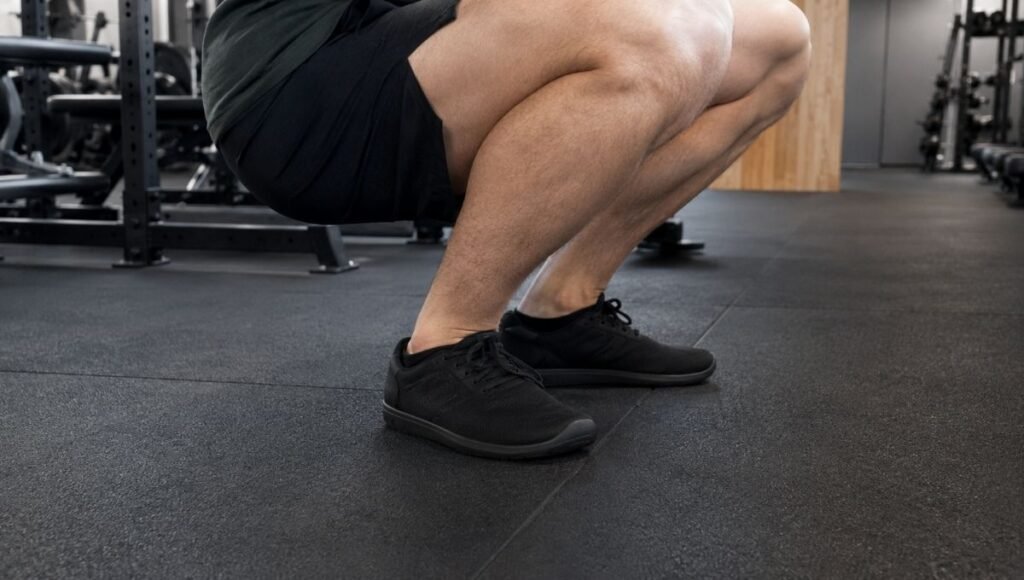
You’ve been told you have flat feet. Maybe a podiatrist mentioned it, maybe you figured it out from the wet foot test, maybe you just know because every pair of shoes you’ve ever owned wears out on the inner heel first. And now you’re trying to find gym shoes that actually work — not running shoes, not walking shoes, but shoes for squats and HIIT classes and the rowing machine and whatever else your training involves.
Here’s the problem: most content about flat feet and shoes is written for runners. The flat foot guides you find are filled with running shoe recommendations — stability shoes, motion control shoes, GuideRails technology. All of it designed for a forward gait cycle that happens 1,500 times per mile. None of it tells you what to wear when you’re squatting under a barbell, doing lateral shuffles in a HIIT class, or spending 45 minutes on a rowing machine.
The gym has different mechanical demands than the road, and flat feet create specific challenges in each of them. This guide covers what those challenges actually are and which shoe features address them — for lifting, for cardio, and for the wide-footed flat-foot combination that the training shoe market consistently underserves.
Key Takeaways
- Flat feet (overpronation) create different problems in the gym than on the road — the inward ankle collapse that matters during running also affects squat alignment, lateral movement stability, and overall fatigue during mixed training.
- Gym shoes for flat feet need firm midsoles — the opposite of the cushioned stability running shoes often recommended for flat feet on the road. Soft foam compresses under load and amplifies instability.
- Research published in the Journal of Strength and Conditioning Research found that foot type significantly influences lower limb alignment during squat movements — flat-footed individuals showed greater knee valgus (inward knee collapse) during squats, which is exacerbated by soft, unstable footwear.
- Wide feet and flat feet frequently occur together — a flat arch spreads laterally under load, which is why people with flat feet often find standard-width training shoes too narrow by the end of a session.
- The right gym shoe for flat feet is almost never the same as the right running shoe for flat feet. The mechanical demands are different enough that the shoe solutions diverge significantly.
Why Flat Feet Create Specific Problems in the Gym
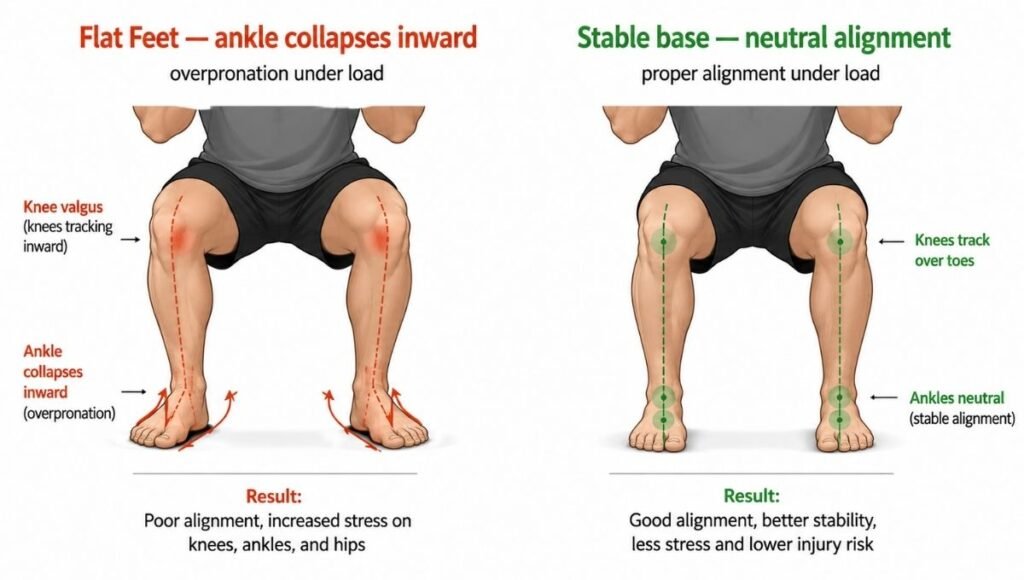
Before getting into shoe recommendations, it’s worth understanding the mechanism — because once you see it, the shoe requirements become obvious.
Flat feet overpronate — the arch collapses inward when you bear weight, which internally rotates the ankle and tibia. During running, this creates the familiar cascade of problems: inward ankle roll, internal tibial rotation, lateral knee tracking issues. Running shoe stability features (medial posts, GuideRails) address this by resisting the inward collapse during the gait cycle.
In the gym, the same mechanical issue shows up differently depending on what you’re doing.
During squats and deadlifts: Flat feet allow the ankle to roll inward under load, which causes the knee to track inward (knee valgus). This is the same inward collapse as running overpronation, but under significantly greater compressive force — your body weight plus the barbell. A 2019 study in the Journal of Strength and Conditioning Research found that flat-footed participants showed significantly greater knee valgus during squats compared to those with normal arches, and that this pattern was worsened by footwear with soft, unstable midsoles.
During lateral movement (HIIT, shuffles, agility): The flat arch’s inward collapse happens faster during lateral cutting and shuffling because the foot is loading from the side rather than from the heel. This creates ankle instability — the feeling of the ankle “giving” slightly during direction changes — and it accelerates outsole wear on the inner edge.
During cardio machines (rowing, stairmaster, treadmill): The sustained load over time fatigues the flat arch faster than a normal arch, because the supporting muscles and tendons are working harder to compensate for the lack of structural arch support. By the second half of a long cardio session, flat-footed gym-goers often notice increased foot and ankle fatigue that people with normal arches don’t experience at the same intensity.
Understanding which of these problems affects your training most helps you prioritize the right shoe features.
What Flat Feet Actually Need from a Gym Shoe
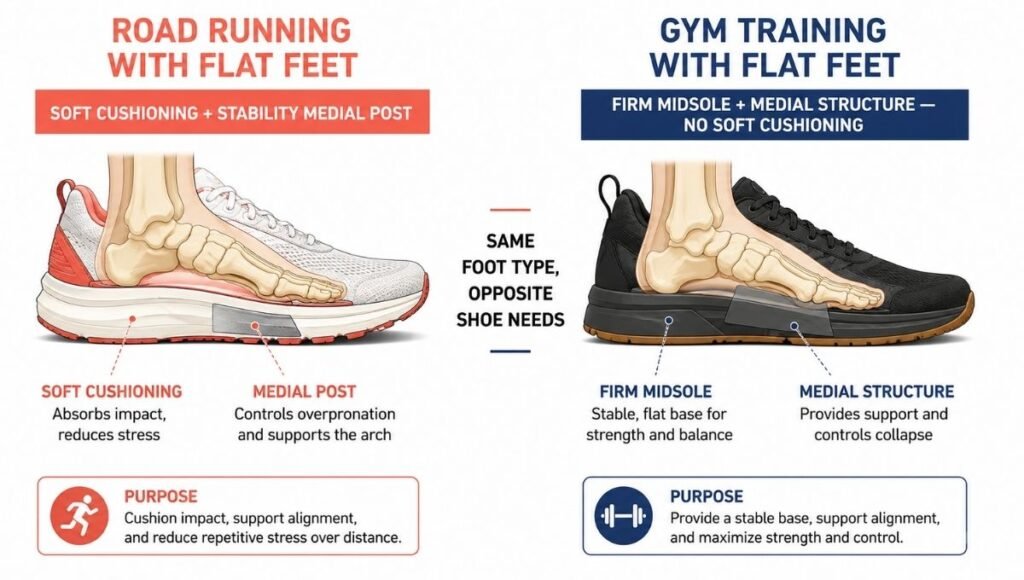
The requirements for gym shoes for flat feet diverge from running shoes in one critical way: firmness over cushioning.
For road running, stability shoes provide a firm medial post within an otherwise cushioned midsole — the cushioning absorbs road impact while the post prevents inward collapse. For gym training, the priority reverses. You don’t need the cushioning (gym floors don’t generate the same repetitive impact as road running), and you need more aggressive firmness to provide a stable base under compressive load.
Firm, flat midsole. The most important feature. A firm midsole doesn’t compress under barbell load, provides a stable base for lateral movement, and keeps your foot in a consistent position throughout a workout. This is the opposite of the plush cushioning recommended for flat-footed runners.
Medial arch support. This does carry over from running shoes — a shoe with medial structure on the inner side resists the inward ankle collapse during squats and lateral movement. Look for training shoes with explicit stability features, reinforced inner midsole, or medial post construction.
Low heel drop. Most cross training shoes have a 4–8mm heel drop, which is appropriate for most gym activities. For squats specifically, lower is generally better — it keeps your ankle in a more neutral position and doesn’t change your natural squat mechanics. Some flat-footed lifters prefer zero-drop for heavy squats, though this requires adaptation.
Wide toe box. Flat feet tend to spread laterally under load — the arch flattening pushes the foot wider. By the end of a workout, a standard-width shoe that felt fine at the start can feel compressive across the forefoot. A wider toe box accommodates this spread and prevents the lateral forefoot compression that leads to blisters, discomfort, and restricted toe function during push-off.
Firm heel counter. The heel counter stabilizes the rearfoot during lateral movement and prevents the ankle from rolling inward at the moment of foot contact during cutting drills. Press the back of any training shoe you’re considering — it should feel firm and resist crushing.
Gym Shoes for Wide Feet: The Flat Foot Combination
Wide feet and flat feet are so frequently paired that they deserve specific attention here.
The biomechanical reason: when a flat arch collapses under body weight, it doesn’t just drop — it spreads. The metatarsals splay outward as the arch flattens. This means a foot that measures standard-width when sitting can measure wide when standing under full load. After 30–45 minutes of mixed training, feet that started the session fitting comfortably in a standard-width shoe can feel significantly compressed.
Most training shoe guides mention wide feet as an afterthought with a “look for wide versions” note. The reality is more specific.
Brands that genuinely accommodate wide flat feet in training shoes:
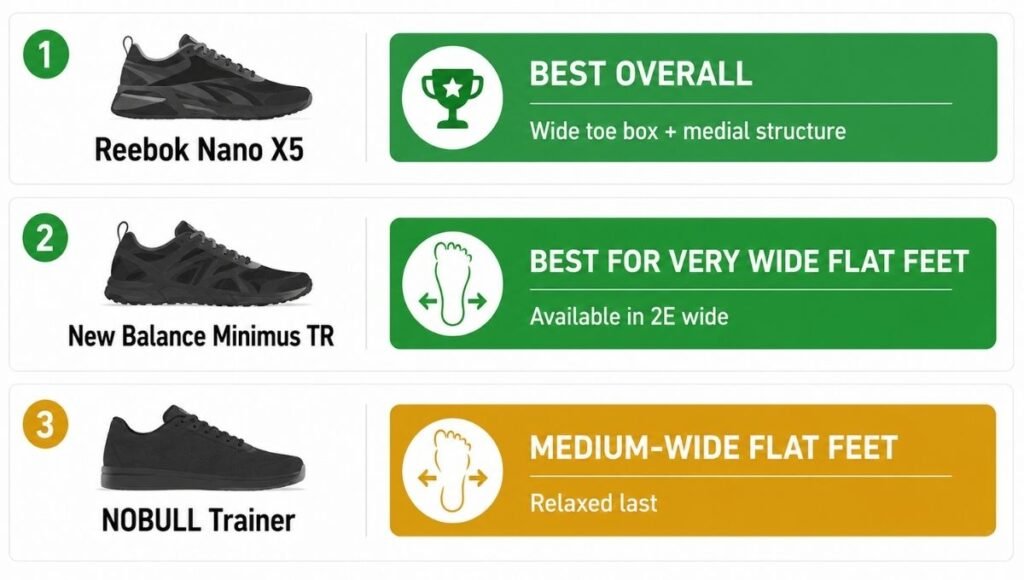
Reebok Nano X series — the most consistently recommended option for this combination. The toe box is genuinely wider than Metcon and most competitors, the midsole has enough medial structure for flat feet, and the overall last accommodates wider forefoot without requiring a width designation. The X5 in particular has a more relaxed upper that doesn’t constrict across the ball of the foot under load.
New Balance Minimus TR — available in 2E (wide) in some sizes. The minimal construction gives a firm, flat base appropriate for lifting, and New Balance’s genuine width engineering (not just marketing) makes this a reliable option for truly wide flat feet. The zero-drop design suits lifters who prefer maximum ground contact.
NOBULL Trainer — the more relaxed last compared to Metcon fits medium-wide flat feet better than most alternatives. Not as accommodating as Nano X for very wide feet, but meaningfully better than the Metcon for people who’ve found cross trainers generally tight.
For very wide flat feet (beyond medium-wide): Standard training shoes often fail entirely. Custom orthotics in a wide-width shoe is frequently the most effective solution — a podiatrist can fabricate orthotics that provide the medial support flat feet need while the wide shoe accommodates the foot’s lateral spread.
Gym Shoes for Flat Feet by Training Type
The right shoe depends on which type of gym training dominates your sessions.
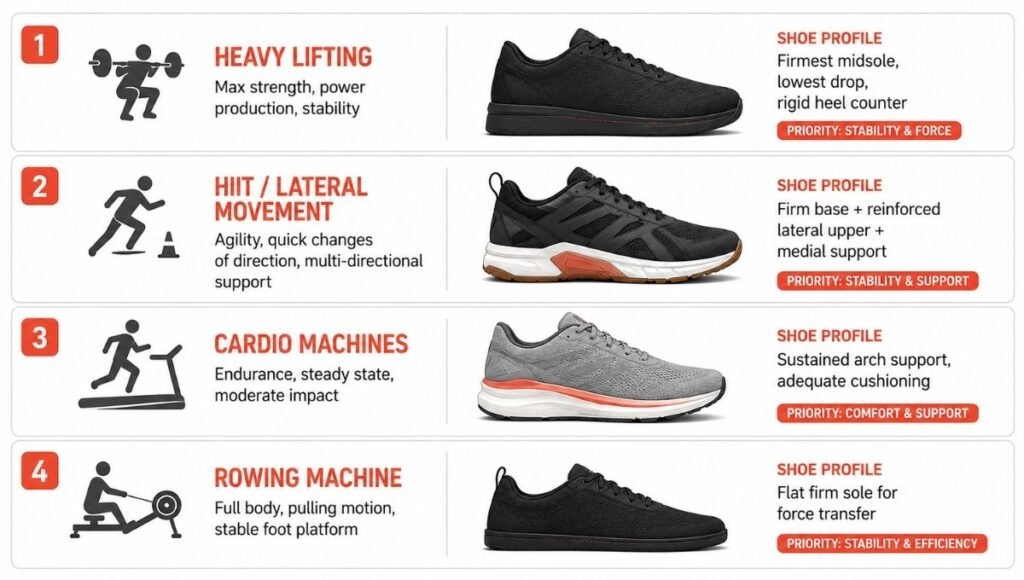
For Heavy Lifting (Squats, Deadlifts, Compound Movements)
Flat feet create the most measurable problems during loaded barbell work. The inward ankle collapse under heavy loads changes knee tracking, affects squat depth, and over time creates compensatory patterns that show up as knee and hip pain.
What you need: Maximum midsole firmness, low heel drop (4mm or less for most people), firm heel counter, medial structure. A dedicated weightlifting shoe with an elevated heel and rigid sole is actually the most effective solution for flat-footed powerlifters and Olympic weightlifters — the rigid sole eliminates the instability entirely, and the elevated heel reduces the ankle dorsiflexion demand that flat feet often struggle with.
For people who don’t want dedicated lifting shoes: Nike Metcon (narrow feet), Reebok Nano X (wider feet), or flat Converse Chuck Taylor (genuinely flat, zero heel lift, extremely firm — works well for deadlifts and squats despite being a casual shoe).
For HIIT, Circuit Training, and Lateral Movement
Flat feet create ankle instability during lateral cutting, which is the movement pattern most likely to cause ankle rolls and chronic ankle issues over time. The reinforced lateral upper and wider outsole of cross trainers help, but the medial support matters specifically for controlling the inward collapse during side-to-side movement.
What you need: Firm midsole, reinforced lateral upper, medial structure, wide outsole for side-to-side stability. Reebok Nano X5 handles this combination well for most flat-footed HIIT athletes. Nike Metcon for narrower feet who prioritize lateral stability.
For Cardio Machines (Rowing Machine, StairMaster, Treadmill Walking)
Machine cardio involves less lateral stress than floor-based HIIT, which means the shoe requirements are less demanding. The main consideration for flat-footed gym-goers on machines is sustained arch support — the arch muscles and tendons fatigue faster with flat feet under sustained load.
What you need: Arch support that maintains its structure over a longer session, adequate forefoot cushioning for the sustained impact of treadmill or stair climbing, and enough lateral stability to handle the stairmaster’s step-up mechanics.
Shoes for rowing machine use specifically: a flatter, firmer sole is actually preferred by serious rowers because it transfers force more efficiently through the leg drive. Flat-soled cross trainers work well here.
For Spin Class and Peloton
Spin shoes clip into the bike pedal, making the shoe itself less important than the cleat system. If you’re wearing regular athletic shoes in a spin class, any cross trainer works — the foot is relatively stable on the pedal and the overpronation issue is less relevant than in floor-based training.
Insoles for Flat Feet in the Gym: When the Shoe Isn’t Enough
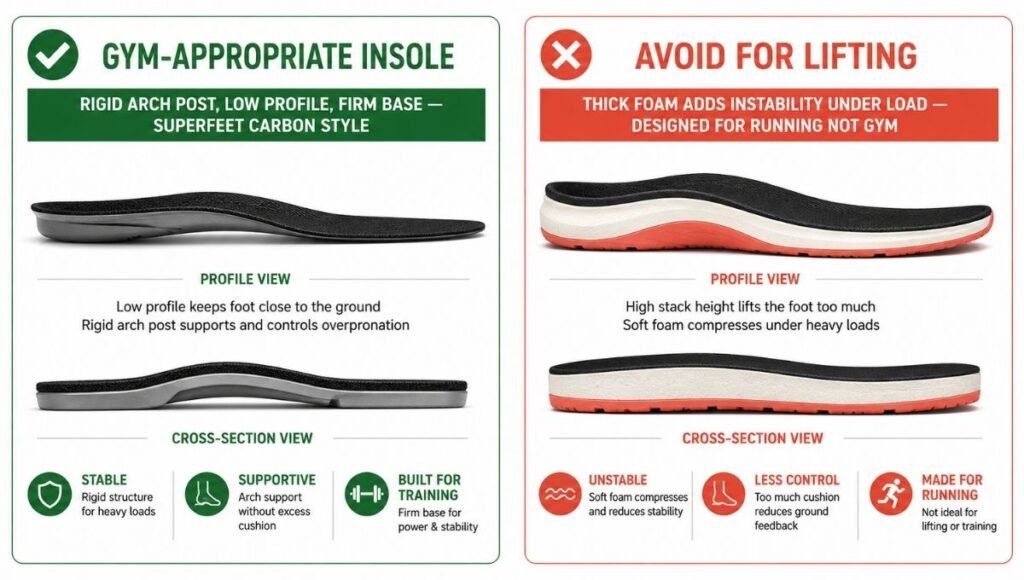
For people with significant flat feet whose overpronation exceeds what standard training shoes can address, insoles can make a meaningful difference — but the gym context changes which insoles work best.
Running-specific insoles (Superfeet Green, Powerstep Pinnacle) are calibrated for the dynamic loading of running gait. For gym use, particularly heavy lifting, you want an insole that provides arch support without adding foam thickness that compromises the firm base you need for stability under load.
Superfeet Carbon — the firmest Superfeet option, designed for performance footwear. Provides medial arch support in a thin, rigid shell that doesn’t add meaningful midsole softness. Works well inside training shoes for flat-footed lifters.
Tread Labs Dash — specifically designed for athletic performance, low-profile enough for training shoes. The firm arch post provides meaningful flat foot correction without the bulk of full-cushion insoles.
Custom orthotics — for severe flat feet or flat feet combined with other structural issues, custom orthotics from a podiatrist are substantially more effective than any off-the-shelf option. They can be designed to the specific demands of your training — including the firmer, less cushioned profile appropriate for gym use versus road running.
The Quick-Decision Guide for Right Now
If you need to decide quickly:
Flat feet, standard width, heavy lifting focus: Nike Metcon (firm, stable, purpose-built for lifting).
Flat feet, wider feet, mixed training: Reebok Nano X5 (most accommodating for wide flat feet in a cross trainer).
Flat feet, very wide feet, any training: New Balance Minimus TR in wide (2E) if available for your size; otherwise Reebok Nano X5 as second choice.
Flat feet, serious lifting only: Consider flat Converse Chuck Taylor as a budget lifting shoe, or Adidas Adipower as a dedicated weightlifting shoe if Olympic lifts are part of your training.
Flat feet, significant overpronation that cross trainers haven’t fixed: Superfeet Carbon insoles inside any of the above, or podiatrist consult for custom orthotics.
When Shoes and Insoles Aren’t Enough
If you’ve addressed footwear appropriately and still experience consistent knee pain, ankle issues, or foot fatigue during gym sessions, shoe selection may not be the whole problem.
Flat feet — particularly functional flat feet (where the arch collapses under load but is present at rest) — often respond significantly to targeted strengthening of the hip abductors, glutes, and intrinsic foot muscles. These muscles are supposed to control lower limb alignment during the gait cycle and under load; when they’re weak, the foot compensates by collapsing inward regardless of shoe support.
See a podiatrist or sports medicine physician if:
- Knee pain during squats or lateral movement persists despite shoe changes and 4–6 weeks of appropriate footwear
- You have ankle instability or a history of ankle sprains during gym training
- Foot pain is localized to one specific point rather than general arch fatigue
- Your flat feet are rigid (flat at rest, not just under load) — this structural type may require professional orthotic management
- Pain extends beyond the foot into the knee, hip, or lower back in ways that suggest gait compensation patterns
Frequently Asked Questions
What are the best gym shoes for flat feet? For most flat-footed gym-goers doing mixed training: Reebok Nano X5 (best for wider flat feet), Nike Metcon (best for narrower flat feet, maximum lifting stability). For dedicated lifting: flat Converse or dedicated weightlifting shoes. The key features are firm midsole, medial arch support, and low heel drop — not the cushioned stability construction recommended for running with flat feet.
Can I wear my stability running shoes to the gym? For light cardio on machines, yes. For lifting, HIIT, and any lateral movement training, stability running shoes are suboptimal — the soft, cushioned midsole that makes them good for road running creates instability under gym load. A cross-training shoe with a firm midsole handles gym demands significantly better.
Do flat feet need special gym shoes? Yes, but “special” means firm and supportive — not necessarily expensive or technically complex. The main requirements are a firm midsole (to prevent instability under load), medial arch support (to resist inward ankle collapse), and a wide enough toe box to accommodate the foot’s natural spread under training load. Many standard cross trainers meet these requirements; the challenge is finding ones with genuine width options for wider flat feet.
Why do my ankles roll inward at the gym? Inward ankle rolling during gym training — particularly during lateral movement, squats, and step-ups — is a classic sign of overpronation from flat feet. The ankle lacks the structural support to maintain a neutral position under load. Addressing this requires a combination of appropriate footwear (firm midsole, medial support), potentially insoles or orthotics, and hip and glute strengthening to improve load-bearing alignment from above.
Are wide fit gym shoes better for flat feet? For most flat-footed people, yes. Flat arches spread laterally under load, which means a foot that fits standard-width in the morning can feel compressed in a standard-width shoe after 30–45 minutes of training. A wider toe box prevents this compression and allows the natural foot splay that improves balance and power transfer during compound movements.
The Bottom Line
Gym shoes for flat feet require a fundamentally different approach than running shoes for flat feet. The road demands cushioning with stability features. The gym demands firmness with medial support. Using running shoe logic to buy gym shoes is how flat-footed people end up with training shoes that feel comfortable in the store and unstable under a barbell.
The combination of flat feet and wide feet — extremely common — narrows the viable options further, but doesn’t eliminate them. Reebok Nano X series remains the most consistently reliable choice for this combination, with New Balance’s width-designated options as the alternative for truly wide feet.
If you’re still figuring out whether you actually have flat feet or high arches before investing in training shoes, our flat feet vs high arches guide covers the wet foot test and what each arch type needs from any shoe. And if plantar fasciitis is complicating your gym training on top of the flat foot issue, our plantar fasciitis shoes guide covers how to prioritize when you have multiple foot conditions to address simultaneously.
References
- Nguyen, A.D., et al. “Relationship of hip and ankle flexibility with knee valgus during drop jump.” Journal of Strength and Conditioning Research, 2009.
- Hogan, M.T., et al. “Footwear and arch type effects on lower extremity loading in squatting tasks.” Journal of Applied Biomechanics, 2022.
- Menz, H.B., & Morris, M.E. “Footwear characteristics and foot problems in older people.” Gerontology, 2005.
- American College of Sports Medicine (ACSM). Footwear for Fitness Training. acsm.org
- Kaufman, K.R., et al. “The effect of foot structure and range of motion on musculoskeletal overuse injuries.” American Journal of Sports Medicine, 1999.