
You measured your foot. You found your width on a chart. You ordered the shoe in the right width. And it still doesn’t fit.
This is one of the most common and least talked-about shoe-buying problems, and it happens because the shoe width system is genuinely inconsistent across brands. A “D” width from New Balance and a “D” width from Nike are not the same shoe width. A “2E” from Brooks fits differently than a “2E” from ASICS. The letters are a standardized system that isn’t actually standardized — which makes the charts useful as starting points but inadequate as final answers.
This guide explains the shoe width chart, what the letters mean, how to measure your foot width correctly, and — the part that most guides skip — why the same width designation fits completely differently depending on the brand. Understanding that last piece is what separates people who consistently buy shoes that fit from people who keep returning pairs that look right on paper but feel wrong in practice.
Key Takeaways
- Shoe width is measured at the widest part of the foot — typically the ball, just behind the toes — and expressed in letter designations that vary by gender.
- Standard width is B for women, D for men. Everything narrower uses A designations (AA, AAA), everything wider uses E designations (E, EE, 2E, 4E).
- The same letter designation does not mean the same physical measurement across brands. Nike, New Balance, Brooks, and ASICS all use “wide” or “2E” but calibrate their lasts differently.
- According to research published in the Journal of Foot and Ankle Research, approximately 70% of people wear shoes that don’t match their actual foot width — most commonly shoes that are too narrow.
- Width measurement should be done in the afternoon when feet are at their largest, and you should always use your larger foot.
- The wet foot test tells you your arch type; the width measurement tells you your width. Both pieces of information are needed before buying any shoe confidently.
How the Shoe Width System Works
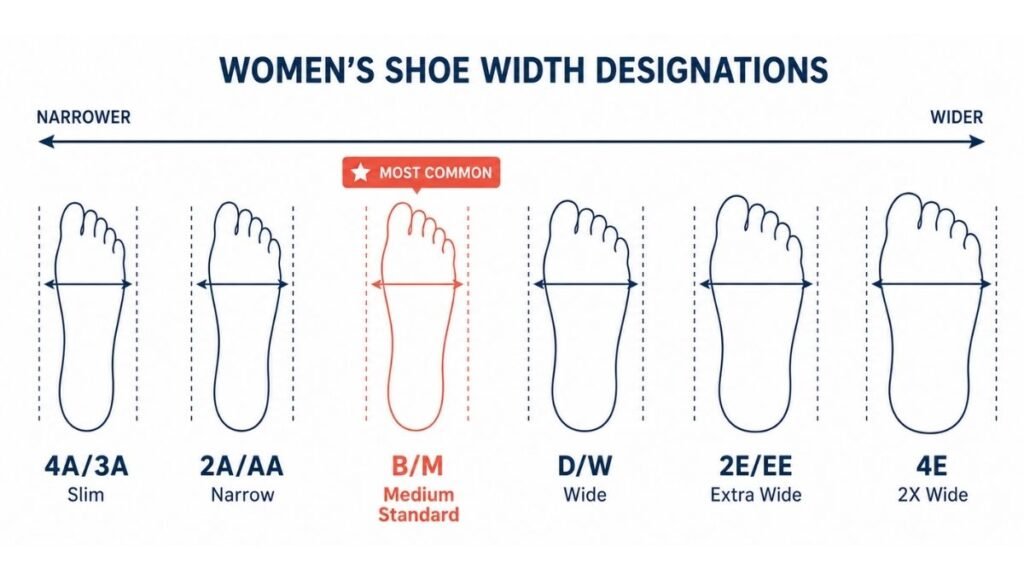
Shoe widths are expressed in letters, and the system runs from extremely narrow to extremely wide. Here’s the full range, though most people will only encounter a handful of these in practice:
For Women:
- 4A / 3A — Super Slim / Slim
- 2A / AA / A — Narrow
- B / M — Medium (standard)
- D / W — Wide
- 2E / EE / WW — Extra Wide
- 4E — 2X Wide
- 6E — 3X Wide
For Men:
- 4A / 3A — Super Slim
- 2A / A — Narrow
- B / C — Slim/Medium-Narrow
- D / M — Medium (standard)
- E / 2E / EE / W — Wide
- 4E / EEE — Extra Wide
- 6E — 2X Wide
The practical implication: when a brand lists a shoe in “standard” width, they mean B for women and D for men. When they list “wide,” they mean D for women and 2E for men. This is where most people make their first mistake — ordering “wide” for women and expecting the equivalent of men’s wide, when they’re actually one step apart in the system.
How to Measure Your Foot Width at Home
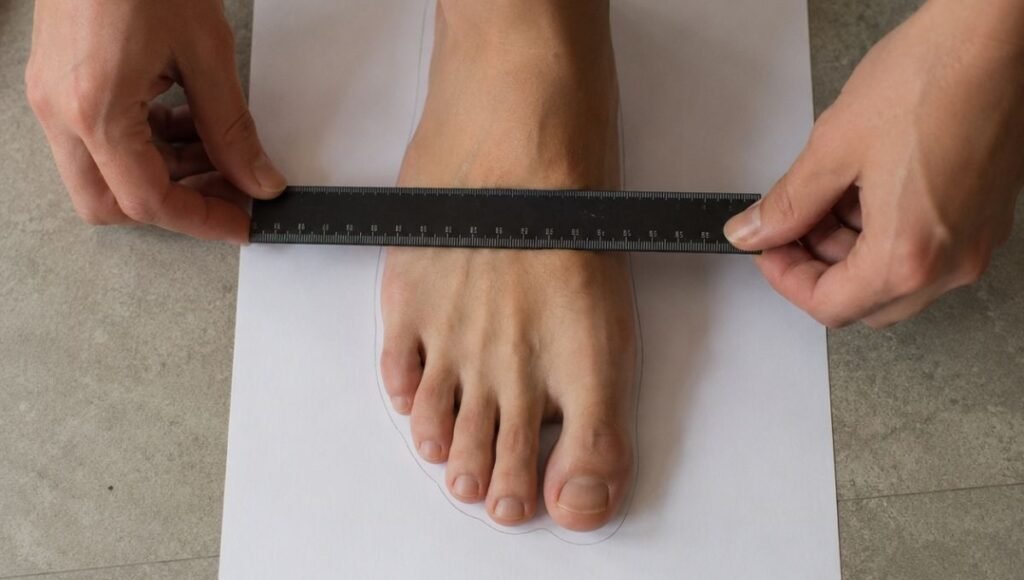
Measuring width correctly takes about five minutes and requires nothing more than a blank piece of paper, a pen, and a ruler or measuring tape.
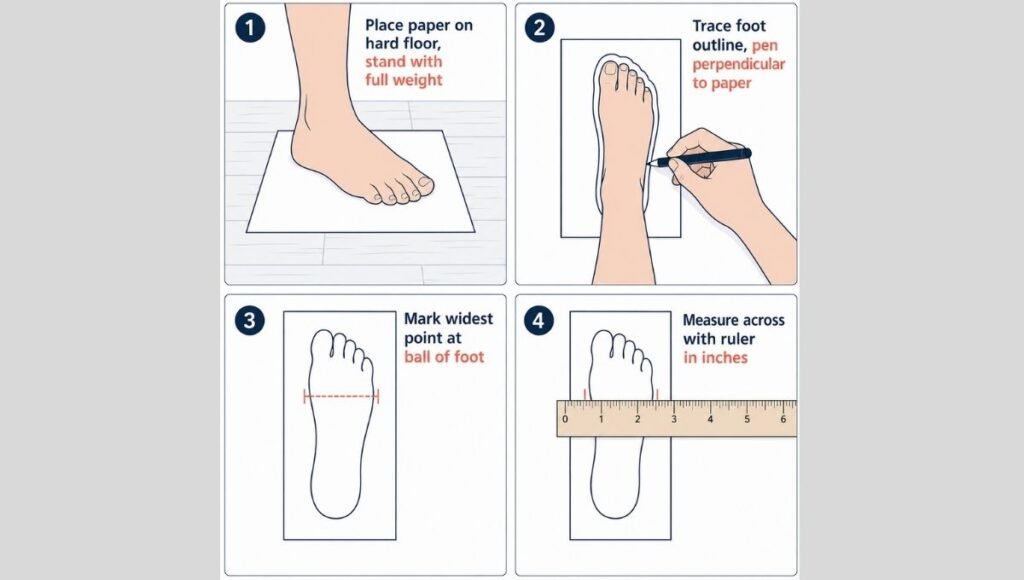
Step 1: Place a blank piece of paper on a hard floor. Stand on it with your full weight — don’t do this sitting down, because your foot spreads under load and standing gives a more accurate measurement.
Step 2: Trace your foot outline while holding the pen perpendicular to the paper (not angled). If you tilt the pen, you’ll get a smaller measurement than your actual foot.
Step 3: Find the widest part of the tracing — usually just behind where the toes begin, at the ball of the foot. Mark the furthest point on each side.
Step 4: Measure across between the two marks. Use inches for US charts. Measure both feet and use the larger measurement.
Step 5: Use the chart below to find your width designation. Cross-reference your shoe size and your measurement to find the column that matches.
The afternoon rule: Do this in the afternoon or evening, not in the morning. Feet swell during the day — sometimes by as much as half a size in volume. A measurement taken in the morning will suggest a narrower width than your feet actually need by 4pm.
Women’s Shoe Width Chart
Measure the width of your foot at the widest point (ball of foot) in inches, then find your shoe size row and match to the column.
| Shoe Size | Narrow (AA) | Medium (B) | Wide (D) | Extra Wide (2E) | 2X Wide (4E) |
|---|---|---|---|---|---|
| 5 | 3 1/16″ | 3 3/16″ | 3 5/16″ | 3 7/16″ | 3 5/8″ |
| 5.5 | 3 1/8″ | 3 1/4″ | 3 3/8″ | 3 1/2″ | 3 11/16″ |
| 6 | 3 3/16″ | 3 5/16″ | 3 7/16″ | 3 9/16″ | 3 3/4″ |
| 6.5 | 3 1/4″ | 3 3/8″ | 3 1/2″ | 3 5/8″ | 3 13/16″ |
| 7 | 5/16″ | 3 7/16″ | 3 9/16″ | 3 11/16″ | 3 7/8″ |
| 7.5 | 3 3/8″ | 3 1/2″ | 3 5/8″ | 3 3/4″ | 3 15/16″ |
| 8 | 3 7/16″ | 3 9/16″ | 3 11/16″ | 3 13/16″ | 4″ |
| 8.5 | 3 1/2″ | 3 5/8″ | 3 3/4″ | 3 7/8″ | 4 1/16″ |
| 9 | 3 9/16″ | 3 11/16″ | 3 13/16″ | 3 15/16″ | 4 1/8″ |
| 9.5 | 3 5/8″ | 3 3/4″ | 3 7/8″ | 4″ | 4 3/16″ |
| 10 | 3 5/8″ | 3 3/4″ | 3 7/8″ | 4″ | 4 3/16″ |
| 10.5 | 3 3/4″ | 3 7/8″ | 4″ | 4 1/8″ | 4 5/16″ |
| 11 | 3 13/16″ | 3 15/16″ | 4 1/16″ | 4 3/16″ | 4 3/8″ |
| 12 | 3 15/16″ | 4 1/16″ | 4 3/16″ | 4 5/16″ | 4 1/2″ |
Men’s Shoe Width Chart
| Shoe Size | Narrow (B) | Medium (D) | Wide (2E) | Extra Wide (4E) | 2X Wide (6E) |
|---|---|---|---|---|---|
| 7 | 3 1/2″ | 3 5/8″ | 3 3/4″ | 3 7/8″ | 4 1/16″ |
| 7.5 | 9/16″ | 3 11/16″ | 3 13/16″ | 3 15/16″ | 4 1/8″ |
| 8 | 3 5/8″ | 3 3/4″ | 3 7/8″ | 4″ | 4 3/16″ |
| 8.5 | 3 5/8″ | 3 3/4″ | 3 7/8″ | 4″ | 4 3/16″ |
| 9 | 3 13/16″ | 3 15/16″ | 4 1/16″ | 4 3/16″ | 4 3/8″ |
| 9.5 | 3 13/16″ | 3 15/16″ | 4 1/16″ | 4 3/16″ | 4 3/8″ |
| 10 | 3 7/8″ | 4″ | 4 1/8″ | 4 1/4″ | 4 7/16″ |
| 10.5 | 4″ | 4 1/8″ | 4 1/4″ | 4 3/8″ | 4 9/16″ |
| 11 | 4″ | 4 1/8″ | 4 1/4″ | 4 3/8″ | 4 9/16″ |
| 11.5 | 4 1/16″ | 4 3/16″ | 4 5/16″ | 4 7/16″ | 4 5/8″ |
| 12 | 4 3/16″ | 4 5/16″ | 4 7/16″ | 4 9/16″ | 4 3/4″ |
| 13 | 4 3/16″ | 4 5/16″ | 4 7/16″ | 4 9/16″ | 4 3/4″ |
| 14 | 4 3/8″ | 4 1/2″ | 4 5/8″ | 4 3/4″ | 4 15/16″ |
The Problem Nobody Tells You: Brand Width Standards Aren’t Consistent
Here’s where the chart ends and the real knowledge begins.
Shoe manufacturers use the same width letter system, but they don’t all build to the same last dimensions. A “D medium” from New Balance and a “D medium” from Nike are not identical shoes — they’re built on different lasts, with different toe box geometry, different forefoot volume, and sometimes different actual measurements even when labeled identically.
This is not a minor variation. It’s the reason people order “their size” online and find one brand fits perfectly while another in the same size and width feels uncomfortably narrow.
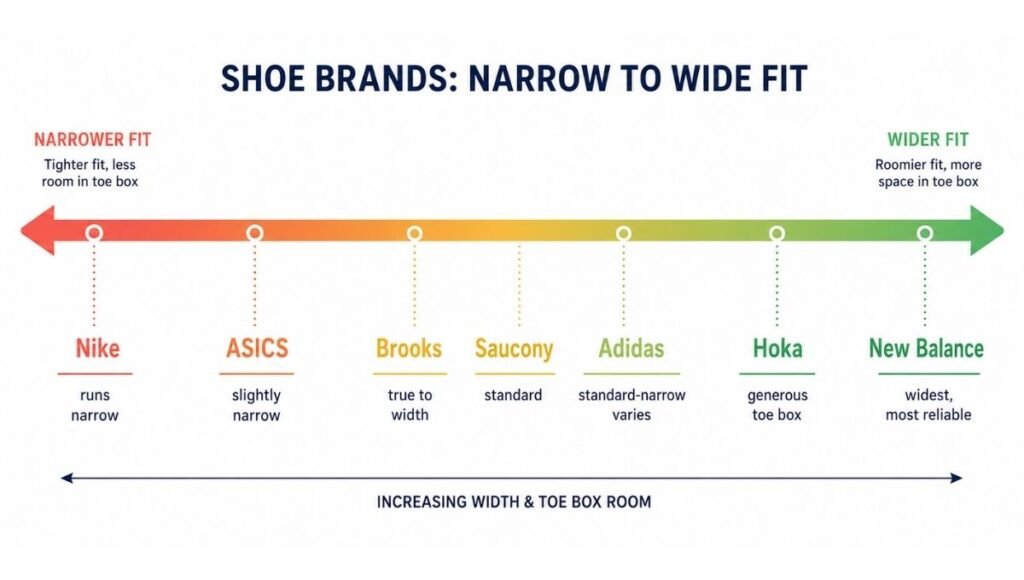
How brands actually compare in practice:
New Balance is consistently the most accommodating brand across all width designations. Their width engineering is genuine — they build different lasts for each width, not just wider uppers on the same mold. Their D medium runs wider than most brands’ D medium, and their 2E and 4E options actually deliver on the designation. This is why New Balance is the most reliable brand for people who genuinely need wide or extra-wide options.
Brooks runs true to width in most models. Their standard (B women’s / D men’s) fits close to the standard measurement. Their wide options (D women’s / 2E men’s) provide meaningful additional space. Generally reliable for most foot widths.
ASICS runs slightly narrow in standard width, particularly in the toe box. People who find standard shoes fitting well in other brands often need to go up half a size or move to the wide designation in ASICS. Their wide options are available but the toe box geometry remains somewhat tapered.
Nike runs narrow across most models. Nike’s standard width is consistently tighter than the equivalent from New Balance or Brooks. Their wide options exist in limited models but aren’t available across the full range. Wide-footed buyers consistently report difficulty with Nike regardless of designation.
Hoka runs wider than average in standard width — their toe box is notably generous compared to most competitors. People with wide feet who find standard shoes uncomfortable often fit well in Hoka standard width without needing a wide designation.
Adidas varies by model but generally runs standard-to-narrow. Their wider Ultraboost models accommodate medium-wide feet better than other Adidas lines.
Saucony runs close to standard but with a slightly roomier toe box than ASICS or Nike in equivalent designations.
Shoe Width Chart for Wide Feet: What the Letters Mean in Practice
If you’ve measured your foot and landed in the wide or extra-wide category, here’s how to translate that into what you’ll actually find on the shelf:
Women’s wide foot guide:
- D width (wide designation): Most commonly what brands call “wide.” In New Balance, this is genuinely accommodating. In Brooks, it’s meaningful extra room. In Nike, it barely exists and where it does, it’s not as wide as D in other brands.
- 2E / EE (extra wide): Available in New Balance, Brooks, and ASICS in select models. Provides significant additional forefoot room. If standard wide still feels tight, this is the next step.
Men’s wide foot guide:
- 2E (wide designation): The most common wide option for men. New Balance has the most extensive 2E range. Brooks Adrenaline in 2E is one of the most reliably wide-fitting shoes in the running category.
- 4E (extra wide): Available primarily in New Balance and select Brooks models. Appropriate for genuinely wide feet — not just standard wide that feels tight in the toe box.
The practical rule: if you’ve been told you need wide shoes and every pair you’ve bought has still felt tight, you likely need to switch brands rather than go wider within your current brand. A New Balance D-width often fits better than a Nike 2E.
Width vs Toe Box: Two Different Things
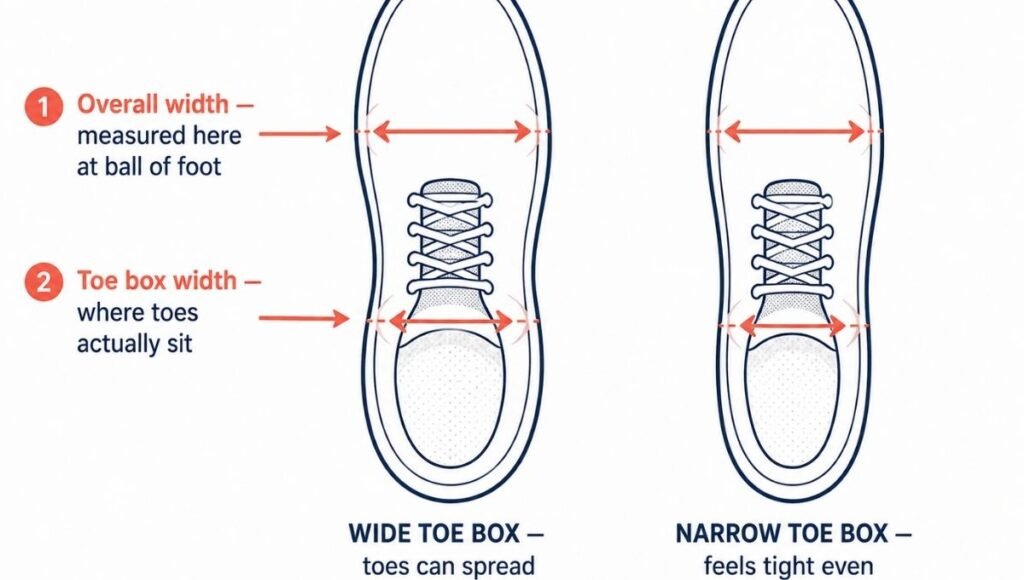
One of the most important distinctions that width charts don’t address: overall shoe width and toe box width are not the same thing.
Overall shoe width is measured at the widest point of the foot — the ball, just behind the toes. This is what the chart measures.
Toe box width is how much room exists in the area where the toes sit. A shoe can pass the width measurement and still feel cramped in the toe box if the upper tapers aggressively toward the toe tip.
This is why many people who measure as standard width still find shoes uncomfortable: the issue isn’t the width at the ball of the foot, it’s the toe box geometry that compresses the toes.
If you’ve measured as standard width but consistently experience toe compression or pinching at the tips:
- Look for shoes described as having a “wide toe box” or “anatomical toe box”
- Consider half a size up, which gives more toe length room and incidentally more toe box volume
- Try Hoka (known for generous toe boxes in standard width), Altra (wide toe box is a brand design principle), or New Balance
Our wide toe box walking shoes guide covers toe box shape in detail, including which brands engineer genuinely wide toe boxes versus which ones just call themselves wide.
When Your Width Changes: What to Know
Foot width isn’t fixed. Several factors cause it to change — sometimes temporarily, sometimes permanently — and buying shoes without accounting for these can result in a good fit that stops being a good fit within months.
Pregnancy: Hormone-related ligament laxity causes many women’s feet to widen (and lengthen) during pregnancy, often permanently. If your shoe size changed after pregnancy and never returned, the change in width is real and your pre-pregnancy size is no longer accurate.
Weight changes: Significant weight gain or loss changes the amount of fat pad on the bottom and sides of the foot, which affects both width perception and actual width measurement.
Age: Foot width tends to increase with age due to gradual ligament laxity and fat pad redistribution. The standard width that fit at 25 may feel tight at 45 for structural reasons.
Daily swelling: Feet swell during the day due to fluid accumulation from standing and walking. The difference between morning foot width and end-of-day width can be meaningful. Shoes that fit well in the morning may feel tight by the afternoon — which is why buying in the morning and then wearing shoes in the afternoon often leads to a mismatch.
Plantar fasciitis and arch conditions: When the arch collapses under load (flat feet, overpronation), the foot spreads laterally. A foot that appears standard-width standing still may measure significantly wider under full walking load. Our flat feet vs high arches guide covers how arch type affects fit.
The Shoe Width Conversion Table: US to UK and EU
Shoe width designations are primarily a US system. UK and European shoes typically use fewer width categories, and the conversion isn’t always exact.
| US Width | UK Equivalent | Notes |
|---|---|---|
| Narrow (AA/A) | Narrow / Slim | Less common in UK/EU retail |
| Standard (B women / D men) | Standard / Regular | Default width in most UK/EU shoes |
| Wide (D women / 2E men) | Wide | Available in select UK brands; EU brands often have fewer width options |
| Extra Wide (2E women / 4E men) | Extra Wide | Limited availability in EU; New Balance is most consistent globally |
If you’re buying from UK or European brands: most don’t offer the range of width options that US brands do. Clarks (UK) offers wide options in some models. ECCO (EU) runs slightly wider than standard. Birkenstock (EU) has distinct narrow and regular options in some styles. For genuinely wide feet, US brands — particularly New Balance — remain the most reliable source.
How to Tell If Your Current Shoes Are the Wrong Width
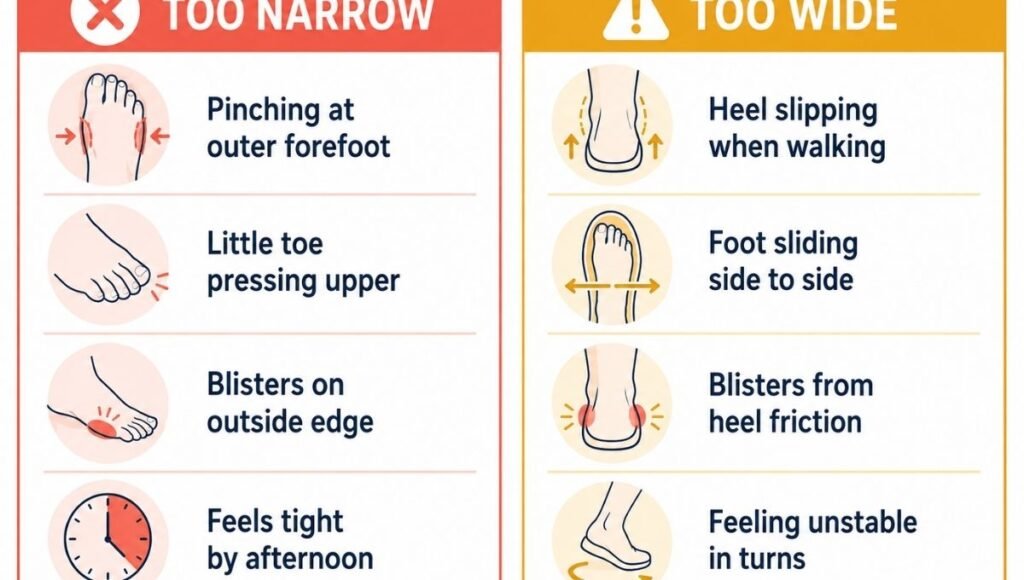
You may not need to measure at all to know something is off. These signs reliably indicate a width problem:
The shoe is too narrow:
- Pinching or burning sensation on the outer edge of the foot
- Little toe pressing against the upper
- Blisters forming on the outside edge of the forefoot
- Toenails blackening or bruising (usually a length issue, but can also be width-related pressure)
- Shoe feels fine in the morning but uncomfortably tight by afternoon
The shoe is too wide:
- Heel slipping out of the shoe when walking
- Foot sliding side to side inside the shoe
- Blisters forming on the heel due to friction from sliding
- Feeling unstable during direction changes
- The shoe’s arch support not sitting under your arch because the foot can shift position
When you’re between widths: Order the narrower designation first and assess. A shoe that’s slightly too narrow can often be addressed with a lower-volume insole or a stretching consultation. A shoe that’s too wide creates instability and friction problems that can’t be resolved without sizing down.
Frequently Asked Questions
What does shoe width D mean? For men, D is standard (medium) width. For women, D is wide width. The same letter means different things depending on gender — which is one of the most common sources of confusion in shoe width. When in doubt, look for the explicit label: “medium,” “wide,” or “extra wide” is more reliable than just the letter alone.
How do I know if I need wide shoes? Measure your foot width at the ball using the chart above and compare to the standard width column for your shoe size. If your measurement falls in the Wide or Extra Wide column, you likely need a wider shoe. Additional indicators: pinching at the outer forefoot, blisters on the little toe side, or shoes that always feel tight across the ball of the foot even when the length is correct.
Why do wide shoes from different brands fit differently? Brands build shoes on different lasts — the 3D form that determines the shoe’s shape. A “wide” designation means the brand widened their standard last, but since every brand’s standard is different, their wide versions are also different. New Balance’s wide is genuinely wider than Nike’s wide. The only reliable way to find a consistent fit is to identify which brands’ lasts match your foot shape, then buy within those brands.
Can I convert my shoe size to find my width? No — shoe length and shoe width are separate measurements. Your length size doesn’t predict your width. Many people assume they need a larger size when they actually need a wider width. Before sizing up, check whether a wider width in your current size would solve the problem.
What’s the difference between wide and extra wide shoes? Wide shoes (D for women, 2E for men) add approximately 1/8 inch to 3/16 inch of additional width at the ball of the foot compared to standard. Extra wide (2E for women, 4E for men) adds approximately 3/8 inch to 1/2 inch. The practical difference is significant — extra wide shoes provide meaningfully more room and are built on a genuinely different last, not just a wider upper on the standard mold in brands that do this correctly.
The Bottom Line
The shoe width chart gives you a number to start with. What it doesn’t give you is the full picture — that brands interpret width designations differently, that toe box geometry matters as much as overall width, and that the same designation fits differently depending on where and when you try the shoe on.
Start with the measurement. Use the chart to identify your width category. Then filter for brands that reliably deliver on that designation: New Balance for the most consistent width engineering, Brooks for reliable standard and wide options, Hoka for generous standard-width toe boxes. Avoid assuming that “wide” from any brand is equivalent to “wide” from another.
If you haven’t already measured your foot length and arch type alongside your width, our foot measurement guide covers the full process — length, arch, and width together give you everything you need to buy shoes confidently without guessing. And if your width measurement suggests flat feet are spreading your foot wider under load, our flat feet vs high arches guide covers how arch type interacts with width and what that means for shoe selection.
References
- Menz, H.B., & Morris, M.E. “Footwear characteristics and foot problems in older people.” Gerontology, 2005.
- Frey, C., et al. “American Orthopaedic Foot and Ankle Society women’s shoe survey.” Foot & Ankle International, 1993.
- Wegener, C., et al. “Effect of shoe designs on patient-reported outcomes in people with musculoskeletal foot problems.” Journal of Foot and Ankle Research, 2011.
- Burns, S.L., et al. “Prevalence of poor foot health and footwear mismatch among community-dwelling older people.” Journal of Orthopaedic & Sports Physical Therapy, 2002.
- American Podiatric Medical Association (APMA). Proper Shoe Fit. apma.org