
Walk into any gym and you’ll see the full spectrum of footwear mistakes: running shoes at the squat rack, dress shoes on the treadmill, basketball shoes in the HIIT class. Most people wear whatever shoe they already own, or whatever shoe they most recently bought, without thinking about whether it was designed for what they’re asking it to do.
Training shoes exist as a category because the gym involves demands that running shoes, walking shoes, and casual sneakers weren’t built for. Lateral movement. Compressive load from barbells. Rope climbs. Box jumps. The combination of impact, stability, and multi-directional force that characterizes most gym training is genuinely different from the forward-only, sustained-impact demands of running — and shoes optimized for one will consistently underperform at the other.
This guide explains what training shoes actually are, what they’re built to do, and — more usefully — how to figure out which type of training shoe matches the way you actually train. Not the way you intend to train. The way you actually show up and work out.
Key Takeaways
- Training shoes are designed for multi-directional stability — firmer midsoles than running shoes for load-bearing, wider outsoles for lateral support, and more durable uppers for the abrasion of gym-specific movements.
- There is no single “best training shoe.” The right shoe depends on your training split: lifting-heavy, mixed CrossFit/HIIT, or cardio-dominant. These categories need different shoe features.
- Running shoes are actively wrong for heavy lifting. Thick foam in a highly cushioned shoe doesn’t provide the grounded feel ideal for gym training sessions. If the cushioning is getting between you and your ability to press firmly into the floor, it can hamper your ability to lift heavier weights.
- According to a podiatrist quoted by NBC News, training shoes are “your jack of all trades gym shoes — they’re made for HIIT workouts, CrossFit, weight training and short running or jumping exercises.”
- Foot type matters for training shoes just as it does for running shoes — flat feet and wide feet have specific requirements that most generic training shoe guides ignore.
- Most quality training shoes last 12–18 months of regular mixed-use training before meaningful performance degradation — longer than running shoes used for equivalent time, because multi-directional gym use compresses foam differently than sustained forward running.
What Are Training Shoes?
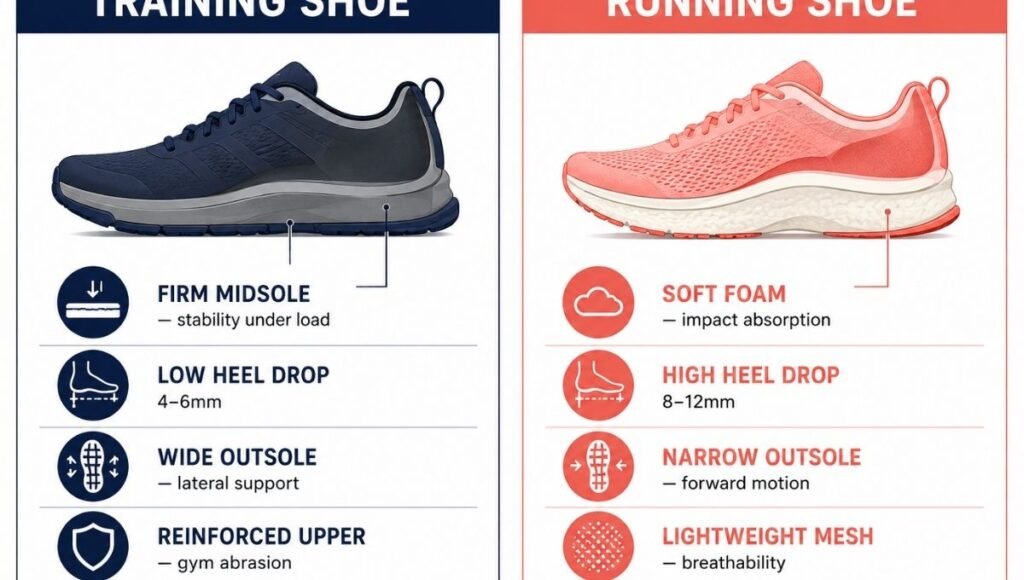
Training shoes are purpose-built for gym and athletic training environments — specifically for the combination of lifting, jumping, lateral movement, and short cardio intervals that characterize most gym workouts. Training shoes are constructed differently from running shoes as they target exercises that are performed in the gym: aerobic and anaerobic conditioning including jumping, lunging, speed and agility training and HIIT, as well as strength training and weightlifting including squats, deadlifts, cleans, jerks, and bench presses.
The defining structural characteristics that make a training shoe different from a running shoe:
Firm, lower-stack midsole. Running shoe midsoles are calibrated for sustained impact absorption at 2–3x body weight per stride, repeated thousands of times per mile. Training shoe midsoles are calibrated for compressive stability under load and multi-directional movement. Training shoes are lightly cushioned, flat, firm sneakers that prioritize stability and help keep you grounded while exercising. The firmness isn’t a comfort compromise — it’s a performance requirement.
Lower heel drop. Most training shoes have a heel drop of 4–8mm, compared to the 8–12mm typical of road running shoes. Lower drop keeps your ankle in a more neutral position during squats and lateral movements, which improves mechanics and reduces the forward weight shift that elevated heels create under load.
Wider outsole coverage. Training shoe outsoles extend laterally to provide grip and stability for side-to-side movements — shuffles, lateral lunges, agility drills. Running shoe outsoles concentrate rubber at the heel and forefoot for forward-motion efficiency, which is inadequate when loading the foot from the side.
Reinforced upper construction. Training shoe uppers are built to handle rope climb friction, box jump edges, and the lateral abrasion that gym training generates. Running shoe uppers are built for breathability and low weight — appropriate for forward motion, not for the abrasion of gym-specific movements.
Training Shoes vs Running Shoes: Why It Actually Matters
This is the question most gym-goers only ask after their knees start hurting, their squat feels unstable, or their running shoes blow out at the sides from HIIT class. Understanding the difference before that point prevents the problem.
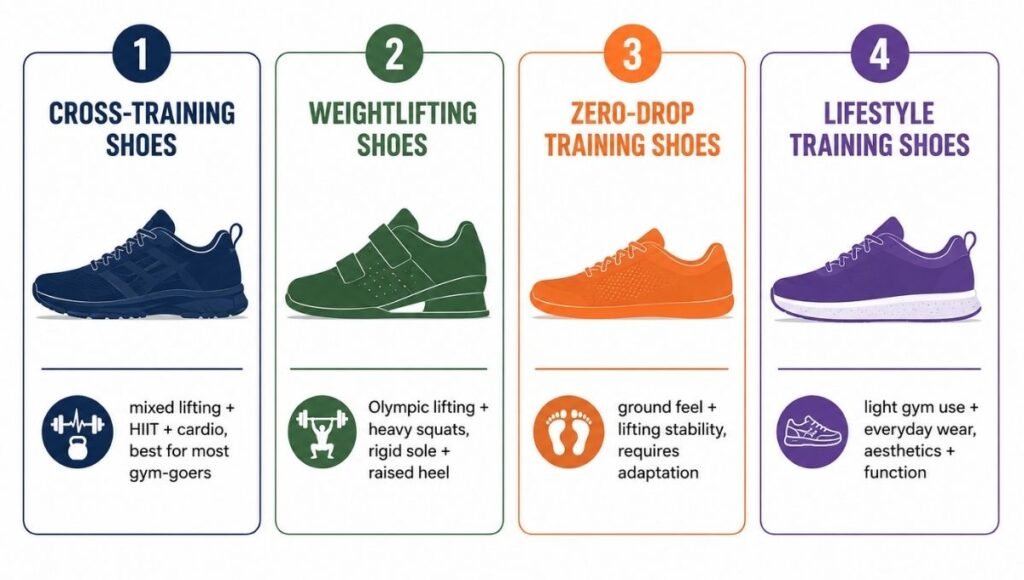
The core mechanical issue: running shoes are designed for a gait cycle that involves heel strike, midfoot loading, and toe-off in a straight line. Training involves loading the foot from multiple directions — laterally during shuffles, compressively during squats, rotationally during lunges. Running shoe construction doesn’t account for these forces.
Running shoes prioritize features that assist with the distinct forward, repetitive, linear motion of running, while training shoes are firm and stabilizing, making them suitable for a broad range of exercises in the gym or at home.
The practical consequence of using running shoes for lifting: the soft foam midsole compresses under barbell load, creating an unstable base that affects bar path, knee tracking, and force transfer to the floor. A 2021 study in the Journal of Strength and Conditioning Research confirmed that participants showed significantly better squat stability in firm-soled shoes compared to cushioned sneakers.
For a complete breakdown of the mechanical differences and which gym activities running shoes can handle versus which require training shoes, our training shoes vs running shoes guide covers the specifics with foot-by-foot activity analysis.
The Four Types of Training Shoes
Not all training shoes are the same category. Understanding the sub-types helps you buy the right shoe for your training rather than the most popular shoe in the general category.
Cross-Training Shoes
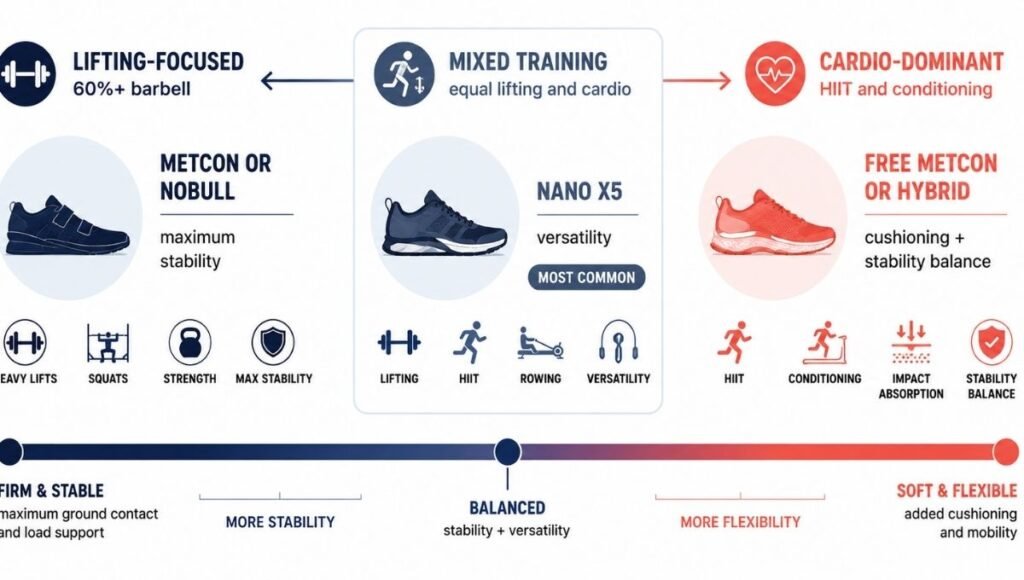
The most versatile category. Cross trainers handle the combination of lifting, HIIT, cardio intervals, and lateral movement that characterizes most gym programming. They make compromises in both directions — less stable than dedicated lifting shoes under maximum loads, less cushioned than running shoes for sustained running — but they handle mixed training without the clear mechanical failures that running shoes produce.
Best for: CrossFit programming, gym classes, mixed lifting and cardio sessions, people who want one shoe for multiple training types.
Key examples: Nike Metcon, Reebok Nano X5, NOBULL Trainer. Our cross training shoes guide covers these in detail, including the Metcon vs Nano vs NOBULL comparison with specific guidance for women.
Dedicated Weightlifting Shoes
Purpose-built for Olympic lifting and heavy squats. Rigid sole, elevated heel (typically 0.6–0.75 inches), zero cushioning. The elevated heel increases effective ankle dorsiflexion, which allows deeper squat depth and better torso positioning during cleans, snatches, and front squats.
If you’re into heavy weightlifting, your shoes should be designed with sturdy and stiff soles and a lift in the heel to give you more range of mobility in your calf and ankle. This helps you to squat lower and have more stability in big power lifts.
Not appropriate for HIIT, running, or any dynamic movement — the rigid construction that makes them excellent for Olympic lifting makes them unsuitable for anything else. Pair them with cross trainers if your programming involves both lifting and conditioning.
Minimalist and Zero-Drop Training Shoes
Flat soles, thin construction, maximum ground feel. Zero-drop means equal heel and forefoot height — no heel elevation. These provide excellent lifting stability and proprioceptive connection to the floor, with minimal cushioning for cardio or impact activities.
Appropriate for: experienced gym-goers who prefer ground feel, deadlift specialists, people who’ve adapted to lower-drop footwear over time. Not appropriate for: beginners, anyone transitioning from standard shoes without an adaptation period, or training that includes significant running or jumping.
Our zero drop shoes guide covers the full transition protocol and explains why using these without adaptation causes predictable Achilles and calf injuries.
Lifestyle Training Shoes
Shoes that function adequately in the gym while also passing as everyday footwear. Lower performance ceiling than purpose-built training shoes, but suitable for casual gym-goers who prioritize aesthetics alongside function.
Examples: On Cloud X, New Balance Fresh Foam lifestyle versions, Adidas Rapidmove. Appropriate for light-to-moderate training loads; not appropriate for serious lifting or high-volume CrossFit programming.
How to Choose Training Shoes: The Decision Framework
Step 1: Define Your Training Split
The most important question is what your training actually looks like — not what it will look like theoretically, but the real distribution of activities in your current sessions.
Lifting-focused (60%+ barbell or resistance work): Prioritize midsole firmness and heel stability. A dedicated lifting shoe or a stability-first cross trainer (Metcon, NOBULL) will serve you better than a versatility-first option.
Mixed training (roughly equal lifting and cardio/conditioning): A versatile cross trainer is the right category. Reebok Nano X5 and similar models handle this split without the clear limitations of either extreme.
Cardio-dominant with some lifting: You need enough cushioning to handle the cardio demands without sacrificing the midsole firmness needed for any lifting you do. Nike Free Metcon and similar hybrid options bridge this better than either pure running shoes or pure lifting shoes.
Step 2: Identify Your Foot Type
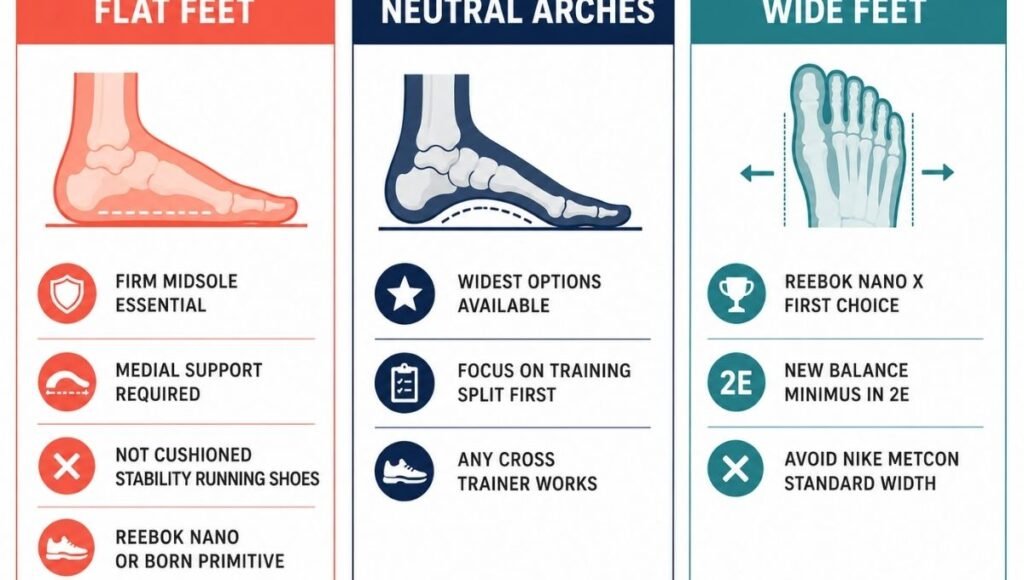
Flat feet and wide feet have specific training shoe requirements that standard guides consistently overlook.
Flat feet / overpronation in the gym: The inward ankle collapse that flat feet produce during running also affects squat alignment and lateral movement stability. Gym shoes for flat feet need firm midsoles and medial support — but the priorities are different from running shoes for flat feet. Soft, cushioned stability shoes designed for road running are wrong for the gym. Our gym shoes for flat feet and wide feet guide covers this in detail, including why gym training needs opposite properties to road running for flat-footed athletes.
Wide feet: Most training shoes run narrow-to-standard width. Reebok’s Nano series accommodates wider feet better than Nike Metcon or NOBULL in standard sizing. New Balance Minimus TR offers explicit wide-width options (2E) in some sizes.
Neutral arches: The widest range of options applies. Focus on training split first, then foot type as a secondary filter.
Step 3: Match Heel Drop to Your Training
For most mixed-training gym-goers, 4–6mm heel drop is appropriate. This range keeps your ankle in a neutral position during squats without the extreme of zero drop or the elevation of dedicated lifting shoes.
For heavy Olympic lifting: consider a dedicated lifting shoe with 16–22mm heel elevation for better squat mechanics.
For people with Achilles or calf history: stay toward the higher end of the training shoe drop range (6–8mm) to reduce posterior chain tension.
For people who prefer ground feel: explore zero-drop options after confirming you have the posterior chain conditioning to handle them — see our zero drop shoes guide for the full picture.
Step 4: Check Width and Fit
Try on shoes in the afternoon. Your feet swell during the day, so it’s best to try on gym shoes in the afternoon when your feet are at their largest. Make sure there’s enough space — there should be a little space between the end of your longest toe and the end of the shoe, about the width of your thumb. You should be able to wiggle your toes inside them without causing the rest of the shoe to move.
For training shoes specifically, the toe box width check matters more than in running shoes. During heavy squats and deadlifts, the foot naturally splays outward — a toe box that feels adequate standing still may feel compressive under load. A wider toe box improves both comfort and stability by allowing the toes to grip the floor during lifts.
Training Shoes for Women: What’s Different
Most training shoe guides are written from a male-athlete perspective. The fit, width, and training-mix considerations differ enough to warrant specific mention.
Fit: Women’s training shoes are built on different lasts than men’s, but the width variation within women’s sizing is significant. Brands like Nike tend to run narrower in women’s sizing; Reebok provides more room. If you’ve found women’s athletic shoes generally tight across the forefoot, Reebok Nano X series is consistently more accommodating.
Training mix: Women in CrossFit and gym classes tend to do more mixed programming — combining lifting, HIIT, and conditioning — than the lifting-specialist profiles that dominate male training shoe reviews. This makes versatility a higher priority. Reebok Nano X5 handles this mix better than the stability-first Metcon for most women.
Specific recommendations by training type:
- Mixed CrossFit and HIIT: Reebok Nano X5 (wide feet) or Nike Metcon (standard-narrow feet)
- Heavy lifting focus: Nike Metcon or NOBULL Trainer
- Cardio-dominant with some lifting: Nike Free Metcon or Under Armour TriBase Reign
Our Nike Metcon vs Reebok Nano vs NOBULL guide covers the three-way comparison in full with specific guidance for women’s fit and training demands.
Training Shoes for Men: The Practical Guide
Men’s training shoes have a wider range of purpose-built options than women’s, partly because the men’s athletic performance market has historically been more developed in the training shoe category.
For heavy lifting: Nike Metcon 10 (maximum stability, narrower fit) or NOBULL Trainer (maximum durability, medium-wide fit). Both handle barbell loads well; Metcon edges ahead for Olympic-style movements.
For mixed CrossFit: Reebok Nano X5 (most versatile, best for wider feet) or Nike Metcon (better for narrow-fit preference and lifting-heavy programming).
For HIIT and cardio-dominant training: Nike Free Metcon 6 or Under Armour TriBase Reign 6. Both balance cushioning for impact with enough stability for moderate lifting.
For wide feet: Under Armour TriBase Reign 6 specifically accommodates medium-to-wide men’s feet better than most alternatives. Reebok Nano X series is the most consistently wide-foot-friendly cross trainer.
Training Shoes for Specific Foot Conditions
Training Shoes for Flat Feet
The reinforced heel and low heel height make an ideal shoe for gym-goers who deal with flat feet. Flat-footed gym-goers need the same medial support principles that apply to flat-footed runners — but in a firm midsole context rather than a cushioned one. The inward ankle collapse that flat feet produce under load affects squats, lateral movement, and sustained cardio in the gym.
Key features: medial arch support, firm midsole, reinforced heel counter. The Born Primitive Savage 1 and Inov-8 F-Lite Max are specifically noted for flat-foot compatibility in training contexts.
Our gym shoes for flat feet and wide feet guide covers the complete picture — including why training shoes for flat feet need to be firm rather than cushioned, the opposite of road running recommendations.
Training Shoes for Wide Feet
In our experience, Nike shoes tend to run a little narrower, Reeboks give the most room, and No Bull feels in between. For genuinely wide feet, Reebok Nano X series is the most reliable starting point. For extra-wide, Inov-8 F-Lite G 300 is specifically recommended for wide-footed CrossFit athletes.
What to Check Before Buying Any Training Shoe
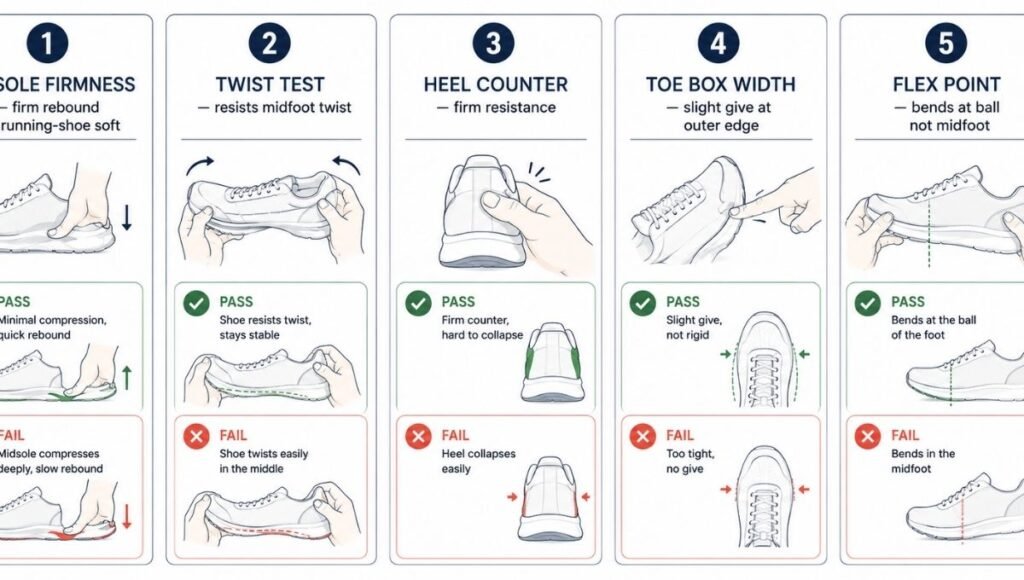
Five quick assessments that take under five minutes:
The midsole firmness test. Press your thumb into the forefoot of the midsole firmly. A training shoe should feel meaningfully firmer than a running shoe — moderate give with fast rebound. A shoe that feels like a running shoe’s foam under thumb pressure will perform like a running shoe under squat load.
The twist test. Hold the shoe at heel and toe and twist. A training shoe should resist twisting through the midfoot — this structural integrity is what provides lateral stability. A running shoe twists easily; a training shoe shouldn’t.
The heel counter test. Squeeze the back of the shoe. Firm resistance indicates a heel counter that will keep your foot stable during lateral movement and lifting. Soft compression indicates inadequate heel support.
The toe box width check. Press the outer edge at the widest toe point. There should be slight give — not immediate resistance against your little toe. Feet spread under load during lifts.
The flex point check. Press the toe down while holding the heel. A training shoe should flex primarily at the ball of the foot. A shoe that flexes at the midfoot or barely flexes at all has the wrong flex pattern for training mechanics.
Frequently Asked Questions
What are training shoes used for? Training shoes are designed for multi-directional gym activities — lifting, HIIT, CrossFit, circuit training, and lateral movement exercises. They have firm midsoles for load-bearing stability, lower heel drop than running shoes for better squat mechanics, wider outsoles for lateral support, and more durable uppers for rope climbs and box jumps. They’re not optimal for sustained running beyond 1–2 miles.
What’s the difference between training shoes and running shoes? Running shoes prioritize cushioning for sustained forward impact at speed. Training shoes prioritize firm stability for multi-directional load-bearing. Using running shoes for lifting creates midsole compression and instability under barbell load. Using training shoes for distance running creates inadequate cushioning and joint stress. Both shoes are category-specific — they’re not interchangeable for serious use of either activity.
How do I know what training shoes to buy? Define your training split first: if you primarily lift, prioritize stability (Metcon, NOBULL); if you do mixed CrossFit or HIIT, prioritize versatility (Nano X5); if you’re cardio-dominant with some lifting, look at hybrid options (Free Metcon, TriBase Reign). Then filter by foot type — flat feet need medial support, wide feet need Reebok or New Balance options. Fit in the afternoon when feet are at their largest.
Are training shoes good for walking or everyday use? For light daily use — errands, commuting, casual wear — training shoes are adequate. Their firm midsoles are less comfortable for extended walking than purpose-built walking shoes, and their outsoles are designed for gym floors rather than pavement traction. For people who walk significant distances daily, a separate walking shoe is worth the investment. Our lifestyle sneakers guide covers everyday footwear that bridges gym-appropriate and street-appropriate aesthetics.
How long do training shoes last? With regular mixed gym use (4–5 sessions per week): 12–18 months before meaningful performance degradation. The upper typically shows wear before the midsole’s performance drops — replace when the shoe feels less stable under load, not when it looks worn. For dedicated lifting shoes, the sole doesn’t compress the same way running shoes do, so they can last longer; the upper and strap hardware typically fail first.
Your Training Shoe Resource Library
Every article below covers one specific aspect of training shoe selection in depth:
- Training vs running shoes — which for what: Training Shoes vs Running Shoes
- Cross training shoes explained: Cross Training Shoes Guide
- Flat feet and wide feet in the gym: Gym Shoes for Flat Feet and Wide Feet
- Zero drop shoes — the full picture: Zero Drop Shoes Guide
- Lifestyle sneakers for everyday wear: Lifestyle Sneakers Guide
- Metcon vs Nano vs NOBULL comparison: Nike Metcon vs Reebok Nano vs NOBULL
The Bottom Line
Training shoes exist because gym training has specific mechanical demands that running shoes, walking shoes, and casual sneakers weren’t designed to meet. The firm midsole that feels less plush than a running shoe is precisely what provides the stable platform your squats need. The reinforced upper that looks less breathable than mesh is what survives rope climbs without blowing out after three months.
Getting the right training shoe requires knowing your training split and your foot type before looking at brands or models. Define those two things and the viable options narrow from dozens to a handful that genuinely work for how you train.
If you’re starting from zero on understanding your foot type — which matters as much for training shoes as it does for running shoes — our flat feet vs high arches guide covers the self-assessment that should inform any shoe purchase, gym or otherwise.
References
- Sato, K., et al. “The effect of footwear on squat performance.” Journal of Exercise and Health Science, 2021.
- Sinclair, J., et al. “Effects of footwear on the biomechanics of multi-directional movement.” Journal of Sports Sciences, 2015.
- American Council on Exercise (ACE). Footwear for Fitness Training. acefitness.org
- Canzanese, A. (podiatrist). Quoted in NBC News Select, Best Training Shoes Tested, February 2026.
- Boly, J. “Best Gym Shoes: I Tested 50+.” That Fit Friend, January 2026. thatfitfriend.com
- Malisoux, L., et al. “Shoe cushioning influences the running injury risk according to body mass.” American Journal of Sports Medicine, 2017.