
You’ve probably heard the rule: replace your running shoes every 300 to 500 miles. Which, as rules go, is about as useful as telling someone a recipe takes “between 20 minutes and two hours” to cook. Technically true. Practically useless.
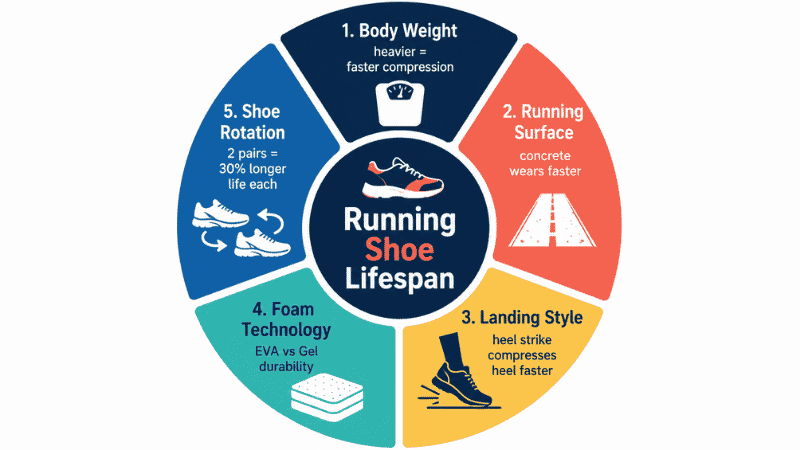
The 300–500 mile range exists because running shoe lifespan genuinely varies — but not randomly. It varies based on specific, identifiable factors: your body weight, your running surface, how hard you land, the foam technology in the shoe, and whether you’re rotating pairs or beating one pair into the ground. Once you understand which factors push you toward 300 and which push you toward 500, the range stops being a shrug and starts being an actual answer.
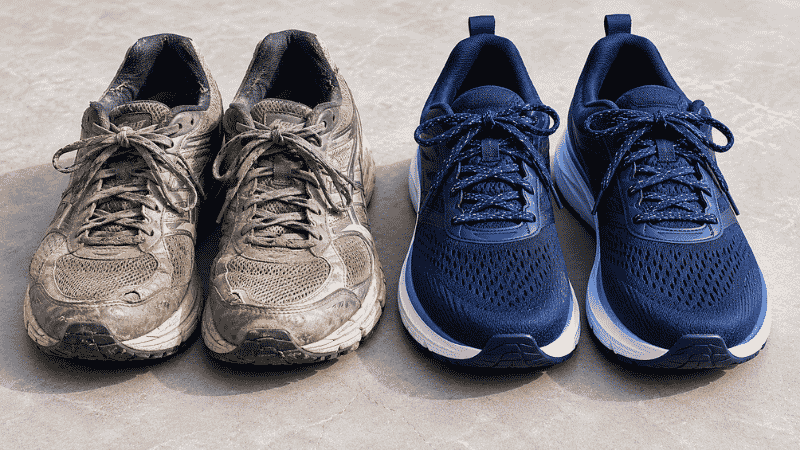
There’s also a more immediate problem that most articles don’t address: most people can’t tell when their running shoes are worn out by looking at them. The upper — the mesh fabric part you can see — can look completely pristine long after the midsole foam has compressed to the point of uselessness. You’re essentially driving on bald tires that look fine because the hubcaps are still shiny. And the consequences aren’t just foot discomfort — worn midsoles change your gait mechanics in ways that quietly accumulate as knee pain, shin splints, and hip issues before you ever make the connection.
Key Takeaways
- Running shoe midsoles are designed for 300–500 miles, but the actual number for your specific shoes depends on five identifiable factors — not guesswork.
- The midsole foam degrades significantly before any visible signs appear on the upper or outsole. A shoe can look new and be functionally exhausted.
- Body weight is the single biggest variable: a 200lb runner compresses midsole foam roughly twice as fast as a 130lb runner at the same mileage.
- Research published in the Journal of Applied Biomechanics found that midsole foam loses meaningful cushioning properties after as few as 150 miles of running in some foam compounds, with degradation accelerating in the second half of the shoe’s life.
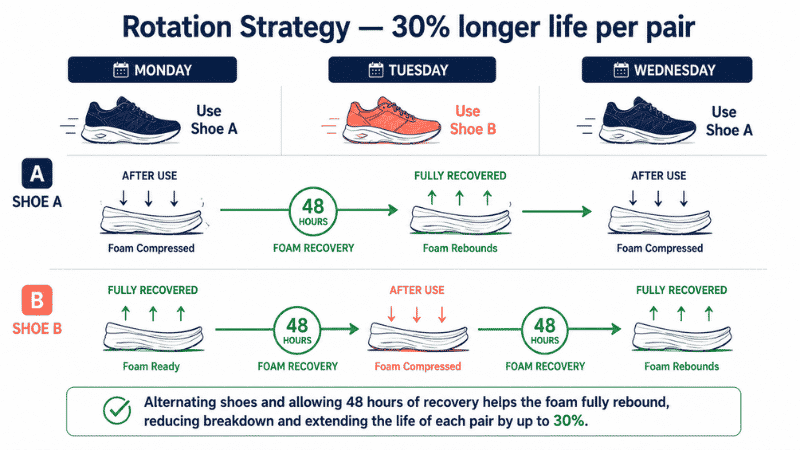
- Rotating two pairs of shoes can extend the effective lifespan of each by up to 30%, because foam needs 24–48 hours to fully rebound after compression.
- Hoka’s high-stack EVA foam, while exceptional for cushioning, compresses faster under heavy daily use than Brooks’ DNA foam or ASICS’ Gel technology — a real-world difference that affects replacement timing.
Why the “300-500 Mile Rule” Is Both Right and Useless
The 300–500 mile figure comes from shoe manufacturers and sports medicine research — and it’s not wrong, exactly. It’s just that this range covers such a wide variety of runners, shoes, and conditions that it barely narrows anything down.
Think about what 300 miles and 500 miles represent in time for different runners:
A casual runner doing 15 miles per week hits 300 miles in about five months and 500 miles in about eight months. A serious runner doing 50 miles per week hits 300 miles in six weeks and 500 miles in ten weeks. Both people get the same advice — “300 to 500 miles” — and it means something completely different in practical terms for each of them.
The more useful frame is understanding what actually determines where your shoes fall on that spectrum. It’s not random, and it’s not impossible to assess. There are five factors, and they’re worth knowing.
The Five Factors That Determine How Long Your Running Shoes Last
1. Your Body Weight
This is the single biggest variable and the one most guides mention only in passing. Every time your foot strikes the ground while running, the midsole foam absorbs a force of roughly two to three times your body weight. A runner who weighs 200 pounds is applying approximately 400–600 pounds of compressive force per stride. A runner who weighs 130 pounds is applying 260–390 pounds.
The math here is relatively straightforward: heavier runners compress foam faster. As a rough guide:
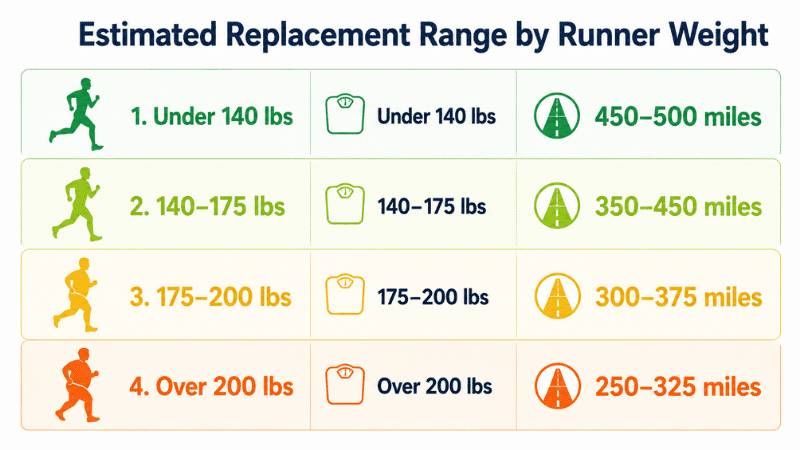
- Under 140 lbs: You’re likely toward the higher end of the range — 450–500 miles is reasonable for quality shoes.
- 140–175 lbs: The middle of the range — 350–450 miles is a practical expectation.
- 175–200 lbs: Toward the lower end — 300–375 miles before meaningful degradation.
- Over 200 lbs: Closer to 250–325 miles for most running shoe midsoles. Some heavier runners find they need to replace shoes before the outsole shows significant wear.
This isn’t a judgment on body weight — it’s foam physics. The same compression force applied more times per mile degrades foam faster. Full stop.
2. Your Running Surface
Treadmill running is significantly easier on midsoles than road running. The treadmill belt absorbs some of the impact that would otherwise go entirely into the midsole foam. Trail running, depending on terrain, can go either way — soft trail surfaces reduce midsole compression, but technical terrain with roots and rocks increases overall shoe stress.
Concrete is the hardest surface for both midsoles and joints — harder than asphalt, harder than packed dirt. If you primarily run on concrete sidewalks (as most urban commuter-runners do), expect your shoes to reach the lower end of the mileage range.
As a surface adjustment to the weight-based estimate above:
- Treadmill: add 50–75 miles to your estimate
- Asphalt roads: use the baseline estimate
- Concrete: subtract 25–50 miles
- Mixed trail/road: use the baseline estimate
3. Your Running Form — Specifically How You Land
Heavy heel strikers compress the heel portion of the midsole faster than midfoot or forefoot strikers. The heel is designed to take some impact, but a pronounced heel strike at a slow pace puts disproportionate load on the posterior midsole with every step.
If you’re a heel striker (which you can identify by looking at wear on the back of your outsole — significant wear there indicates heel striking), your heel cushioning will degrade faster than the rest of the shoe. This is worth knowing because the first sign of midsole fatigue will show up in heel impact — increased jarring sensation, heel pain after runs — before the rest of the shoe has reached its limit.
4. The Foam Technology in Your Specific Shoe
Not all running shoe midsoles are created equal, and the difference in foam longevity between brands is more significant than most buyers realize. Here’s an honest breakdown based on consistent real-world user patterns:
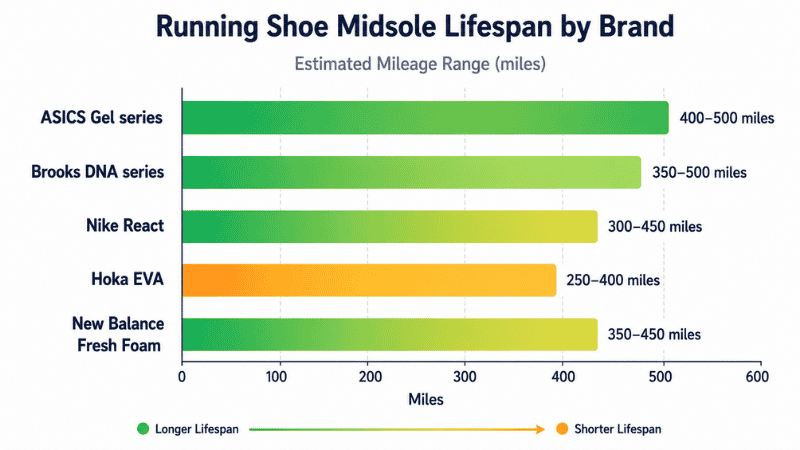
Brooks DNA foam (Adrenaline, Ghost, Glycerin): Generally durable — tends to hold up well toward the higher end of the mileage range. DNA foam is designed to adapt to your gait and weight, which helps it age more evenly rather than compressing unevenly.
ASICS Gel technology (Gel-Kayano, Gel-Nimbus): The gel units in the heel are specifically engineered for longevity — they compress less permanently than standard EVA. ASICS shoes tend to outlast comparable competitors’ shoes in midsole terms, often reaching toward 450–500 miles for average-weight runners.
Hoka EVA foam (Bondi, Clifton, Arahi): This is where honest assessment diverges from marketing. Hoka’s thick foam stack provides exceptional initial cushioning, but the high-stack EVA compresses faster under sustained use than Brooks’ DNA or ASICS’ Gel. Real user reports consistently note that Hoka’s outsole rubber also wears more quickly than competitors. Expect 300–400 miles for average-weight runners, with heavier runners potentially seeing meaningful degradation at 250 miles. This isn’t a reason not to buy Hoka — the cushioning is genuinely excellent — but it’s a reason to track your mileage carefully and not assume the upper’s condition reflects the midsole’s condition.
New Balance Fresh Foam (1080, 860): Reasonably durable, generally toward the middle of the range. The Fresh Foam X compound in newer models has improved longevity compared to earlier versions.
PEBA-based foams (used in carbon plate racing shoes — Vaporfly, Alphafly, Adizero): These performance foams are NOT designed for everyday training mileage. Carbon plate racing shoes typically last 150–250 miles before the foam’s energy return properties degrade significantly. They’re built for race day performance, not daily training durability.
5. Whether You Rotate Pairs
This is the most underused longevity strategy in recreational running, and it genuinely works. Midsole foam is viscoelastic — it compresses under load and then slowly rebounds when the load is removed. Full rebound takes 24–48 hours. If you run in the same shoe every day, the foam never fully recovers between sessions — it gradually compresses to a permanently degraded state faster than it would with adequate recovery time.
Rotating between two pairs of shoes gives each pair 48+ hours between uses. Research published in the Scandinavian Journal of Medicine & Science in Sports found that runners who rotated footwear had a 39% lower injury rate than those who used a single pair — partly from the foam recovery benefit, partly from the slight variation in loading patterns between shoes.
You don’t need two pairs of the same shoe. Two different models with similar support levels work well — one might be your primary training shoe, the other a slightly lighter option for shorter runs. The foam recovery benefit applies regardless of the specific models.
How to Tell If Your Running Shoes Are Worn Out
This is where the information gap is most costly. The upper looks fine — the mesh isn’t torn, the sole isn’t falling off, the color hasn’t faded. But the foam is gone.
Here’s how to actually check:
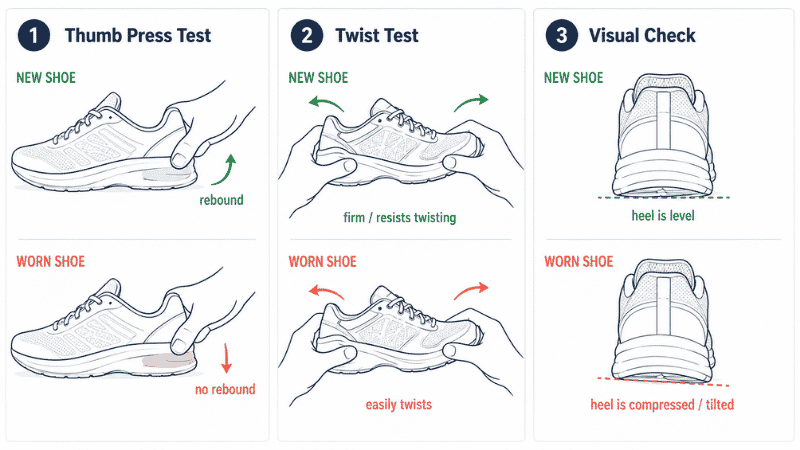
The thumb press test. Press your thumb firmly into the midsole foam in the heel area. On a relatively new shoe, you’ll feel meaningful compression and the foam will rebound when you release. On a worn shoe, you’ll feel minimal give — the foam is already at a compressed state and has nowhere further to go. No rebound, no cushioning left.
The sole twist test. Hold the shoe at the heel and toe and twist it in opposite directions. A shoe with functional midsole integrity will resist twisting. A shoe with broken-down midsole structure will twist easily in the midfoot — the foam has lost the structural rigidity that was built into it.
The visual compression check. Look at the shoe from the back. Is the heel visibly compressed or tilted compared to when it was new? Place the shoe on a flat surface and check whether it sits completely level. A heel that’s compressed on one side often indicates pronation-related uneven wear — and the midsole support on that side is likely compromised.
The body feedback method. Your body is a reasonable sensor — but with a significant lag. Knee pain, shin splints, hip discomfort, or unusual calf soreness that appears without a clear training load cause are common signals that your midsole support has degraded. The problem with relying on this signal alone is that the degradation happens gradually and symptoms may take weeks to become noticeable, by which point you’ve been running with inadequate support for a significant period.
Signs your running shoes are worn out:
- The thumb press test shows no foam give in the heel or forefoot
- New aches in knees, shins, or hips without a change in training load
- You can feel the impact of each stride more than you used to
- The shoe twists easily at the midfoot
- You’ve exceeded your estimated mileage range based on weight and surface
How Long Do Specific Brands Last?
People search this question by brand, so here’s an honest answer:
How Long Do Hoka Shoes Last?
For running: 250–400 miles depending on your weight and running surface. Hoka’s thick EVA stack provides outstanding initial cushioning but compresses faster than competitors’ foam compounds under sustained running load. The outsole rubber also tends to wear through more quickly than Brooks or ASICS. If you run more than 25 miles per week in Hoka, track your mileage carefully — don’t rely on appearance alone.
For walking and all-day wear: Hoka holds up better than for running, because the compressive load per step is significantly lower. Daily walkers often get 6–12 months of functional cushioning from a Hoka walking shoe.
How Long Do Brooks Running Shoes Last?
For running: 350–500 miles for most models. Brooks’ DNA foam is consistently cited as one of the more durable midsole compounds in the running shoe market. The Ghost, Adrenaline GTS, and Glycerin lines regularly reach the higher end of the mileage range for average-weight runners. Heavier runners will see compression sooner, but Brooks generally outlasts Hoka in midsole terms for equivalent running use.
How Long Do Nike Running Shoes Last?
Highly model-dependent. Nike’s performance range varies significantly:
- Nike React foam (Pegasus, InfinityRN): 300–450 miles, reasonably durable
- Nike ZoomX foam (Vaporfly, Alphafly): 150–250 miles — these are racing shoes, not daily trainers, and the foam degrades quickly with regular use
- Standard Nike EVA: 300–400 miles
How Long Do ASICS Running Shoes Last?
For running: 400–500 miles for Gel-series shoes, making ASICS among the most durable options in terms of midsole longevity. The gel heel units are specifically engineered to resist permanent compression. GT-2000 and Gel-Kayano owners consistently report getting toward or beyond 500 miles before noticing meaningful cushioning loss.
How to Get More Miles Out of Your Running Shoes
If you’re not ready to buy new shoes and want to extend what you have:
Rotate two pairs. This single change extends effective midsole life by 20–30% for each pair. The foam gets recovery time between sessions. Start a second pair before your primary pair is completely done — the comparison between them will also help you notice when the primary is starting to feel different.
Use them only for running. Every mile you walk or stand in your running shoes is midsole compression that doesn’t get logged as mileage but contributes to degradation. If you wear your running shoes for gym sessions, errands, or walking, those miles count against the foam even if they don’t show up in your running log.
Dry them properly after each run. Wet foam degrades faster. Remove the insole after wet runs, stuff the shoe loosely with newspaper to absorb moisture, and let them air dry at room temperature — not near a heat source, which accelerates foam breakdown.
Track actual mileage. Apps like Garmin Connect, Strava, and Nike Run Club all have shoe tracking features. Assign each pair of shoes in the app and let it count your miles automatically. This removes the guesswork and tells you exactly where you are in the expected lifespan.
When to Replace Regardless of Mileage
Some situations call for replacement regardless of where you are in the expected mileage range:
New injury without training change. If knee pain, shin splints, or hip discomfort appears without a change in your training volume or surface, check the shoes first. This is often the earliest signal that midsole support has degraded past the functional threshold.
Significant outsole wear through to the midsole layer. When the rubber outsole wears through to expose the foam layer underneath, the shoe’s structural integrity and traction are compromised. This is a hard replacement signal.
Post-injury return to running. If you’ve taken time off for an injury, don’t return to running in the shoes you were wearing when the injury occurred — particularly if those shoes were at or near their mileage limit. Starting fresh with a new pair removes one variable from your recovery equation.
After more than 12 months of regular use. Even if you haven’t hit the mileage threshold, foam degrades from exposure to moisture, UV light, and temperature cycling over time. A shoe that’s been in regular use for more than 12 months has likely lost meaningful cushioning regardless of mileage count.
Frequently Asked Questions
How often should you replace running shoes? Every 300–500 miles for most runners, which translates to every 4–10 months depending on weekly mileage. Heavier runners and those running primarily on concrete should expect replacement toward the lower end. Lighter runners using quality foam compounds (ASICS Gel, Brooks DNA) may reach toward 500 miles before meaningful degradation.
How can you tell if running shoes are worn out? Press your thumb into the heel midsole — no give indicates compressed foam. Twist the shoe at the midfoot — easy twisting indicates structural breakdown. Check for new aches in knees or shins without a training change. Look for outsole wear through to the foam layer. If the shoe is more than 12 months old with regular use, replace regardless of appearance.
Do running shoes expire if not used? Yes. Foam degrades from UV exposure, temperature cycling, and humidity even without use. A shoe stored unworn for 2–3 years has likely lost meaningful cushioning compared to a fresh pair. If you’re returning to running after a long break, check whether your stored shoes pass the thumb press test before assuming they’re still functional.
Is it worth repairing or re-soling running shoes? Generally no. The midsole foam — not the outsole rubber — is what fails in most running shoes, and midsole replacement isn’t a standard repair option at most cobblers. Re-soling the rubber outsole is possible but doesn’t address the underlying foam degradation. The cost of professional repair often approaches the cost of a new shoe, without addressing the core problem.
Can I use old running shoes for walking? Yes, with caveats. A running shoe that’s past its running mileage life still has useful cushioning for walking, where impact forces are significantly lower. Many runners “demote” shoes from running to daily walking as a second life. Just don’t assume that a shoe retired from running is still appropriate for high-mileage walking — if the foam is fully compressed, it’s done for both purposes.
The Bottom Line
How long do running shoes last? For most runners: 300–500 miles, with your body weight, running surface, and shoe brand determining where in that range you actually fall. Heavier runners on concrete in Hoka foam are at the low end — 250–350 miles. Lighter runners on mixed surfaces in ASICS or Brooks are at the high end — 400–500 miles.
The more important habit is tracking your mileage and doing the thumb press test regularly, rather than waiting for your body to tell you the shoes are done. By the time your knees are complaining about inadequate cushioning, you’ve been running in functionally dead shoes for a while.
If you’re currently experiencing knee pain that may be related to worn shoes, our guide on knee pain after running explains the mechanism in detail — including how midsole compression changes your gait and accelerates joint stress. And if you’re due for a new pair and want to make sure you’re matching the shoe to your foot type and running mechanics, our flat feet vs high arches guide is the place to start.
References
- Kong, P.W., & Candelaria, N.G. “Running in new and worn shoes: a comparison of three types of cushioning footwear.” British Journal of Sports Medicine, 2009.
- Malisoux, L., et al. “Shoe cushioning influences the running injury risk according to body mass.” American Journal of Sports Medicine, 2017.
- Malisoux, L., et al. “Can parallel use of different running shoes reduce the risk of injury?” Scandinavian Journal of Medicine & Science in Sports, 2015.
- Verdejo, R., & Mills, N.J. “Heel-shoe interactions and the durability of EVA foam running-shoe midsoles.” Journal of Biomechanics, 2004.
- American Academy of Podiatric Sports Medicine (AAPSM). Athletic Footwear Guidance. aapsm.org
- Cook, S.D., et al. “Shock absorption characteristics of running shoes.” American Journal of Sports Medicine, 1985.