
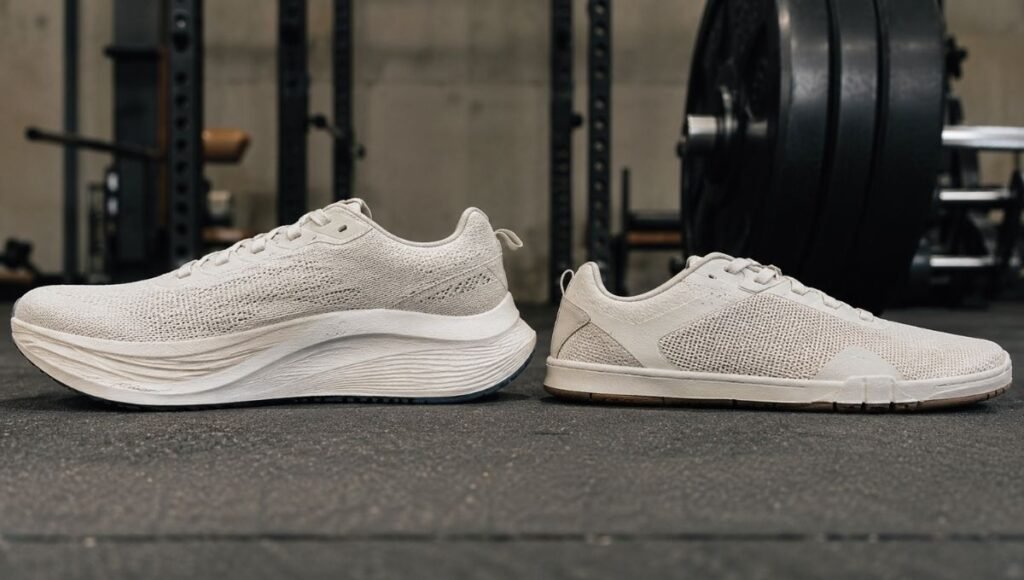
You bought running shoes because you run. Then you started going to the gym. And now those same shoes are doing everything — the treadmill warmup, the squat rack, the HIIT class, the walk to the car. They still look fine. You haven’t thought about it much.
Here’s what’s actually happening: running shoes and training shoes are engineered for completely different mechanical demands, and using them interchangeably isn’t neutral — it has consequences. The consequences aren’t always dramatic. They’re quiet. Your squat form is slightly off and you can’t figure out why. Your HIIT outsoles are wearing through in weird places. Your knees feel more beaten up after leg day than they should. You’re blaming your programming, your recovery, your age. The shoes are doing their part without getting any of the credit.
This guide is the honest version of the training shoes vs running shoes conversation — not “you need two pairs” as a conclusion, but a clear explanation of what each shoe is actually built for, what happens mechanically when you use the wrong one, and a realistic framework for deciding what you actually need based on how you train.
Key Takeaways
- Running shoes and training shoes are optimized for opposite mechanical demands — one for forward propulsion and impact absorption, the other for lateral stability and ground contact during load-bearing exercises.
- Squatting in cushioned running shoes is mechanically problematic — the soft midsole foam compresses under load, creating an unstable base and bleeding energy that should be going into the lift. A 2021 study in the Journal of Exercise and Health Science found significantly better squat balance when participants wore weight-lifting shoes compared to standard sneakers.
- Lateral movements in running shoes — side shuffles, lateral lunges, court cuts — wear through the outsole faster than forward running does, and the lack of lateral support increases ankle roll risk.
- For treadmill running, elliptical, and most cardio machines: your running shoes are exactly right. The debate isn’t about those.
- Cross-training shoes exist as a compromise category — better for gym work than running shoes, but not optimal for either running or heavy lifting.
- Most people who train in a mixed way (some cardio, some lifting, some HIIT) genuinely benefit from two pairs. The question is whether the cost is justified by your actual training split.
What Running Shoes Are Actually Built For
Running shoes are engineered around one motion: forward propulsion at speed. Every design decision flows from this.
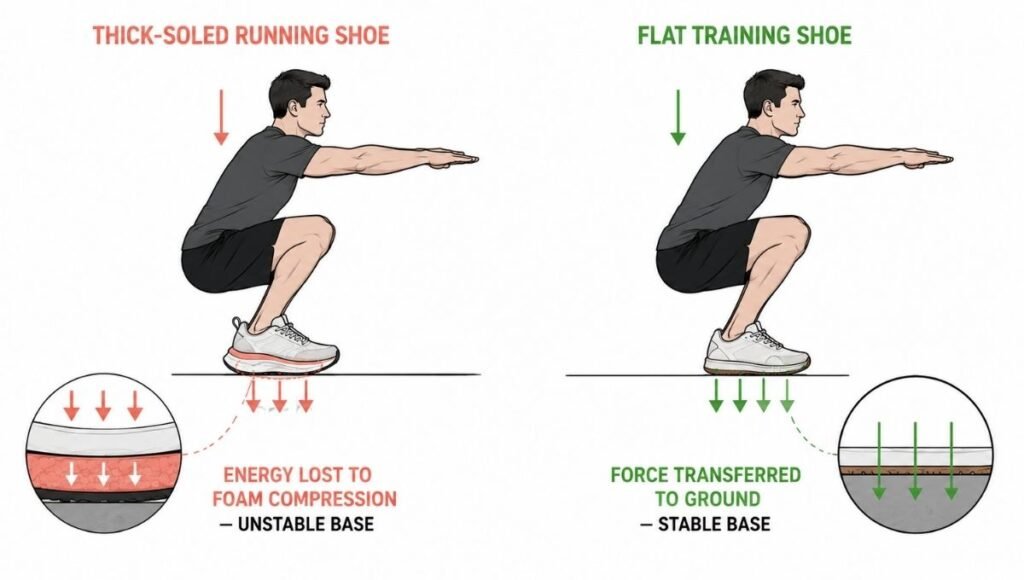
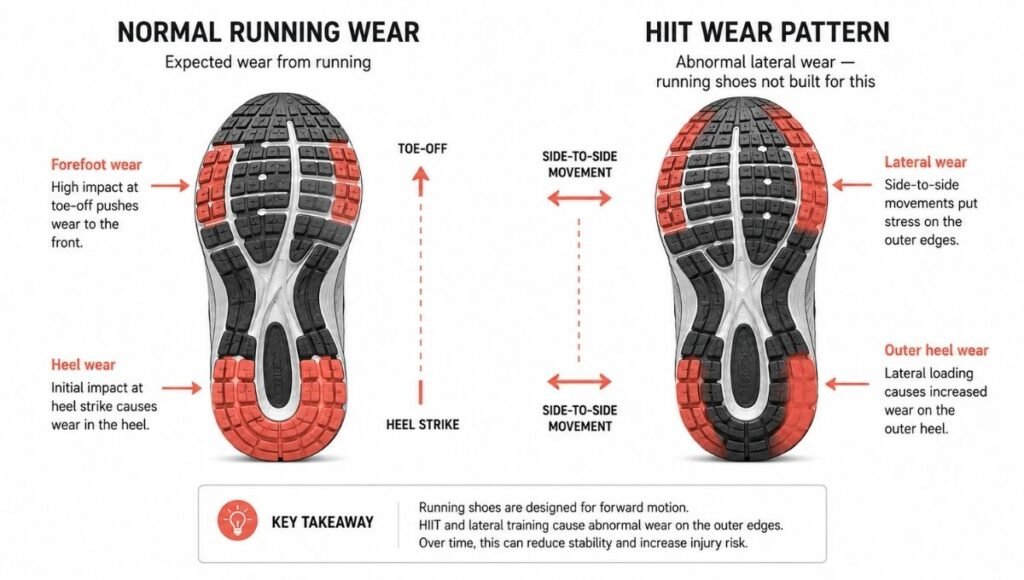
The thick, soft midsole foam is calibrated to absorb the impact of a foot striking the ground at running pace — 2 to 3 times body weight per stride, repeated 1,500 times per mile. The heel drop (typically 8–12mm) promotes the heel-to-toe rolling motion of running gait. The outsole rubber is concentrated at the heel and forefoot, where running impact occurs. The upper is lightweight and breathable because forward motion generates heat.
None of this is designed with lateral movement, load-bearing, or rotational force in mind. And that’s not a design flaw — it’s a design choice. Running shoes are exceptional at what they’re built for.
The problem arises when you ask a running shoe to do things it wasn’t designed for. The same foam that absorbs impact beautifully during a stride becomes an unstable, energy-absorbing surface under a loaded barbell. The same heel elevation that supports heel striking during running changes your ankle and shin angle during a squat. The same flexible, forward-motion outsole provides inadequate resistance to the lateral forces of a shuffle or a cut.
What Training Shoes Are Actually Built For
Training shoes are built around a completely different set of demands: stability, lateral support, and ground contact during multi-directional movement and load-bearing exercises.
The midsole in a training shoe is significantly firmer than in a running shoe — intentionally so. During a squat, deadlift, or any loaded compound movement, you want to feel the ground beneath you. A firm, flat midsole gives you a stable base that doesn’t compress or wobble under load. Energy that goes into compressing soft foam is energy that doesn’t go into the lift.
The heel drop is lower in most training shoes (typically 4–8mm) or even zero in some flat-heeled options. Lower drop means your ankle, shin, and knee alignment during squats is more neutral — which affects both form and joint stress over time.
The outsole in a training shoe extends laterally, providing more coverage and grip for side-to-side movement. The upper is reinforced at the sides to resist the forces of lateral shuffles, jumping, and direction changes that would degrade a running shoe’s more minimal upper construction.
Training shoes are heavier than running shoes, generally. They’re not built to be run in for miles — they’re built to be moved in, in all directions, under load.
The Specific Problem with Running Shoes for Lifting
This is where the stakes are highest, and where the most consistent real-world feedback (and research) points to a genuine issue.
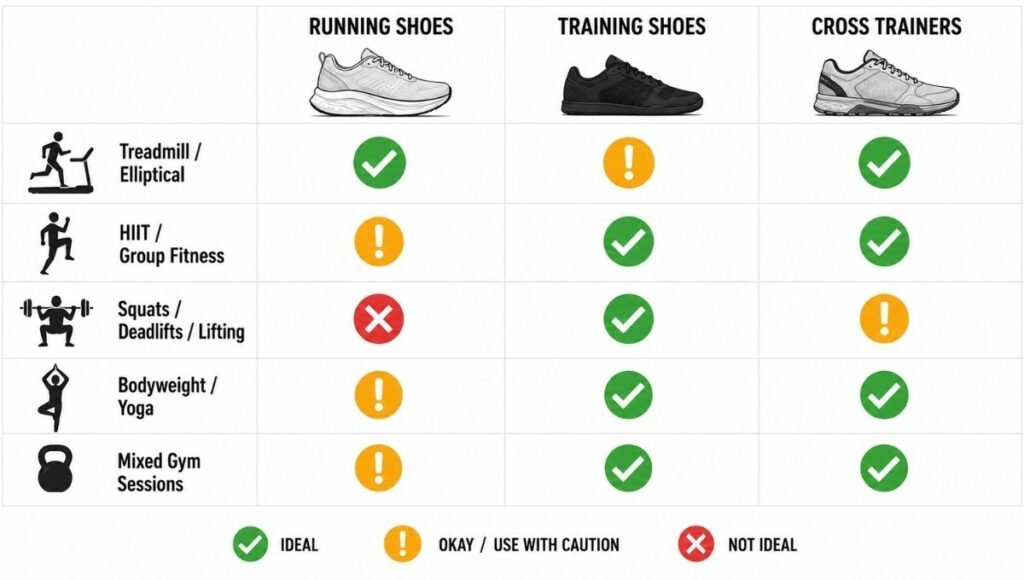
When you squat in a soft-soled running shoe, two things happen that affect both performance and safety.
Energy leakage into the midsole. Under load, the compressed foam beneath your foot absorbs force that should be transferred into the ground and converted into upward movement. This is called energy leakage — the same principle that makes carbon plate racing shoes fast (they return energy efficiently) works in reverse here. A running shoe with a thick, soft midsole is actively absorbing the energy of your squat. This is why experienced lifters often describe squatting in flat shoes as feeling “stronger” or “more powerful” — they’re not imagining it.
Instability at the base. Soft foam compresses unevenly under load, particularly when weight is distributed asymmetrically. During a squat, any rocking or shifting of the midsole becomes a rocking or shifting of your entire body position. This makes maintaining proper bar path, knee track, and hip alignment harder — not impossible, but actively more difficult. A 2021 study in the Journal of Exercise and Health Science confirmed that participants wearing weight-lifting shoes showed significantly better balance during squats than those wearing standard sneakers — and standard sneakers are already firmer than most running shoes.
Ankle angle effects. Running shoes with significant heel drop (10–12mm) elevate the heel relative to the forefoot. During a squat, this changes the effective dorsiflexion range available at the ankle — you’re starting in a plantarflexed position, which limits how deep you can squat without compromising your torso position. Some people inadvertently compensate with excessive forward lean, which increases lower back stress.
None of this makes squatting in running shoes acutely dangerous for most people. But it makes it mechanically suboptimal — and over months and years of training, suboptimal mechanics accumulate.
Can You Wear Running Shoes to the Gym? A Realistic Assessment by Activity
The answer isn’t binary. It depends entirely on what you’re doing.
Treadmill Running, Elliptical, Stair Climber
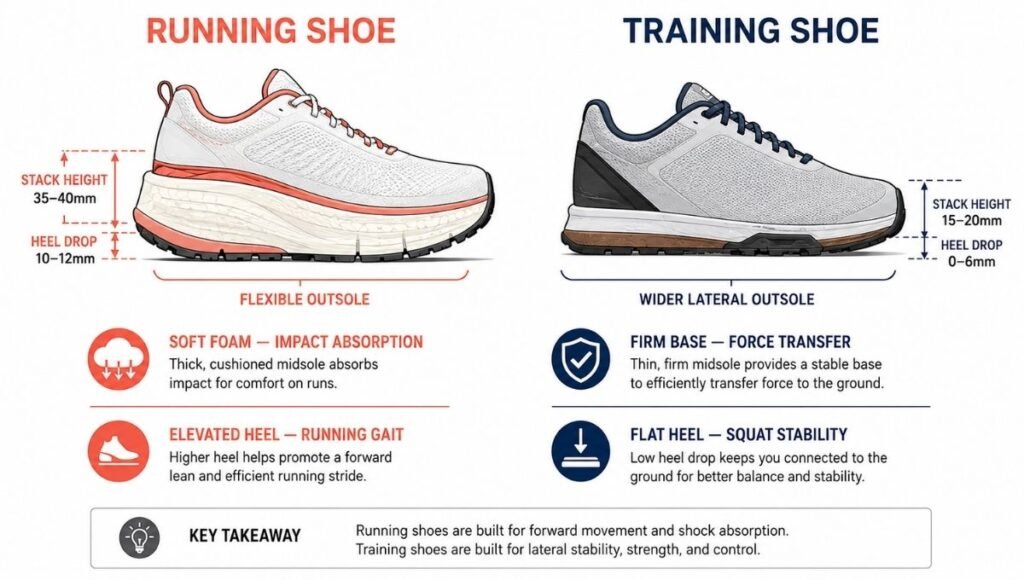
Running shoes: fully appropriate. This is exactly what they’re designed for. Using your running shoes on a treadmill is not a misuse — it’s the correct use. The only consideration is mileage tracking: treadmill miles count against your shoe’s midsole life just like road miles do.
HIIT Classes, Cardio Kickboxing, Group Fitness
Running shoes: manageable for occasional use, problematic for regular use. The lateral movements in most HIIT formats — shuffles, lateral jumps, cutting movements — wear through running shoe outsoles faster than forward running does. Running shoe outsoles are built for heel-to-toe wear patterns, not lateral friction. You’ll notice uneven outsole wear appearing at the outer edges, often within a few months of regular HIIT use. The lateral support is also inadequate — running shoes don’t brace the foot against side-to-side force, which increases ankle instability risk during explosive lateral movements.
Weightlifting — Squats, Deadlifts, Overhead Press
Running shoes: actively problematic for heavy loads. The energy leakage and instability issues described above are most significant here. For light weights or casual gym sessions, the practical risk is low. For anyone training with meaningful loads (even bodyweight squats as a beginner), the mechanical disadvantage is real enough to address. Flat-soled shoes, minimalist shoes, or dedicated lifting shoes are meaningfully better options.
Bodyweight Training, Yoga, Stretching
Running shoes: fine, or unnecessary. Barefoot or minimal footwear is often preferable for yoga and stretching. Running shoes don’t interfere significantly with bodyweight movements that don’t involve heavy lateral force.
Cross Training Shoes vs Running Shoes for Mixed Workouts
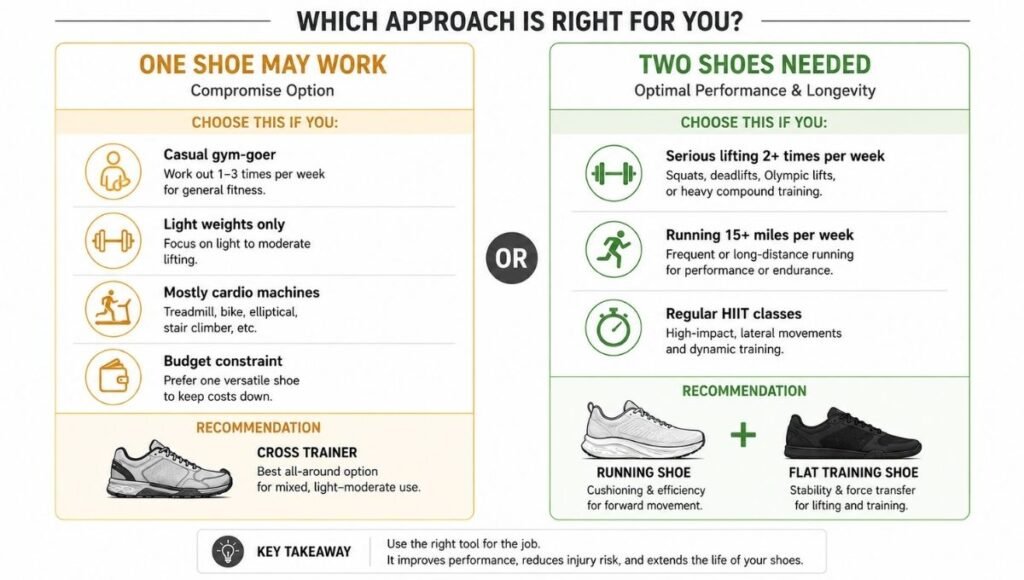
If your gym sessions involve a mix of cardio, bodyweight, and light-to-moderate lifting, a cross-training shoe is a legitimate compromise. Cross trainers have firmer midsoles than running shoes (better for lifting stability), more lateral support (better for HIIT), and enough cushioning for light cardio use. They’re not optimal for running outside or serious lifting, but they handle mixed gym sessions without the clear mechanical mismatches that running shoes create.
Reliable cross trainer options: Nike Metcon (excellent lifting stability, adequate for HIIT), NOBULL Trainer (firm, versatile, wide toe box), Reebok Nano (long-standing CrossFit standard, handles both lifting and high-intensity cardio), New Balance Minimus TR (lower-profile, more barefoot-style option for people who prefer less shoe).
Why Squatting in Soft Running Shoes Is Sabotaging Your Lifts
Let’s be specific about the mechanics, because this is where most discussions stay vague.
During a back squat, the force path goes from the barbell → through your back and core → into the floor via your feet. The efficiency of that force transfer depends on the rigidity of every link in the chain. Your bones and joints are rigid. Your muscles and connective tissue are somewhat rigid. Your shoes are the final link before the ground.
A running shoe with 30–38mm of foam at the heel is not rigid. Under a loaded barbell, that foam compresses — not dramatically, not visibly while you’re lifting, but measurably. Biomechanics research has quantified foam compression under static and dynamic loading in athletic shoes, and the results consistently show that midsole foam under compressive load reduces the effective force transfer to the floor.
The practical consequence: you’re working harder to move the same weight than you would be in a flat shoe. Your ankle proprioception — the sensory feedback that tells your nervous system where your foot is in space — is reduced by the foam layer between your foot and the ground. And your base of support is less stable, which your nervous system compensates for by limiting the load it’s willing to generate (this is a real and documented response: the nervous system reduces muscle activation when balance is compromised).
Flat Converse, wrestling shoes, or dedicated weightlifting shoes (which have an elevated heel of ~0.75 inches that increases quad activation during squats) all outperform running shoes for this purpose. Even bare feet outperform running shoes for deadlifts, which is why deadlift socks exist as a category.
The One-Shoe Question: Is There a Shoe That Does Both?
Honestly? Not really — not if you run serious mileage outside and also lift seriously.
A shoe optimized for running outside (high stack, forward-motion geometry, lightweight upper) will always compromise on gym stability. A shoe optimized for heavy lifting (firm, flat, minimal stack) will always compromise on running cushioning and gait support.
The cross-trainer category narrows the gap, but it does so by being mediocre at both rather than excellent at either. For casual gym-goers who do 20 minutes on the treadmill and some light machines, a cross trainer is absolutely sufficient. For someone running 20 miles per week who also squats twice a week, the compromise is too significant at both ends.
The practical two-shoe solution costs less than most people assume. A solid training shoe doesn’t need to be expensive — flat-soled Converse Chuck Taylor Highs ($70) are a legitimate gym shoe for most people’s lifting needs. Add your running shoes for running, and you’ve solved the problem for under $200 total including both pairs.
If You’re Only Going to Own One Pair Right Now
If budget or space genuinely doesn’t allow for two pairs right now, here’s the priority framework:
If you run more than you lift: Keep your running shoes. The risk of running in training shoes (inadequate cushioning for the mileage) is higher than the risk of lifting in running shoes at moderate weights. Just avoid maximal loads.
If you lift more than you run: Prioritize training shoes or flat shoes. You can do light cardio in training shoes without significant consequence. Lifting seriously in running shoes creates real mechanical disadvantages.
If you do equal amounts of both: A cross-training shoe is the most reasonable single option, accepting its limitations at both ends. Plan to add running shoes when the budget allows — your joints will notice the difference.
Frequently Asked Questions
Can I wear running shoes to the gym? For treadmill running, elliptical, and light cardio: yes, running shoes are appropriate. For weightlifting — especially squats, deadlifts, and overhead press — running shoes create stability and energy-transfer problems that affect both performance and form. For HIIT and lateral-movement classes, running shoes work but wear through outsoles faster and provide less ankle support than dedicated training shoes.
Can you use running shoes for cross training? For light cross training involving mostly cardio movements: yes, adequately. For cross training that includes significant lifting, heavy squats, or explosive lateral movements: running shoes are a compromise that produces suboptimal results in each area. A dedicated cross-training shoe handles this mix better.
Can you use running shoes for weightlifting? Technically yes, but mechanically it’s one of the clearer cases where the wrong shoe actively works against you. The soft midsole foam compresses under load, reducing stability and bleeding energy. For light weights as a casual gym-goer, the practical risk is low. For anyone training with meaningful loads, flat shoes or dedicated lifting shoes are meaningfully better.
Why can’t you use running shoes for lifting? Three reasons: the soft foam midsole is unstable under compressive load and absorbs energy that should go into the lift; the elevated heel changes your ankle angle during squats and can force compensatory forward lean; and the flexible, forward-motion-oriented construction provides inadequate lateral stability for multi-directional loaded movements.
What shoes are best for gym and running? There is no single shoe that does both optimally. Cross-training shoes (Nike Metcon, Reebok Nano, NOBULL Trainer) handle mixed gym sessions reasonably, but aren’t ideal for serious running mileage. The most effective solution is running shoes for running and a flat or training shoe for the gym — often a total investment of $130–200 that solves both problems cleanly.
The Bottom Line
Training shoes vs running shoes isn’t a preference debate — it’s a mechanical one. Running shoes are designed around forward propulsion and impact absorption. Training shoes are designed around stability, ground contact, and multi-directional support. Each is excellent at what it’s built for and compromised when asked to do the other thing.
The practical takeaway: keep your running shoes for running. For lifting, get something flat — even a $70 pair of Converse is meaningfully better for squats than a $180 running shoe. For HIIT and mixed gym sessions, a cross-training shoe is worth the investment if that’s a regular part of your routine.
If you’re already experiencing knee, ankle, or lower back discomfort during gym sessions and you’ve been training in running shoes, changing your footwear is a reasonable first intervention before assuming the problem is biomechanical or training-related. Our knee pain after running guide covers how shoe mechanics translate into joint stress up the kinetic chain — the same principles apply to gym-based knee complaints. And if you’re not sure what foot type you have before investing in training shoes, our flat feet vs high arches guide covers the foot type assessment that should inform any shoe purchase.
References
- Sato, K., et al. “The effect of footwear on squat performance.” Journal of Exercise and Health Science, 2021.
- Sinclair, J., et al. “Effects of footwear on biomechanics of multi-directional movements.” Journal of Sports Sciences, 2015.
- Warne, J., & Gruber, A. “Transitioning to minimal footwear: a systematic review of methods and future clinical recommendations.” Sports Medicine Open, 2017.
- American Council on Exercise (ACE). Footwear for Fitness Training. acefitness.org
- Saragiotto, B.T., et al. “What are the main risk factors for running-related injuries?” Sports Medicine, 2014.