
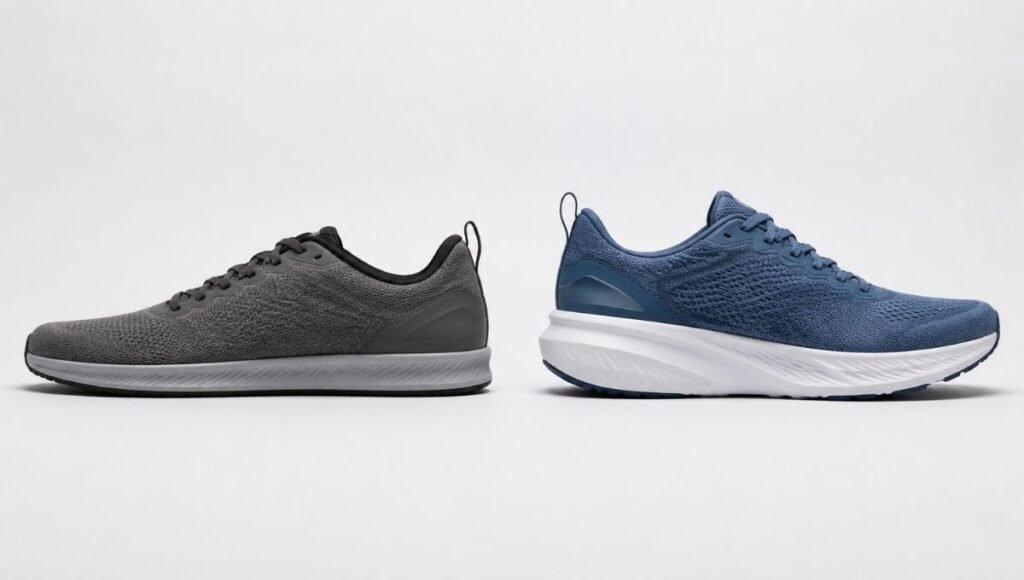
Someone at the gym tells you that zero drop shoes changed their life. Your running group has three people who’ve switched and swear by them. You’ve read that they promote a more natural gait, reduce knee stress, and strengthen your feet. You order a pair, lace them up on a Tuesday, go for a 4-mile run.
By Thursday your calves feel like someone has replaced them with concrete. By the following Monday you’re walking down stairs sideways. By the end of the month you’re wondering if you’ve developed Achilles tendinitis.
This is not an unusual story. It’s actually the most common zero drop shoes experience, and it happens because the information about zero drop shoes focuses almost entirely on the benefits and almost never on the transition reality — which is genuinely demanding, genuinely slow, and genuinely responsible for a predictable pattern of overuse injuries when it’s rushed.
Zero drop shoes aren’t a bad idea. For some people and some uses, they’re genuinely the right choice. But the gap between the promise and the week-one experience is wide enough that it deserves honest coverage before you spend $120–180 on a pair.
Key Takeaways
- Zero drop shoes have equal heel and forefoot height — no heel elevation relative to the toe. This is the only technical definition. Zero drop does not mean minimalist, thin-soled, or barefoot-style.
- The calf and Achilles strain is real and predictable. Switching from standard shoes (typically 8–12mm heel drop) to zero drop changes the angle at which your Achilles tendon operates, placing it under more tension. Research published in the Journal of Orthopaedic & Sports Physical Therapy found significantly higher Achilles tendon loading in zero-drop compared to conventional footwear during running.
- A proper transition from standard to zero drop takes 8–16 weeks of gradual mileage increase — not days or weeks.
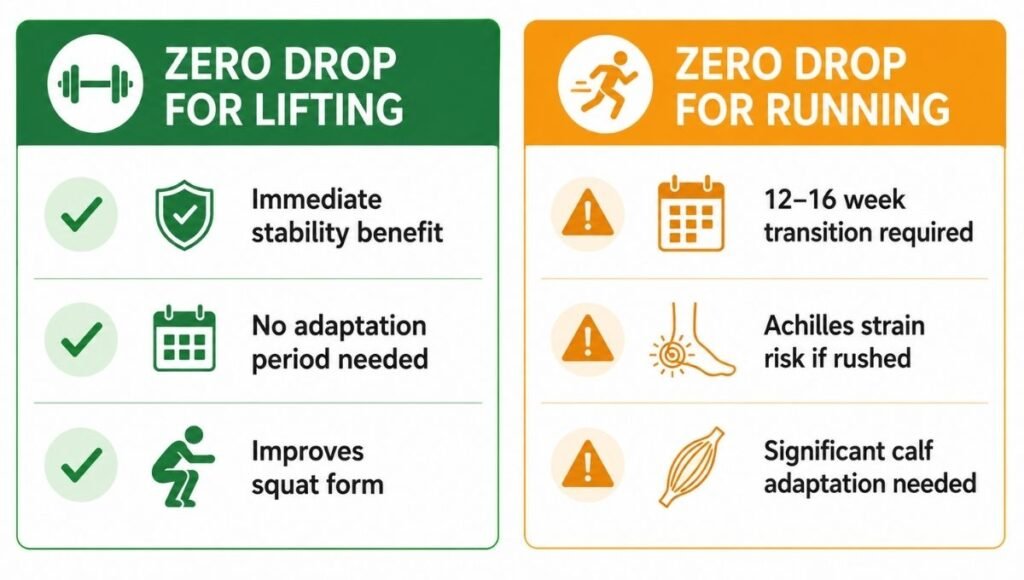
- For lifting, zero drop is immediately beneficial for most people. The flat base improves squat stability and force transfer without the adaptation demands that running in zero drop creates.
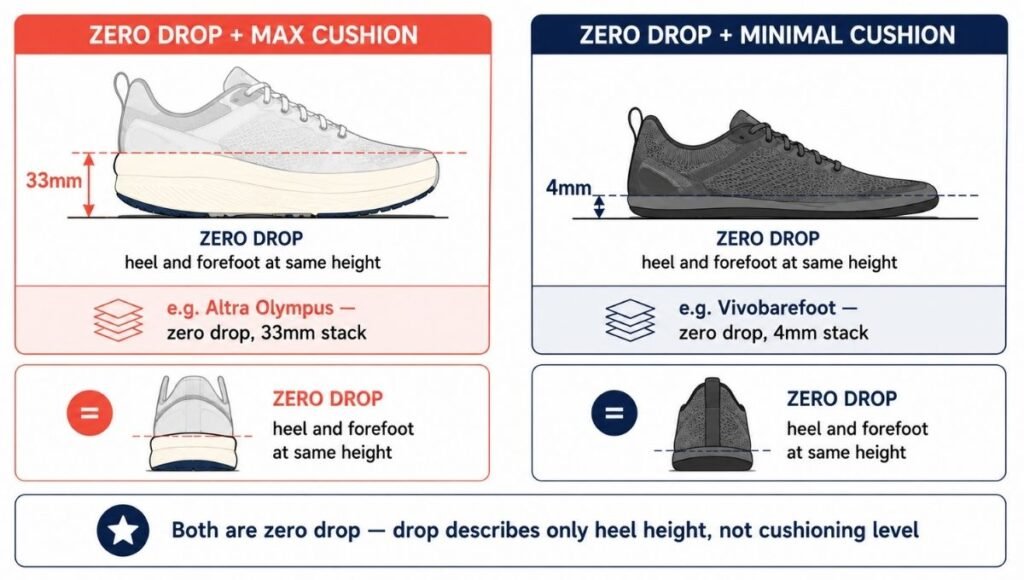
- Zero drop and barefoot/minimalist are not the same thing. You can have a zero drop shoe with 30mm of cushioning (Altra Olympus) or a zero drop shoe with 4mm of cushioning (Vivobarefoot). The drop and the stack height are separate variables.
- People most likely to benefit from zero drop: lifters who want ground contact stability, runners with established posterior chain conditioning, and people whose biomechanics make heel-elevated shoes actively problematic.
Zero Drop vs Barefoot Shoes: The Confusion Nobody Clears Up
This is the single most common source of confusion in the zero drop conversation, and it matters because the two categories have very different wear experiences.
Zero drop means one thing: the heel and forefoot of the shoe are at the same height. There is no elevation of the heel relative to the toe. That’s it. The shoe can have 40mm of cushioning foam and still be zero drop. It can have a wide toe box or a narrow one. It can be a trail shoe, a running shoe, or a gym trainer. The zero drop designation only describes the relative height difference — not the cushioning level, the stiffness, or the sole thickness.
Barefoot or minimalist shoes are a different but overlapping category. Minimalist shoes are characterized by low stack height (thin soles that allow ground feel), high flexibility, wide toe boxes, and minimal structure. Most minimalist shoes are also zero drop, but not all zero drop shoes are minimalist.
The distinction matters because the experience is completely different. Running in Altra Olympus (zero drop, 33mm stack, maximally cushioned) is nothing like running in Vivobarefoot Primus Lite (zero drop, 4mm stack, ground-feel focused). Both are zero drop. One feels like a standard cushioned running shoe. The other feels like running in thick socks.
If you bought “zero drop shoes” expecting maximum ground feel and got a highly cushioned shoe, or vice versa, the mismatch is likely a stack height misunderstanding rather than a zero drop problem.
Why Zero Drop Shoes Destroy Calves in Week One
The mechanism is straightforward once you understand it, and it explains why the transition injury pattern is so consistent.
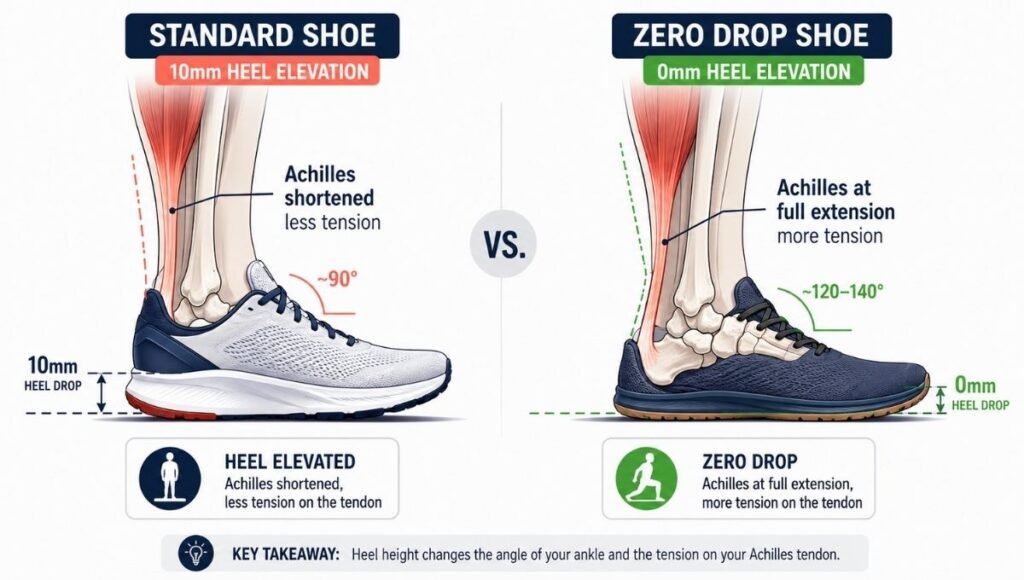
Standard running shoes have a heel drop of 8–12mm. This means the heel sits 8–12mm higher than the forefoot inside the shoe. When your heel is elevated relative to your forefoot, your Achilles tendon and calf are operating in a slightly shortened position — the heel elevation reduces the tension placed on the posterior chain during each stride.
When you switch to zero drop, the heel drops to the same height as the forefoot. The Achilles and calf now operate through a fuller range of motion — they’re stretched more with each stride, and they work harder to generate propulsion because they can no longer rely on the elastic recoil advantage that heel elevation provides.
For most people who’ve spent years in standard shoes, the calf-Achilles complex has adapted to that shortened position. The muscles and tendons are effectively conditioned for a range of motion that zero drop immediately exceeds. The result: soreness, tightness, and if the transition is too fast, actual injury.
Research published in the British Journal of Sports Medicine found that runners transitioning to minimalist footwear experienced significantly higher injury rates when the transition was rapid — with stress fractures, plantar fasciitis, and Achilles tendinopathy being the most common presentations. The injuries weren’t caused by the shoes themselves, but by the rate of transition exceeding the tissue’s adaptation capacity.
This is not a reason not to use zero drop shoes. It’s a reason to transition properly.
Zero Drop Shoes Benefits: What the Research Actually Shows
When the transition is done correctly, the documented benefits are real — though they’re more nuanced than the marketing suggests.
Improved running economy for adapted runners. Several studies have found that runners who have fully adapted to minimalist and zero drop footwear show improved running economy compared to their performance in conventional shoes. The key phrase is “fully adapted” — this takes months, not days.
Reduced knee loading. A consistent finding in biomechanics research is that lower heel-drop shoes reduce the knee extension moment during running — meaning less stress is transmitted to the knee joint per stride. For runners with knee pain related to conventional footwear, this can be meaningful. However, the same studies note that the load doesn’t disappear — it shifts to the ankle and Achilles, which must be conditioned to handle it.
Increased foot and ankle strength. Longitudinal studies of runners who transitioned to minimalist footwear over several months showed significant improvements in foot muscle cross-sectional area and intrinsic foot strength. This is a genuine adaptation benefit — but it requires time and represents a conditioning demand, not a free upgrade.
Better squat and deadlift mechanics. This is where zero drop delivers the most immediate, low-risk benefit for most people. The flat sole keeps your ankle in a neutral position during squats and deadlifts, improves ground contact feel, and eliminates the forward weight shift that heel-elevated shoes create. Lifters report almost immediate improvement in squat form and stability when switching to zero drop or flat training shoes. This benefit doesn’t require weeks of adaptation.
Zero Drop Shoes for Running: The Honest Risk Assessment
Running in zero drop shoes is where the injury risk is concentrated, and where the most disciplined approach is needed.
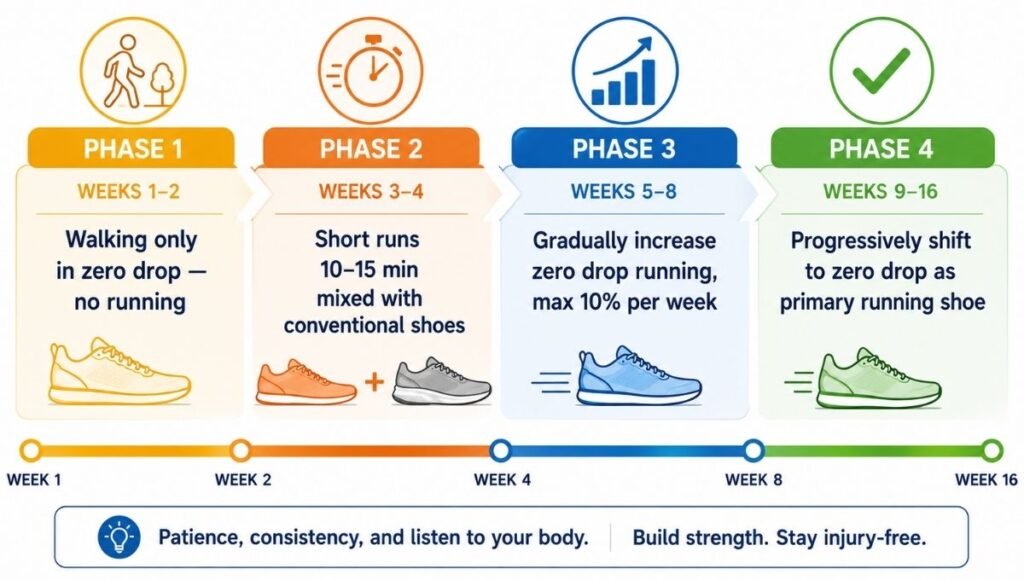
The transition protocol that sports medicine researchers and physical therapists consistently recommend:
Weeks 1–2: Wear zero drop shoes for daily walking only. No running. This gives your Achilles and calf time to adapt to the new load position without the dynamic impact of running.
Weeks 3–4: Introduce short running intervals — 10–15 minutes maximum — in zero drop shoes, interspersed with your normal runs in conventional shoes. Do not replace your regular running; add zero drop running alongside it.
Weeks 5–8: Gradually increase zero drop running time by no more than 10% per week. Continue wearing conventional shoes for most of your running.
Weeks 9–16: Progressively shift your running mileage toward zero drop as your posterior chain adapts. By the end of this period, most people can run in zero drop without significant calf or Achilles complaints.
This timeline feels frustratingly slow when you’ve just spent $150 on a new pair of shoes. But it reflects the actual rate at which tendon and muscle tissue adapts — which is slower than cardiovascular fitness, slower than muscle strength, and not negotiable. Tendons have poor blood supply and adapt slowly. Pushing the transition faster doesn’t make them adapt faster; it makes them fail.
Editor’s note: The most common zero drop transition mistake isn’t wearing the shoes — it’s running your normal mileage in them immediately. If you do nothing else from this guide, remember this: in week one, zero drop is a walking shoe. Everything else follows from that.
Zero Drop Shoes for Lifting: Why This Is Different
The lifting context deserves its own section because the risk profile is completely different from running.
When you squat or deadlift in zero drop shoes, the adaptation demands on the Achilles and calf are minimal — you’re not generating the same repetitive dynamic loading as running. The flat sole provides an immediate stability benefit without the posterior chain strain that zero drop running creates.
For squats specifically, zero drop or flat-heeled shoes keep your ankle in a neutral position and improve your proprioceptive connection to the floor. Lifters who’ve been squatting in cushioned running shoes and switch to zero drop or flat shoes often notice immediate improvements in balance and bar path consistency.
Deadlifts are particularly well-suited to zero drop shoes — many serious lifters deadlift barefoot or in socks specifically for the ground contact advantage. A zero drop shoe with minimal stack provides the same benefit with foot protection.
The only lifting caveat: people with limited ankle dorsiflexion may find that zero drop actually makes squatting harder, not easier. If your squat naturally collapses forward or you struggle to maintain an upright torso, the lack of heel elevation removes a compensatory mechanism you’ve been relying on. A dedicated weightlifting shoe with an elevated heel (0.6–0.75 inches) specifically addresses this by increasing effective dorsiflexion — the opposite of zero drop’s approach.
Specific Zero Drop Shoe Recommendations by Use Case
For Lifting and Gym Training
Altra Solstice XT — zero drop, firm midsole, good lateral support for mixed gym use. The low-stack version provides ground feel without the extreme minimalism of barefoot shoes.
New Balance Minimus TR — zero drop, low stack, excellent for deadlifts and squats. More durable than pure minimalist shoes for the lateral demands of HIIT training.
Inov-8 F-Lite G 300 — zero drop cross trainer with graphene-enhanced outsole for durability. Handles lifting, HIIT, and rope work well.
Flat Converse Chuck Taylor — technically zero drop, extremely firm, zero cushioning. Genuinely excellent for deadlifts and heavy squats. Not a training shoe, not designed for HIIT, but for pure lifting stability it’s hard to beat at $70.
For Running (After Full Transition)
Altra Torin — zero drop with maximal cushioning. The easiest entry point for zero drop running because the cushioning level is comparable to conventional running shoes. Ideal for runners transitioning from standard cushioned shoes.
Altra Paradigm — zero drop, stability features, high cushioning. For overpronating runners who want zero drop without sacrificing medial support.
Topo Athletic Ultrafly — zero drop, moderate cushioning, wide toe box. A versatile daily trainer that handles easy to moderate pace running well.
For Walking and Everyday Wear
Altra Lone Peak — zero drop trail shoe that works well for hiking and walking. Protective enough for varied surfaces with genuine ground-feel characteristics.
Vivobarefoot Geo Court — zero drop lifestyle shoe for daily wear. Lower stack than most Altra options, appropriate for people who want ground feel without running.
The 10-Minute Decision: Should You Try Zero Drop Shoes?
You’re probably a good candidate for zero drop shoes if:
- You primarily want them for lifting — the transition is easy and the benefit is immediate
- You have a history of knee pain in conventional shoes and want to explore load redistribution
- You’re patient enough for a 12–16 week running transition and willing to do it properly
- Your calves and Achilles are already reasonably conditioned from regular activity
You should be more cautious if:
- You want to run normal mileage in them immediately
- You have a history of Achilles tendinopathy or plantar fasciitis
- You have limited ankle dorsiflexion — zero drop may worsen rather than help your squat mechanics
- You’re increasing training volume at the same time as transitioning footwear (don’t change two variables simultaneously)
When Zero Drop Shoes Cause Problems That Don’t Resolve
Most calf soreness from zero drop transition resolves within 2–4 weeks of appropriate gradual adaptation. If it doesn’t, or if the problem escalates:
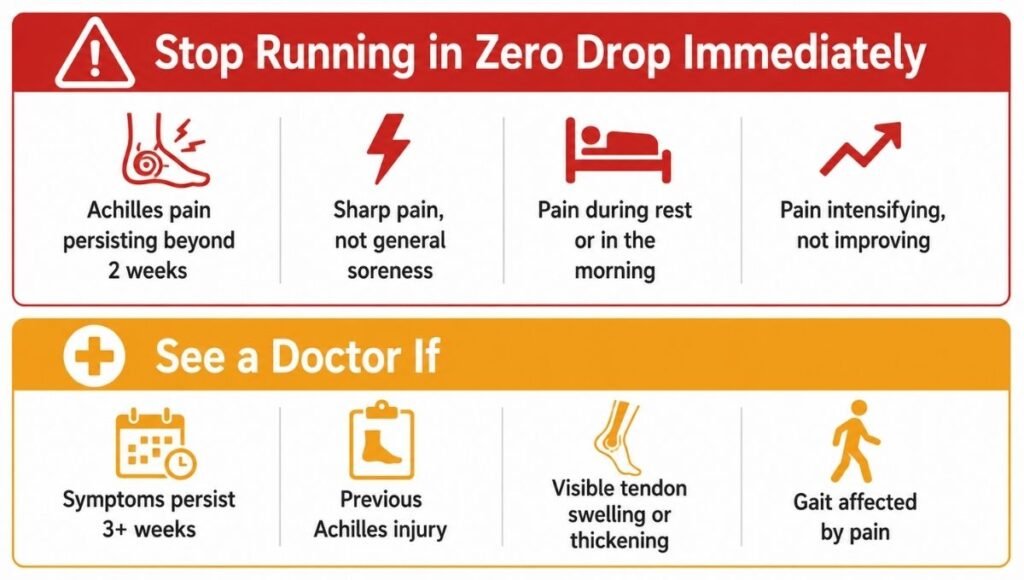
Stop running in zero drop immediately and return to conventional shoes if:
- Achilles pain persists beyond 2 weeks of reduced load
- You feel sharp pain rather than general soreness
- Pain is present during rest or first thing in the morning (a sign of tendinopathy rather than normal muscle adaptation)
- Calf or Achilles pain intensifies rather than improving after the first week
See a sports medicine physician or physiotherapist if:
- Achilles pain has persisted for more than 3 weeks despite rest
- You’ve had a previous Achilles or calf injury
- You notice swelling, warmth, or a palpable thickening of the Achilles tendon
- Pain extends up the leg or affects your gait
Achilles tendinopathy — the most common serious injury from zero drop transition — is highly treatable when caught early and significantly harder to resolve when ignored and continued through. The 4-month recovery timeline mentioned in running communities is for people who pushed through pain. Early intervention typically resolves in 4–8 weeks.
Frequently Asked Questions
What are zero drop shoes? Zero drop shoes have equal heel and forefoot height — the heel is not elevated relative to the toe. Standard shoes typically have 8–12mm of heel elevation. Zero drop is not the same as minimalist or barefoot; you can have a zero drop shoe with substantial cushioning (like Altra’s models) or minimal cushioning (like Vivobarefoot). The drop measurement only describes heel-to-forefoot height difference.
Are zero drop shoes good for lifting? Yes — for most lifters, zero drop or flat-soled shoes immediately improve squat and deadlift stability by providing better ground contact and keeping the ankle in a neutral position. The adaptation demands that make zero drop challenging for running don’t apply to lifting. Zero drop gym shoes are among the most consistent recommendations in strength training communities.
What are the benefits of zero drop shoes? For lifting: immediate stability improvement and better force transfer. For adapted runners: reduced knee loading, improved running economy, and increased foot strength over time. These benefits are real but context-dependent — they apply most clearly when the transition is appropriate for your current conditioning level and use case.
How long does it take to transition to zero drop shoes? For running: 8–16 weeks of gradual mileage increase, starting with walking only in weeks 1–2. For lifting: no meaningful transition required. The calf and Achilles adaptation that makes running in zero drop demanding doesn’t apply to the static and controlled loading of gym work.
Why do zero drop shoes hurt my calves? The elevated heel in standard shoes keeps the Achilles and calf in a shortened position. Zero drop removes that elevation, requiring the Achilles and calf to work through a greater range of motion — which is more demanding than they’re conditioned for if you’ve been in standard shoes. The soreness is a normal adaptation response to new loading, not a sign that zero drop shoes are wrong for you. It resolves with gradual transition.
The Bottom Line
Zero drop shoes are worth considering — but the conversation around them consistently oversells the benefit and undersells the transition demand. The marketing promise is a more natural gait and stronger feet. The week-one reality for anyone who transitions too quickly is significant calf soreness and a real risk of Achilles injury.
The practical answer: if you want zero drop shoes for lifting, buy them and use them immediately — the benefits are real and the adaptation demands are minimal. If you want them for running, buy them and spend the first two weeks walking in them. Then follow a 12-week gradual transition before running your normal mileage.
If you’re currently dealing with the “my calves are destroyed” phase after a too-fast zero drop transition, our training shoes vs running shoes guide covers how to assess whether your current footwear setup is actually the right match for your training demands. And if the lifting benefits of flat-soled shoes are what attracted you to zero drop, our cross training shoes guide covers gym-specific training shoes in detail.
References
- Goss, D.L., & Gross, M.T. “Relationships among self-reported shoe type, footstrike pattern, and injury incidence.” US Army Medical Department Journal, 2012.
- Warne, J., & Gruber, A. “Transitioning to minimal footwear: a systematic review of methods and future clinical recommendations.” Sports Medicine Open, 2017.
- Ridge, S.T., et al. “Foot bone marrow edema after a 10-week transition to minimalist running shoes.” Medicine & Science in Sports & Exercise, 2013.
- Sinclair, J., et al. “Effects of footwear on Achilles tendon loading during running.” Journal of Orthopaedic & Sports Physical Therapy, 2015.
- American College of Sports Medicine (ACSM). Minimalist and Zero Drop Footwear Transition Guidelines. acsm.org